Tabelog 100 #26
Our verdict
In Kamiochiai, Tokyo’s ramen culture shifts from station-front velocity to neighbourhood precision. Chuka Soba Chigonoki belongs to the niboshi side of the city’s ramen map, with Tabelog Ramen TOKYO “Tabelog 100” selections from 2019 through 2025, a 10-seat room, and a price band that keeps the experience in everyday Tokyo territory rather than destination-menu territory.

Pearl is the En Primeur Club membership app, where members save venues, book tables and use the concierge.
The menu
What to order
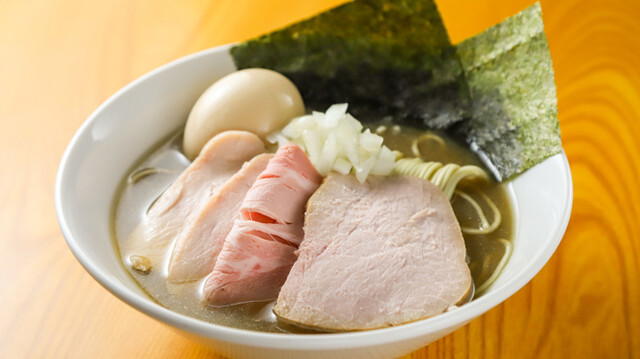
- Niboshi Ramen
- Niboshi Ramen with Pork Back Fat
- Soupless Mazemen
Kamiochiai is not the Tokyo ramen setting visitors usually picture first. The approach is residential and rail-bound rather than neon-heavy: Ochiai Station, Shimo-Ochiai, Nakai and Higashi-Nakano all feed into a pocket of Shinjuku where small counters do the serious work. That geography matters. Ramen here is less about spectacle and more about repeatable precision, the kind of neighbourhood shop that has to satisfy regulars before it can persuade anyone to cross town.
Chuka Soba Chigonoki sits in that quieter register of Tokyo ramen. Its category spread covers ramen, tsukemen, abura-soba and maze-soba, but the useful frame is niboshi, the dried-sardine broth tradition that rewards balance over volume. In Tokyo, niboshi can tilt bitter, saline or heavy; the local conversation has moved toward bowls that carry intensity without exhausting the diner. This shop’s repeated presence in the Tabelog Ramen TOKYO “Tabelog 100” list from 2019 through 2025 places it inside that demanding bracket of ramen rooms judged by sustained public scrutiny rather than by a single opening-season surge.
Kamiochiai ramen, measured by restraint rather than noise
Tokyo’s ramen map is often read through famous hubs: Shinjuku, Ikebukuro, Ginza, Tokyo Station, Koenji. Kamiochiai gives a different lesson. It shows how far the city’s ramen literacy has spread beyond the obvious corridors, and how serious shops can operate in smaller residential-commercial seams. The room size sharpens that point: 10 seats, with counter seating and one four-person table, puts the meal close to the kitchen rhythm without turning it into a luxury counter format.
The price band, JPY 1,000 to JPY 1,999 for both lunch and dinner, is part of the argument. Tokyo has plenty of ramen rooms where acclaim has not pushed the category into tasting-menu economics. Compared with higher-spend Tokyo dining rooms such as green glass or Koi Nobori, this is a different kind of value equation: critical recognition, a compact format, and a meal that remains anchored to ramen’s everyday urban function. Against nearby casual specialists in the wider city, including Mendokoro Kinari and Kashiwagi, the point is not hierarchy but density. Tokyo can support multiple serious noodle languages within a few train stops.
That density is useful for travellers building a Tokyo eating day. A ramen stop in Kamiochiai can sit comfortably beside a broader Shinjuku plan, rather than requiring a full evening commitment. Readers mapping a larger route can cross-reference Our full Tokyo restaurants guide, then decide whether the day leans toward noodle counters, yakitori such as 124. KAGURAZAKA (Yakitori), or a more central meal around 12/10 Shinjuku ten.
The niboshi lane in a city crowded with ramen subcultures
Niboshi ramen has a particular pressure in Tokyo because the city already has well-developed lanes for shoyu, shio, miso, tonkotsu inflections, tsukemen and oil-based bowls. Dried fish broth has to declare itself without becoming blunt. Chuka Soba Chigonoki’s relevance comes from occupying that lane with consistency, not from an elaborate chef narrative or a luxury dining frame. The public recognition is the trust signal: Tabelog’s ramen selection has included the shop across seven consecutive annual cycles from 2019 to 2025.
The menu categories also matter because they show how contemporary ramen shops stretch beyond a single bowl while staying within a noodle grammar. Tsukemen separates noodles and dipping broth, abura-soba reduces the soup component, and maze-soba pushes mixing and seasoning to the foreground. For diners who care about regional technique, this is where Tokyo ramen becomes more than a quick meal: the format itself teaches how broth concentration, noodle texture and seasoning architecture change when the bowl is reassembled.
For a contrast in Tokyo eating styles, EP Club’s city pages cover a wide spread, from . 鮪と炭火焼き うお炭 秋葉原店 to 2D Cafe and 3 Chome no Curry Ya San. The comparison is useful because ramen’s seriousness in Tokyo does not depend on the trappings associated with expensive dining. It depends on repetition, narrow specialization and a customer base that notices small shifts.
How to place it inside a Tokyo itinerary
The practical read is simple: this is a small, non-reservation ramen shop in a neighbourhood pocket of Shinjuku, with recognition strong enough to justify the detour for diners who already care about Tokyo noodle culture. It is not the same decision as planning a multicourse reservation, a hotel bar circuit, or a wine-focused evening. Those belong on other parts of the map, from Our full Tokyo hotels guide to Our full Tokyo bars guide, Our full Tokyo wineries guide, and Our full Tokyo experiences guide.
Tokyo travellers often overbuild food schedules around names that require weeks of planning. A shop like this argues for leaving space for the city’s lower-cost, high-signal counters. The 10-seat scale also means a solo diner or pair fits the format more naturally than a large group, even though children are welcome and the room includes a small table.
Beyond Tokyo, the same Japanese dining map can stretch in many directions: sukiyaki in Kamakura at -Grilled beef Sukiyaki- KAMAKURA TANUKIAN 鎌倉 たぬき庵 in Kamakura, coffee culture at.cafe in Osaka, contemporary dining at.know in Kumamoto, Vietnamese cooking at (Shoku) Vietnam in Kawasaki, curry in Hokkaido at [Curry Senmon Ten] Maruyama Kyoju. in Sapporo, and Kyoto minimalism at [ki:] in Kyoto. For Japanese food culture seen from California, Jōdo Saké Bar in Los Angeles and Onigiri Time in Pasadena show how formats travel, adapt and lose some of their station-by-station Tokyo specificity.
The editorial verdict is that Chuka Soba Chigonoki is most compelling for diners who understand ramen as a city-reading exercise. The draw is not ceremony. It is the combination of a small Kamiochiai room, a niboshi-led identity, a modest price band, and repeated selection by a demanding Tokyo ramen audience.
Frequently asked questions
What should I budget for a meal at Chuka Soba Chigonoki?
Pricing at Chuka Soba Chigonoki is listed as JPY 1,000 - JPY 1,999 JPY 1,000 - JPY 1,999.
Where is Chuka Soba Chigonoki located?
Chuka Soba Chigonoki is located in Tokyo.
Is Chuka Soba Chigonoki reservation-only?
No. Chuka Soba Chigonoki lists reservations as unavailable, and seating is limited to 10 seats, including 6 at the counter and 1 table for 4. It is in Kamiochiai, Shinjuku, Tokyo, near Ochiai Station.
What is Chuka Soba Chigonoki known for?
It is recognised in Tabelog’s Ramen TOKYO 2025 Tabelog 100 selection. The venue is associated with niboshi ramen, and its listed categories also include tsukemen, abura-soba and maze-soba.
Can Chuka Soba Chigonoki accommodate dietary restrictions?
The venue accepts cash, cards, electronic money and QR payments, but the public record does not list a dietary-restriction menu. It does note that no service charge or additional fees apply, and that no pets are allowed. Check the venue's official channels for the latest details.
Can I bring kids to Chuka Soba Chigonoki?
Yes. The venue is marked family friendly, with babies, preschoolers and school-age children welcome, and strollers allowed. That makes sense for a 10-seat shop in Shinjuku with counter and table seating.
Credentials Lens
Comparable venues by category and price.
| Venue | Cuisine | Price | Awards | Notes |
|---|---|---|---|---|
| Chuka Soba ChigonokiThis venue (the venue you are viewing) | Niboshi-focused Ramen Shop | $10–20 | Tabelog 100 #26 | Not listed |
| Kaeru Shokudo | Japanese Curry Counter | $10–20 | Tabelog 100 #5 | Toshima |
| Ramen Go On | Japanese Ramen | $1–10 | Tabelog 100 #65 | Nakano |
| CURRY UP | Japanese curry house by NIGO in Harajuku | $10–20 | Tabelog 100 #48 | Shibuya |
| 青山浅田 | japanese | Not listed | Not listed | Minato |
| Taishu Sakaba Souya | Traditional Japanese standing bar (taishu sakaba) | $30–50 | Tabelog 100 #48 | Minato |
Recognition history
Dated appearances from independent guides and award organizations, with the underlying list record or original source where available.
Tabelog 100 #26 · No. 26
Tabelog · Tabelog 100 - Ramen - TOKYO - 2025