Our verdict
In the dense backstreets of Namba Sennichimae, Chitose has served as a reference point for Osaka's udon culture for decades. The shop occupies a modest counter-and-table format typical of the neighbourhood's working-class eating tradition, where broth quality and noodle texture carry more weight than setting. For visitors learning to read Osaka's food scene, Chitose offers a legible, affordable entry into the Kansai approach to wheat-based comfort.

Pearl is the En Primeur Club membership app, where members save venues, book tables and use the concierge.
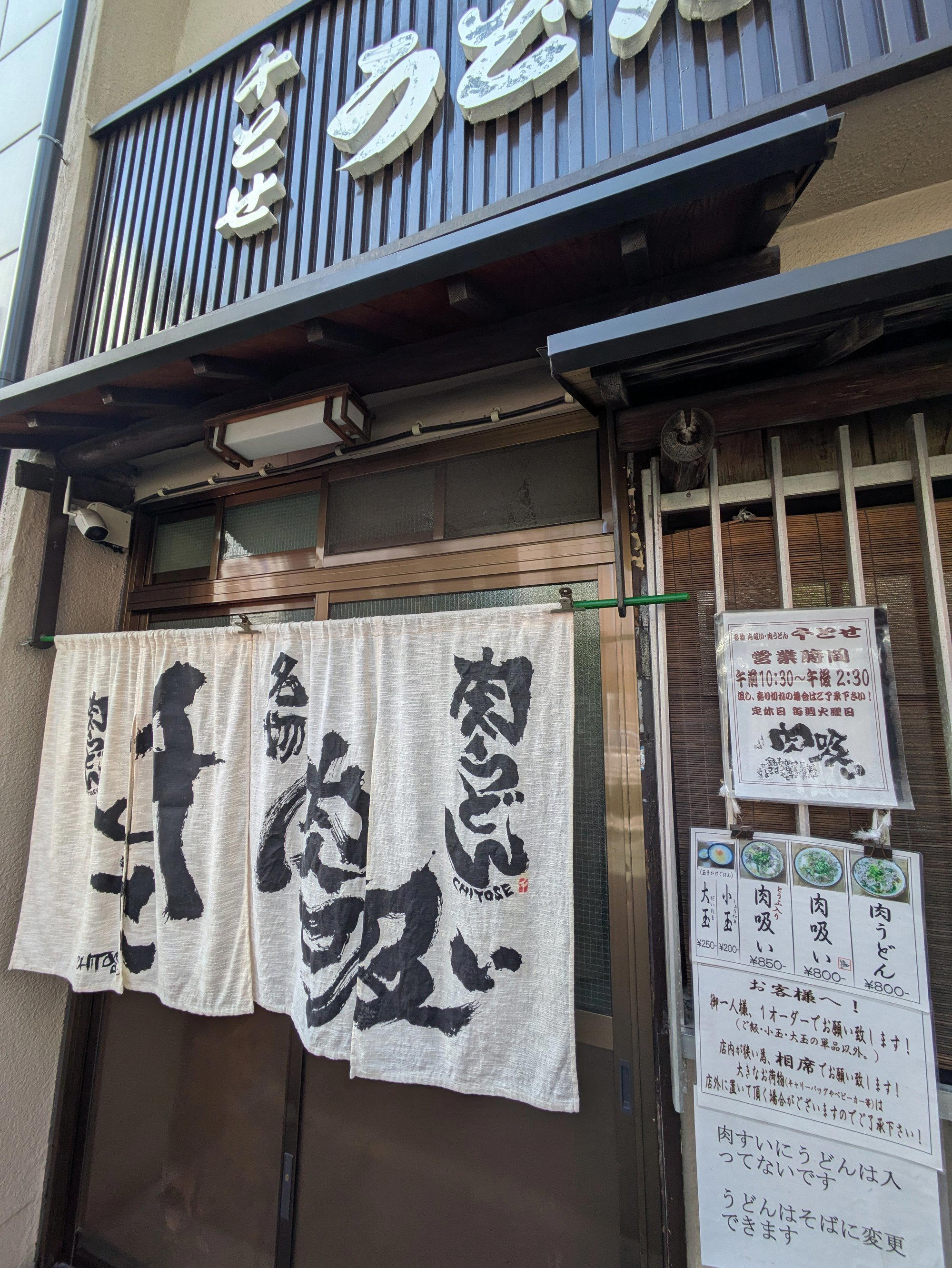
What Namba Sennichimae Sounds Like Before You Eat
The approach to Chitose runs through one of Namba's denser pedestrian corridors, where vendor noise from the covered arcades gives way to the quieter, more functional streets of Sennichimae. The address sits at 中央区難波千日前8-1, a location that places it squarely in a district historically associated with working trades, street performance, and the kind of eating that feeds people rather than impresses them. The interior, by all accounts consistent with the neighbourhood character, belongs to the category of shops where surfaces are clean but not designed, where the sound of a broth ladle and the hiss of a pot dominate the ambient register. This is the sensory grammar of a particular Osaka institution: functional, focused, and largely indifferent to curation.
Kansai Broth as a Regional Argument
The most meaningful frame for understanding Chitose is the broader Kansai approach to udon, which has always positioned itself against Tokyo conventions. Where Kanto broth tends toward a darker, soy-forward intensity, Kansai broth draws on lighter dashi, typically kombu-led, with a transparency that shifts the weight of the bowl toward the noodle itself. This is not minimalism as a style choice but as a regional philosophy about what the diner should actually be tasting. Osaka has maintained this tradition with less self-consciousness than Kyoto, where kaiseki refinement and places like Gion Sasaki in Kyoto set a more ceremonial tone. In Namba, the bowl arrives without ceremony.
That regional argument matters when comparing Osaka's udon culture to what you find in other cities. Harutaka in Tokyo operates at the precision end of Japanese culinary tradition, as do the kaiseki houses that have refined Osaka's own fine-dining tier, including Taian and Kashiwaya Osaka Senriyama. Chitose occupies a different register entirely, closer in spirit to how Kyushu's neighbourhood shops function, a category that places like Goh in Fukuoka approach from a more modern angle. The point is not that Chitose belongs to a lesser tradition, but that it belongs to a specific and defensible one.
Where the Ingredients Come From and Why That Shapes the Bowl
Kansai udon's claim to ingredient integrity is anchored in the region's access to quality kombu from Hokkaido, historically traded through Osaka's port economy, and domestic wheat flours from producers in Kagawa Prefecture (historically Sanuki's territory) and the Kansai plains. The noodle in this tradition is softer than Sanuki-style udon, with a characteristic give that holds heat differently and interacts with the lighter broth in a way a firmer noodle would disrupt. The wheat source matters because the moisture content of the dough, and the altitude and humidity at which the flour was milled, affects how the noodle absorbs liquid during cooking. This is not artisanal marketing language: it is the operating logic behind why Kansai udon tastes the way it does and why replicating it outside the region consistently produces a lesser result.
The dashi base in this style depends on the quality of the kombu, which in Osaka's case has historically benefited from the city's position as the terminus of the昆布 (kombu) road from Hokkaido. The interplay between kelp-forward dashi and a small amount of light soy or salt produces a broth whose colour barely registers, yet carries sufficient depth that it requires no augmentation. Alongside Chitose's Namba context, this is the same sourcing logic that underpins the tasting menus at higher price brackets, such as those at HAJIME and Fujiya 1935, though the expression and cost are radically different. Dashi literacy runs through Osaka's entire food culture, from the counter to the kaiseki room.
The Sennichimae Context
Namba Sennichimae is not the tourist-facing stretch of Dotonbori, and that distinction shapes what kind of eating it supports. The district has a historical association with craftspeople, performers from the nearby entertainment halls, and the kind of regular local custom that keeps prices stable and recipes unchanged across decades. Shops in this zone tend to earn their reputations through repetition rather than reinvention. For those building a wider itinerary across the Kansai region, anchoring an Osaka visit here before moving toward akordu in Nara or Abon in Ashiya provides useful contrast: the neighbourhood eating culture here differs substantially from what either of those cities produces.
The comparison with other Japanese regional scenes is instructive. The kind of anchored local reputation Chitose holds in Sennichimae parallels what certain shops maintain in Hokkaido, where Ajidocoro in Yubari District and aki nagao in Sapporo operate as neighbourhood references rather than destination restaurants. Internationally, the logic of a neighbourhood anchor with deep ingredient sourcing credentials but minimal formal presence echoes how Lazy Bear in San Francisco earned its credibility in a different category, or how Le Bernardin in New York City has always located its authority in sourcing rather than spectacle. Scale and cuisine differ entirely, but the principle that where the ingredient comes from shapes what ends up in the bowl is shared.
Planning a Visit
Frequently asked questions
Is Chitose (千とせ) good for families?
Chitose's setting in Namba Sennichimae, a working local district rather than a tourist-facing arcade, suits families who are comfortable with a no-frills, counter-and-table udon environment. The straightforwardness of a udon-focused menu works well with younger eaters. It is not a destination with dedicated children's facilities, but the format is accommodating rather than exclusionary.
How would you describe the vibe at Chitose (千とせ)?
Functional and unhurried, in the way that long-running Osaka neighbourhood restaurants tend to be. Sennichimae lacks the performance energy of Dotonbori a few blocks away, and Chitose reflects that quieter register. The focus is on the bowl in front of you, not the room around you.
What distinguishes Chitose from other udon spots in Osaka's Namba area?
Chitose sits in Namba Sennichimae rather than the high-traffic Dotonbori strip, which means its customer base has historically been local rather than tourist-driven, a meaningful signal in a city where the two dining circuits rarely overlap. That Chuo Ward address places it within a district with a documented history of serving the theatre and entertainment workers of the area, shaping the no-ceremony, repeat-visit culture around it. In Kansai udon terms, that local grounding is a form of credential.
What's the must-try dish at Chitose (千とせ)?
Chitose is known within the Kansai udon tradition, where the broth, built on kombu dashi rather than the heavier, soy-forward stocks common in Tokyo, is the primary argument for visiting. The kitsune udon, topped with seasoned aburaage, is the dish most associated with this style in Osaka and the logical starting point for any first visit to a Kansai udon-ya.
Where do I go for Chitose (千とせ)?
Chitose (千とせ) is located at 中央区難波千日前8-1, 大阪市, 大阪府, 542-0075, Osaka.
Can I walk in to Chitose (千とせ)?
Chitose at 中央区難波千日前8-1 operates as a traditional Osaka udon-ya, and walk-in is the standard mode for this category of restaurant. Queue times can extend during lunch, particularly on weekends, given the venue's local reputation in Sennichimae. Arriving early or outside peak hours is the practical approach.
In Context: Similar Options
Comparable venues nearby, for context on price, style, and recognition.
| Venue | Cuisine | Price | Awards | Notes |
|---|---|---|---|---|
| Chitose (千とせ)This venue (the venue you are viewing) | Osaka-style Okonomiyaki | $10–20 | Not listed | Not listed |
| AT THE 21 | Osaka okonomiyaki & teppan-yaki | $20–30 | Tabelog 100 #75 | Toyonaka |
| Soba-ya Kida | Traditional Soba Noodle House | $20–30 | Tabelog 100 #94 | Toyonaka |
| Satsuma | Traditional Yakiniku (Japanese BBQ) | $30–50 | Tabelog 100 #95 | Kita |
| Tanaka no Chuka Soba | Japanese Ramen | Not listed | Tabelog 100 #43 | Nishi |
| 橋本屋 | Spice Curry | $10–20 | Tabelog Bronze #99 | Minami-Senba |
Continue exploring
More in Osaka
Restaurants in Osaka
All restaurants in Osaka →



Bars in Osaka
All bars in Osaka →
Hotels in Osaka
All hotels in Osaka →



Wineries in Osaka
Browse all →
Details
- Cozy
- Classic
- Casual Hangout
- Sake Program
- A La Carte
- Vegetarian Friendly
Cozy and welcoming with a cheerful team in a discrete, small establishment.