
Tanaka no Chuka Soba belongs to Osaka’s serious counter-ramen tier: small-format, low-friction, and judged on execution rather than ceremony. Its Tabelog Ramen OSAKA “Tabelog 100” selections for 2023, 2024, and 2025 put it among the city’s more closely watched ramen addresses, with the value sitting in the gap between everyday pricing and specialist recognition.
Pearl is the En Primeur Club membership app — saves, bookings, and concierge access live there. Same editors, same standards.
- Address
- 大阪府大阪市西区靭本町1-18-23 ウルトラビル 1F
- Website
- tabelog.com
 Saves & bookings on Pearl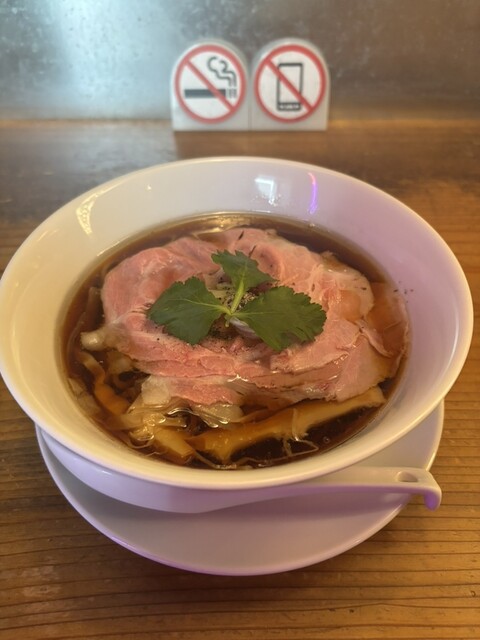
Hommachi’s office blocks and Utsubo Park edges give this part of Osaka a different rhythm from the canal-side theatre of Dotonbori. The ramen counter here is not built for lingering courses or theatrical plating; it is built around speed, proximity, and repeatability. A seven-seat counter compresses the experience into its essentials: a short wait, a seat within arm’s reach of the kitchen, and a bowl that has to justify itself without the cushioning of a long menu or formal service.
That format matters in Osaka. The city’s eating culture is often read through street food and late-night drinking, but its strongest everyday dining rooms are frequently small, technically specific, and priced for regular use. Ramen sits squarely in that category. Tanaka no Chuka Soba has been selected for Tabelog Ramen OSAKA “Tabelog 100” in 2023, 2024, and 2025, a useful signal in a genre where reputation is built through repetition rather than spectacle. The point is not luxury; the point is whether a compact counter can deliver enough precision to be worth crossing town for.
Counter ramen in Hommachi, judged by repetition rather than ceremony
Osaka’s ramen scene rewards clarity. In a city where casual eating is deeply competitive, a small shop cannot rely on a grand dining room or an elaborate drinks program to create momentum. The counter is the test. Seven seats mean turnover, focus, and little margin for drift. For travellers used to reservation-led dining, this is a useful reset: value in Japanese ramen often comes from the ratio of craft to friction, not from the length of the meal.
Hommachi sharpens that proposition. The neighbourhood sits between business Osaka and the calmer Utsubo side of Nishi-ku, so lunch demand and solo dining habits carry real weight. A counter ramen shop in this zone has to serve workers, repeat locals, and visitors who arrive with awards lists in hand. That mixed audience explains why recognition such as the Tabelog 100 matters here. It filters a crowded category without turning the meal into a formal occasion.
The comparison set around Osaka underlines the price-to-purpose question. .cafe operates in a similar low-spend band but answers a different need; 52CHO-ME BAKERY is about baked-goods pacing rather than counter cooking; 551 Horai (551蓬莱) belongs to Osaka’s grab-and-go comfort-food vocabulary. Ramen’s advantage is immediacy with technique: broth, noodles, tare, aroma oil, and timing have to resolve in one bowl. When the format works, the spend feels modest because the kitchen has few places to hide.
Why the value case is stronger than the ceremony
Premium travel dining often overweights rarity. Osaka is a useful corrective because some of the city’s more satisfying meals are not scarce in the luxury sense; they are scarce in the sense that they compress skill into a short, inexpensive sitting. Tanaka no Chuka Soba sits in that lane. Its recognition across three consecutive Tabelog 100 ramen lists gives the shop a credibility marker, while the counter format keeps the experience closer to daily dining than destination tasting-menu culture.
That distinction is worth making for visitors building an Osaka itinerary. A place such as 99 Pizza Napoletana Gourmet or a canto (Italian) can expand the city’s international dining frame, while ramen keeps the itinerary grounded in Japan’s high-skill casual register. Hommachi is also convenient for pairing with Nishi-ku wandering rather than treating dinner as a single fixed event. The smarter move is to let ramen do what ramen does well: a compact meal with clear purpose, then continue into bars, coffee, or another neighbourhood.
There is no need to inflate the experience into fine dining language. The appeal is narrower and more convincing: a small Osaka counter with repeated category recognition, a solo-friendly setup, and a dining format that respects time. In a city where meals can swing from department-store queues to formal kaiseki, that middle ground is valuable. It gives travellers a way to eat seriously without surrendering half a day to the reservation economy.
How to place it inside an Osaka food itinerary
Use Tanaka no Chuka Soba as a precision stop rather than the anchor for an entire evening. The scale suits solo diners, small parties, and travellers who prefer to build a day from several tightly chosen addresses. Families are also part of the audience here, which is not always the case with compact counter dining in Japan; that widens its usefulness for visitors moving through Osaka with children.
For broader planning, Our full Osaka restaurants guide is the logical next layer, especially if the day needs a second meal in Namba, Umeda, or Nishi-ku. Travellers staying overnight can cross-check neighbourhood choices in Our full Osaka hotels guide, then map after-dinner pacing with Our full Osaka bars guide. The wider city pages for Our full Osaka wineries guide and Our full Osaka experiences guide help separate a quick ramen stop from a full-day plan.
For readers comparing Japanese casual formats beyond Osaka, the useful contrast is not prestige but function. -Grilled beef Sukiyaki- KAMAKURA TANUKIAN 鎌倉 たぬき庵 in Kamakura points toward a heavier set-piece meal;. 鮪と炭火焼き うお炭 秋葉原店 in Tokyo reads through fish and charcoal;.know in Kumamoto, (Shoku) Vietnam in Kawasaki, [Curry Senmon Ten] Maruyama Kyoju. in Sapporo, and [ki:] in Kyoto show how regional cities handle specialist casual dining. Outside Japan, Jōdo Saké Bar in Los Angeles and Onigiri Time in Pasadena make the diaspora comparison clear: Japanese comfort formats travel well, but the Osaka counter remains its own kind of discipline.
Nearby-ish Comparables
Comparable venues by price and recognition.
| Venue | Cuisine | Price | Notes |
|---|---|---|---|
| Tanaka no Chuka Soba | Japanese Ramen | $$ | Nishi |
| Niku Ryori PINE | Meat-focused Japanese standing bar | $$ | Kita |
| Kyu Yam Tei Karahori ten | Spice Curry & Café in a Retro Townhouse | $$ | Chūō |
| Nomiba Umeda Umeda | Modern Japanese Lamb & Soba | $$ | Yodogawa |
| Soju En | Traditional Yakiniku (Japanese BBQ) | $$ | Konohana |
| Mensho Yashima | Traditional Osaka Udon Shop | $$ | Moriguchi |
Recognition history
Dated appearances from independent guides and award organizations, with the underlying list record or original source where available.
Tabelog 100 #43 · No. 43
Tabelog · Tabelog 100 - Ramen - OSAKA - 2025
Continue exploring
More in Osaka
Restaurants in Osaka
Browse all →




Bars in Osaka
Browse all →


Hotels in Osaka
Browse all →



Wineries in Osaka
Browse all →
At a Glance
- Cozy
- Modern
- Sophisticated
- Intimate
- Solo
- Family
- Casual Hangout
- Standalone
A small, stylish, relaxed ramen space with only seven counter seats, creating an intimate and focused dining atmosphere.