CatuaBar Amsterdam
CatuaBar Amsterdam occupies a quiet address in the Oosterparkbuurt, a neighbourhood that has quietly become one of the city's more interesting dining corridors. The bar sits at the intersection of local product and internationally trained technique, a combination that defines much of Amsterdam's current mid-tier ambition. Details on format and pricing remain limited, making direct contact a reliable first step.
Pearl is the En Primeur Club membership app — saves, bookings, and concierge access live there. Same editors, same standards.
- Address
- Andreas Bonnstraat 40H, 1091 BA Amsterdam, Netherlands
- Phone
- +31627112772
- Website
- catuabar.nl
- Directions
- Get directions
 Saves & bookings on Pearl
East Amsterdam's Quieter Dining Corridor
The Oosterparkbuurt rarely features in the shortlists that send visitors to the canal belt or the Jordaan. That relative anonymity is partly what makes it worth paying attention to. Over the past several years, a cluster of neighbourhood addresses along and around Andreas Bonnstraat have drawn a local clientele that tracks quality more than profile, the kind of crowd that treats postcode as irrelevant when the cooking earns the trip. CatuaBar Amsterdam, at number 40H, belongs to that pattern: a street-level address in a residential block, positioned in a part of the city where restaurants tend to answer to regulars rather than tourist cycles.
Amsterdam's dining scene has bifurcated sharply over the last decade. At the leading end, a cluster of tasting-menu restaurants, including Ciel Bleu, Flore, Spectrum, and Vinkeles, operate at the €€€€ tier with Michelin recognition and the full infrastructure that implies: long reservations windows, formal service, wine pairings priced separately. Below that bracket sits a more interesting and less legible tier, where neighbourhood bars and smaller restaurants absorb the city's considerable appetite for serious food without the ceremony. CatuaBar operates in this second register, and that positioning carries its own set of expectations.
Local Product, Imported Method
The broader movement shaping Amsterdam's mid-tier dining is the convergence of Dutch raw material and technique drawn from elsewhere. The Netherlands produces notable primary ingredients: North Sea fish, polders-grown vegetables, aged dairy from Gouda and Edam provinces, and an increasingly sophisticated network of small producers supplying urban restaurants directly. What Dutch cooking has historically lacked is a codified fine-dining language of its own comparable to French classical or Japanese kaiseki traditions. The gap has been filled by chefs trained in kitchens across France, Scandinavia, Japan, and the Americas who returned to work with Dutch product through externally acquired frameworks.
This intersection, local ingredient, global technique, now defines a recognisable Amsterdam style. You see it across the city, from the greenhouse sourcing at De Kas to the New Nordic-adjacent approach at BAK in the Westergasfabriek, and in the produce-led menus at Bolenius. The pattern recurs in Dutch restaurant culture at large: De Librije in Zwolle built its three-star identity partly on this principle, sourcing aggressively local while applying international technical vocabulary. De Nieuwe Winkel in Nijmegen takes it further into plant-based territory. Even coastal addresses like Inter Scaldes in Kruiningen and De Bokkedoorns in Overveen have built reputations on proximity to specific Dutch products rather than generic European luxury sourcing.
CatuaBar's name itself does not immediately signal a Dutch identity, the word carries associations elsewhere, which may reflect a deliberate positioning toward a format or tradition that sits outside the Amsterdam mainstream. The record places CatuaBar Amsterdam as a South American & South African Fusion restaurant, a neighbourhood address where the menu can be read through that lens.
The Oosterparkbuurt in Context
The neighbourhood surrounding Andreas Bonnstraat repays some geographical attention. The Oosterpark itself is one of Amsterdam's older public parks, and the streets radiating from it have seen sustained residential investment without the commercial saturation that has made parts of De Pijp feel overscheduled. The dining on these streets trends toward the durable and local: places that have built regulars over years rather than months, that survive on repeat visits rather than first-timer enthusiasm. In that environment, a bar format makes particular sense. The bar-as-anchor is a European model with deep roots, the Spanish bar, the Lyonnais bouchon, the London neighbourhood pub functioning simultaneously as social institution and food operation, and Amsterdam has absorbed versions of all of them.
The street address also places CatuaBar within reasonable reach of the Wils and similar mid-tier addresses that have established the eastern city as a legitimate dining destination rather than an overflow from the centre. For visitors oriented toward Bistro de la Mer or the broader canal-district restaurant cluster, the Oosterparkbuurt represents a twenty-minute transit shift that trades atmosphere for a more local dining register, a trade that can be worth making.
Where CatuaBar Fits in a Wider Dutch Context
Across the Netherlands, the bar-restaurant format has produced some of the country's most compelling dining. Brut172 in Reijmerstok and Tribeca in Heeze demonstrate how smaller addresses outside major cities can generate Michelin attention by focusing tightly on product and consistency. De Groene Lantaarn in Staphorst and De Lindehof in Nuenen have sustained recognition over long periods without the urban density or tourist volume that Amsterdam addresses rely on. De Lindenhof in Giethoorn and De Treeswijkhoeve in Waalre add further texture to the picture of a Dutch dining culture that punches above its population size. Internationally, the technique-first approach that underpins much of this work has parallels in how kitchens like Le Bernardin in New York City and Lazy Bear in San Francisco approach product sourcing through a framework of accumulated classical discipline.
CatuaBar is a smaller address in this ecosystem. But the neighbourhood model it represents, the bar as primary dining format, the eastern city as dining destination, the local-product ethos as organising principle, is a legitimate and increasingly well-mapped corner of Dutch food culture.
Know Before You Go
Cuisine Lens
Comparable venues nearby, for context on price, style, and recognition.
| Venue | Cuisine | Price | Notes |
|---|---|---|---|
| CatuaBar AmsterdamThis venue — the venue you are viewing | South American & South African Fusion | $$ | Not listed |
| Bottleshop Amsterdam | Natural Wine Bar with Fusion Small Plates | $$ | Weesperzijde Midden/Zuid |
| JA | Seasonal Dutch-Asian Seafood Fine Dining | $$ | Sarphatiparkbuurt |
| Box Sociaal | Modern Australian Brunch & Gastropub | $$ | Plantage |
| Portugalia Tasca | Authentic Portuguese Seafood Tasca | $$ | Rembrandtpleinbuurt |
| Quattro Gatti | Authentic Italian Handmade Pasta | $$ | Felix Meritisbuurt |
Continue exploring
More in Amsterdam
Restaurants in Amsterdam
Browse all →
Bars in Amsterdam
Browse all →
Hotels in Amsterdam
Browse all →
Wineries in Amsterdam
Browse all →
At a Glance
- Cozy
- Trendy
- Intimate
- Date Night
- Casual Hangout
- Late Night
- Terrace
- Craft Cocktails
- Natural Wine
- Local Sourcing
Current opening hours
- Monday
- Closed
- Tuesday
- Closed
- Wednesday
- 5–10 PM
- Thursday
- 5–11 PM
- Friday
- 5 PM–1 AM
- Saturday
- 5 PM–12 AM
- Sunday
- Closed
Hours can change for holidays and private events. Last verified .
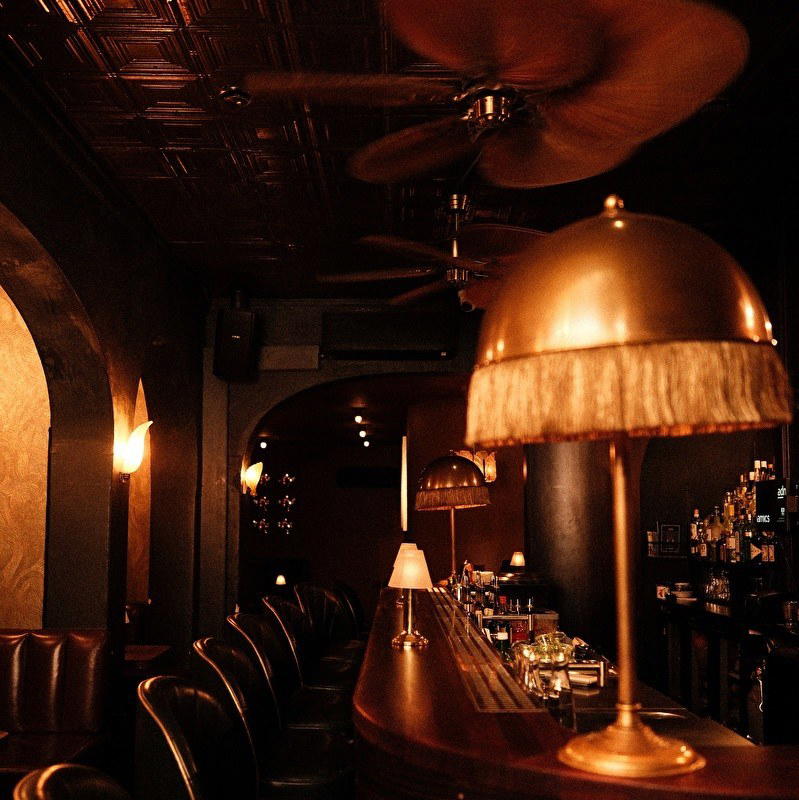
Cozy with lush green hues, dim lighting, velvet sofas, and a warm, inviting atmosphere.