Brücke 10 sits at St. Pauli-Landungsbrücken, Hamburg's working waterfront, where the Elbe and the city's port identity converge. The address alone explains much of its draw: this is where Hamburg regulars come when they want the water close and the atmosphere unfiltered. It operates in the everyday tier of the harbour scene rather than the fine-dining circuit, making it a useful counterpoint to the city's Michelin-weighted options.
Pearl is the En Primeur Club membership app — saves, bookings, and concierge access live there. Same editors, same standards.
- Address
- St. Pauli-Landungsbrücken 10, 20359 Hamburg, Germany
- Phone
- +494033399339
- Website
- bruecke10.com
- Directions
- Get directions
 Saves & bookings on Pearl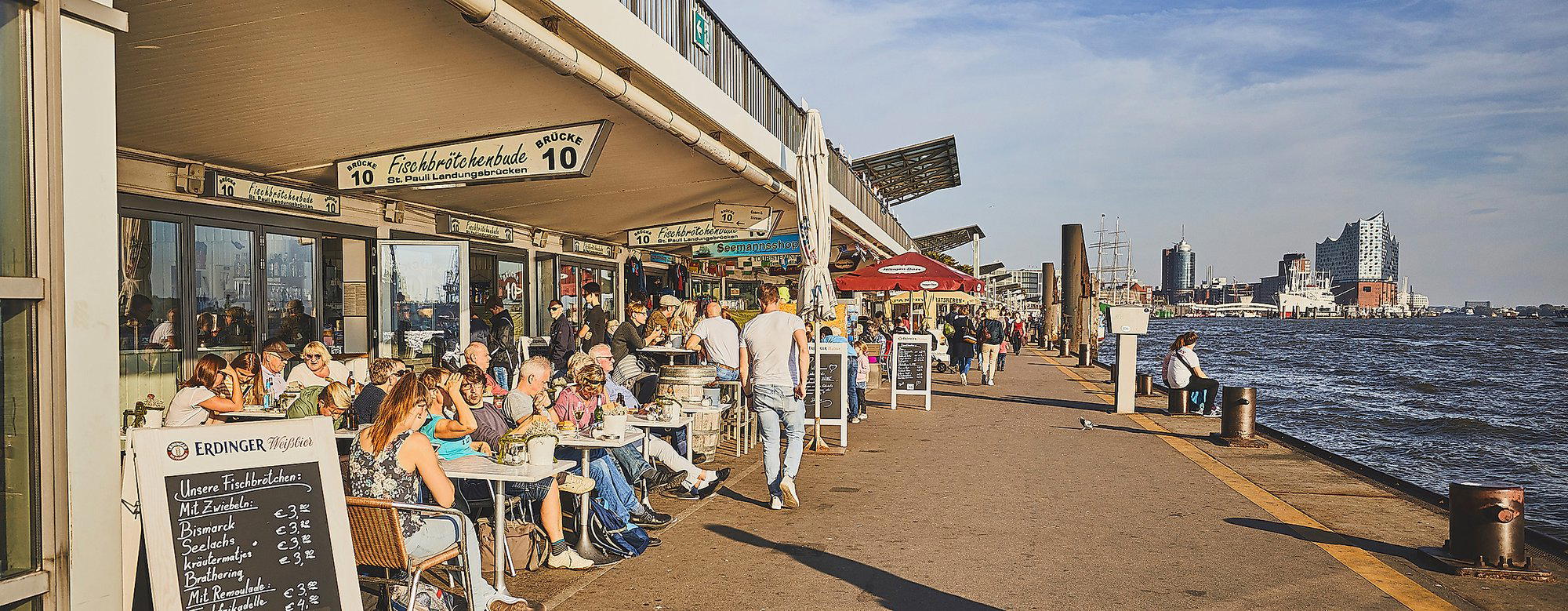
Where the Elbe Does the Talking
Hamburg's relationship with its waterfront is older and more complicated than the postcard version suggests. The St. Pauli-Landungsbrücken pontoon district has served as the city's working embarkation point for well over a century, handling everything from transatlantic emigration traffic to daily harbour ferry crossings. The venues that line the piers here have always operated with a different logic than those in the Altstadt or the Eppendorf dining quarter: the water is the main event, and the food and drink are organised around it rather than the reverse.
Brücke 10 sits at berth ten of those landing bridges, which means it occupies one of the more directly harbour-facing positions on the strip. The approach on foot from the U3 Landungsbrücken station takes you along the refined promenade, with the Elbe opening below and the cranes of the Steinwerder industrial quays visible across the water. On clear days the scene carries to Finkenwerder and the airport flight path beyond. The physical setting does the atmospheric heavy lifting before you have even ordered anything.
The Crowd That Comes Back
The regulars at this end of the waterfront tend not to be the same crowd you find at Restaurant Haerlin in the Fairmont Vier Jahreszeiten or at The Table Kevin Fehling, where three Michelin stars and a multi-course format ask something different of the evening. The Landungsbrücken audience is drawn by proximity to the water, by informality, and by the logic of a working port neighbourhood that has resisted the full gentrification sweep that transformed HafenCity a kilometre east. These are people who come on a Tuesday afternoon as readily as a Saturday evening, often after a harbour ferry crossing or a walk along the Elbe promenade toward the Fischmarkt.
What keeps regulars returning to venues in this district is rarely a single dish or a wine list. It is the accumulated familiarity of a place that makes sense in its context: the Elbe ferry traffic visible from the window, the container ships moving at their slow pace toward the Köhlbrand bridge, the way the light changes across the water through the afternoon. Hamburg's port districts have always created this kind of loyalty in their frequenters, and Brücke 10 occupies that social geography at one of its most direct addresses.
For visitors seeking a finer-grained dining experience in the city, Hamburg's higher register runs from 100/200 Kitchen to bianc and Lakeside, each positioned at the €€€€ tier with distinct format identities. Brücke 10's position in the waterfront tier is a deliberate contrast to that circuit rather than a step toward it. Our full rundown of the city's options is in the Hamburg restaurants guide.
The Harbour Format and What It Implies
Venues at the Landungsbrücken operate under a set of unwritten rules that distinguish them from Hamburg's formal dining addresses. Walk-in culture is the norm here; the spontaneity of harbour life does not accommodate the booking windows you encounter at, say, Schwarzwaldstube in Baiersbronn or Aqua in Wolfsburg, where reservation depth is itself a signal of category. At the piers, the rhythm is set by ferry departures, weather patterns, and the particular logic of a stretch of Hamburg that still functions as a transit point rather than a destination quarter.
The food tradition in this part of Hamburg skews toward the northern German seafood canon: Bismarck herring, Matjes, Fischbrötchen in various preparations, and the broth-based fish soups that belong to this coastline rather than to any international trend cycle. Across Germany's higher-end restaurant tier, from JAN in Munich to Vendôme in Bergisch Gladbach and Victor's Fine Dining by Christian Bau in Perl, the direction of travel has been toward technique-led, produce-driven menus that draw on international reference points. The Landungsbrücken strip holds a different position: it is where Hamburg's port identity is still legible in what people eat and how they eat it.
That does not mean the area is frozen. The Elbe waterfront has absorbed significant infrastructural investment over the past decade, and visitor volumes at Landungsbrücken have grown alongside the HafenCity residential expansion. But the core format of the pier venues has remained more stable than the surrounding city, which is part of what makes it a useful counterpoint to Hamburg's evolving fine-dining and modern European scenes.
Placing Brücke 10 in the Hamburg Waterfront Tier
Within Germany's wider restaurant landscape, where venues like Waldhotel Sonnora in Dreis, Schanz in Piesport, and ES:SENZ in Grassau define one end of the ambition spectrum, the Landungsbrücken pier venues occupy the opposite pole: accessible, weather-dependent, daytime-weighted, and entirely oriented around their physical position on the water. That positioning is not a compromise; it is the point. Hamburg's port identity is one of the city's most persistent cultural facts, and Brücke 10's address at berth ten makes it a direct expression of that identity rather than a reference to it.
For visitors arriving from further afield, the Landungsbrücken U-Bahn station is one of the more useful orientation points in central Hamburg, connecting the waterfront to the city's main transit network. The refined station platform itself offers an early view of the Elbe and the harbour panorama. The walk from there to berth ten is a matter of minutes along the promenade level.
For reference on what experimental or destination-format dining looks like elsewhere in Europe, the comparison set might include CODA Dessert Dining in Berlin, Bagatelle in Trier, Le Bernardin in New York City, or Lazy Bear in San Francisco. Those are different categories entirely. Brücke 10 operates in the register of Hamburg's port itself: direct, weather-facing, and oriented around the Elbe rather than around a tasting menu.
Planning Your Visit
The Landungsbrücken area is most atmospheric in the mid-morning to late afternoon window, when harbour ferry traffic is active and the light sits low across the water on clear days. The pier venues here are generally accessible without advance booking, consistent with the walk-in culture of the district. For those coming from central Hamburg, the U3 line to Landungsbrücken is the most direct route; the refined station puts you at promenade level within a short walk of berth ten. Visitors combining this with Hamburg's formal dining scene should note that the Landungsbrücken strip sits at a distinct remove, both geographically and in format, from the Eppendorf and Rotherbaum addresses where much of the city's Michelin circuit is concentrated.
Frequently Asked Questions
- What is the signature dish at Brücke 10?
- Brücke 10 sits in Hamburg's Landungsbrücken waterfront tier, where the food tradition centres on northern German seafood: Fischbrötchen, Matjes preparations, and harbour-adjacent fish dishes that reflect the port's identity rather than a fine-dining menu structure. This is not the address to compare against Hamburg's creative kitchens at venues like The Table Kevin Fehling or 100/200 Kitchen; it operates in a different register entirely, where the Elbe setting is as much a part of the offering as anything on the counter.
- Do I need a reservation for Brücke 10?
- The Landungsbrücken pier district operates on walk-in culture, shaped by the spontaneous rhythms of harbour transit rather than the advance-booking logic of Hamburg's formal dining tier. If you are planning a visit during peak summer months or on a clear weekend afternoon when the waterfront draws significant foot traffic, arriving earlier in the day reduces waiting times. The contrast with Hamburg's reservation-dependent addresses, where a booking window of several weeks is standard, is deliberate and part of what defines this district's character.
- What makes Brücke 10 different from Hamburg's other waterfront dining options?
- The address at berth ten of St. Pauli-Landungsbrücken gives Brücke 10 one of the most directly Elbe-facing positions on the strip, with working harbour ferry crossings and container shipping traffic forming the backdrop rather than a curated view. While HafenCity to the east has developed a more polished waterfront dining scene in the past decade, the Landungsbrücken pier venues have maintained the port-district character that gives this part of Hamburg its distinct atmosphere. For visitors mapping Hamburg's full dining range, this sits at a different coordinate from the city's fine-dining circuit tracked in the EP Club Hamburg guide.
Comparable Spots, Quickly
| Venue | Cuisine | Price | Awards |
|---|---|---|---|
| Brücke 10This venue — the venue you are viewing | This venue | Not listed | Not listed |
| The Table Kevin Fehling | Creative | €€€€ | Michelin 3 Star |
| bianc | Modern Mediterranean, Mediterranean Cuisine | €€€€ | Michelin 2 Star |
| Lakeside | German Lakeside | €€€€ | Michelin 2 Star |
| Heimatjuwel | German, Creative | €€€ | Michelin 1 Star |
| Landhaus Scherrer | Modern European, Classic Cuisine | €€€€ | Michelin 1 Star |
Continue exploring
More in Hamburg
Restaurants in Hamburg
Browse all →
Bars in Hamburg
Browse all →
Hotels in Hamburg
Browse all →
Wineries in Hamburg
Browse all →
At a Glance
- Cozy
- Scenic
- Casual
- Well Known
- Casual Hangout
- Solo
- Waterfront
- Standalone
- Beer Program
- Sustainable Seafood
- Local Sourcing
- Waterfront
Current opening hours
- Monday
- 10 AM–10 PM
- Tuesday
- 10 AM–10 PM
- Wednesday
- 10 AM–10 PM
- Thursday
- 10 AM–10 PM
- Friday
- 10 AM–10 PM
- Saturday
- 10 AM–10 PM
- Sunday
- 9 AM–10 PM
Hours can change for holidays and private events. Last verified .
Bright, direct, and casual with a maritime theme; outdoor seating on a ponton creates a relaxed, informal atmosphere with wonderful harbor views and the gentle movement of the water.
Know Before You Go
- Getting there
- St. Pauli-Landungsbrücken 10, 20359 Hamburg, Germany