Our verdict
Andhra Pradesh Bhavan on Ashoka Road is one of Delhi's state canteen institutions, where the lunch service draws a crowd that crosses every social tier for fiery Andhra cooking at prices that have no equivalent in the capital. The thali format and no-frills setting place it firmly outside the fine-dining conversation, but for heat-forward Telugu cuisine, it operates in a category of its own.

Pearl is the En Primeur Club membership app, where members save venues, book tables and use the concierge.
The menu
What to order
- Chicken Biryani
- South Indian Thali
- Mutton Fry
- Prawn Fry
Where Ashoka Road Meets the Southern Table
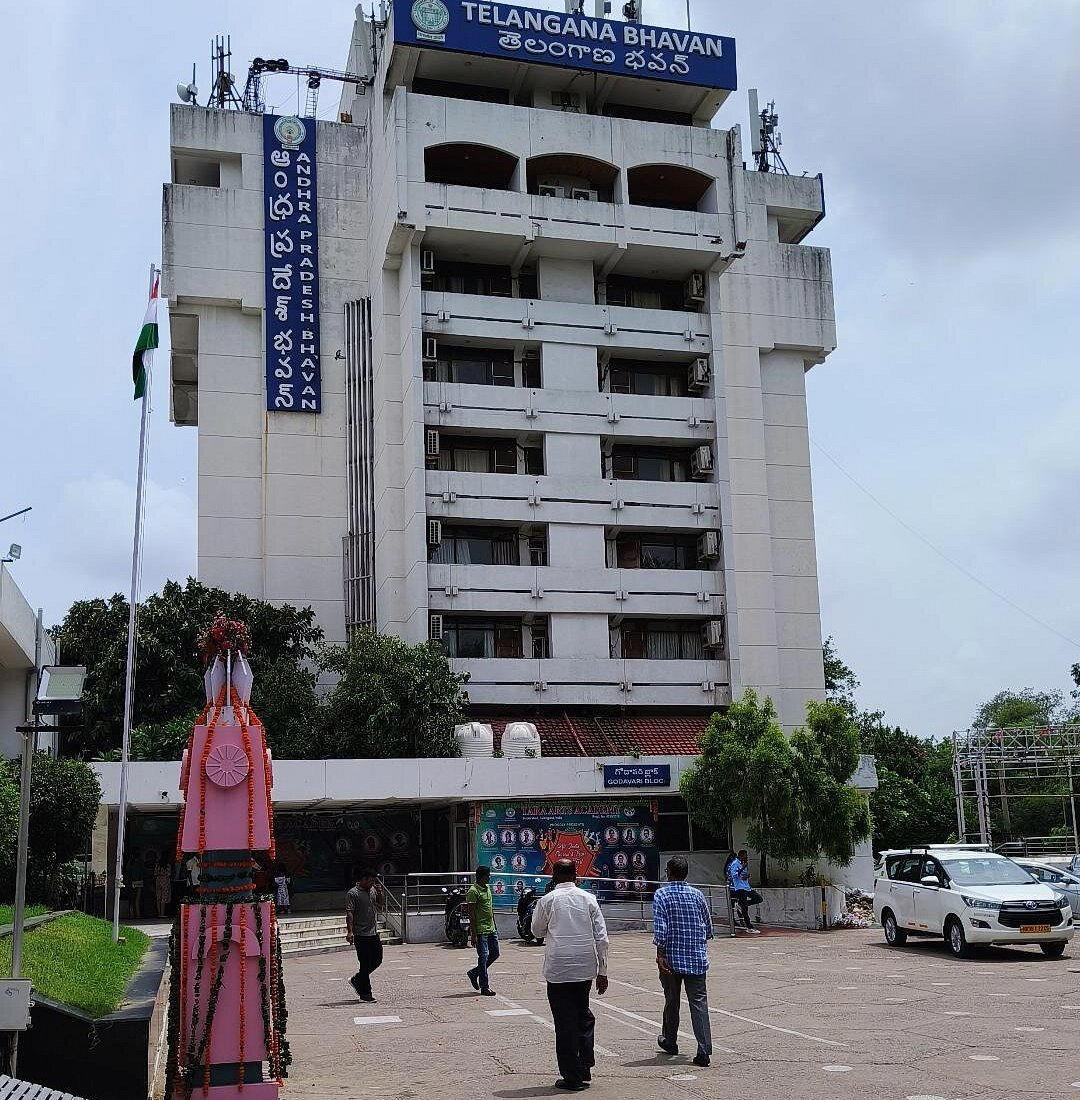
The approach to Andhra Pradesh Bhavan tells you something about what to expect inside. The building sits on Ashoka Road near India Gate, part of Delhi's ring of state bhavans, those government guest houses that each double as unofficial embassies of regional Indian cuisine. The architecture is utilitarian, the signage functional, and the queue at lunch, a genuine, shuffling, impatient queue, extends well before the doors open. This is not a scene manufactured for atmosphere. It is what happens when a city of twenty million contains one place reliably delivering Andhra-standard heat and technique at a price point that most restaurants in the neighbourhood would struggle to justify for a glass of water.
Delhi's state bhavans occupy a specific and largely unexamined position in the city's dining geography. For decades they have served as the only places where migrants from Andhra Pradesh, Telangana, Tamil Nadu, or Maharashtra could eat cooking that actually reflected home rather than a north-Indian approximation of it. Andhra Pradesh Bhavan sits at the sharper end of this tradition. Andhra and Telangana cuisines are among the spiciest in India by most documented measures, built around dried red chillies, tamarind, and mustard in volumes that most restaurant kitchens in Delhi dial back considerably when cooking for a mixed audience. Here, the adjustment is minimal at leading.
The Format and the Room
The dining format at state bhavans is a study in deliberate efficiency. Seating is communal, surfaces are simple, and the thali service moves at institutional pace, which is to say fast and without ceremony. The sensory register is dominated not by the room but by what arrives on the table: the sharp fermented sourness of tamarind rasam, the deep dried-chilli heat of curries, and the cooling presence of rice and yoghurt that structures the meal from start to finish. For anyone arriving from the air-conditioned interiors of the fine-dining circuit, it is a recalibration. Context matters in food, and this room insists you eat on its terms.
The contrast with Delhi's more formally positioned regional restaurants is worth holding in mind. At Adaa at Falaknuma Palace in Hyderabad, Andhra and Hyderabadi cooking arrives within a heritage palace setting with price and presentation to match. At Andhra Pradesh Bhavan, none of that framing exists. What remains is the cooking itself, and the cooking holds up without the scaffolding.
The Cuisine in Context
Andhra Pradesh and Telangana cuisines share a common Telugu-speaking cultural root, which means the cooking at this bhavan draws on a tradition that includes gongura (sorrel leaf) preparations, pesarattu (green moong dosa), and curries built on a base of tamarind, tomato, and generous quantities of chilli. This is not the aromatic, cream-softened cooking that most of Delhi's North Indian restaurants trade in. It is drier, more acidic, more sharply spiced, and, in the context of a state bhavan kitchen, largely unreconstructed.
Across India's southern dining scene, this style of cooking has attracted serious editorial attention in recent years. Kappa Chakka Kandhari in Chennai has drawn recognition for insisting on regional specificity over pan-Indian accessibility. Farmlore in Bangalore sits in a different tier entirely but shares the underlying argument: that India's regional cooking traditions have enough depth to stand without dilution. Andhra Pradesh Bhavan makes the same argument with less formal apparatus and at a fraction of the price.
The lunch thali is the format that built this place's reputation. Rice forms the structural core, surrounded by rotating vegetable preparations, dal, rasam, sambar, curd, pickle, and papad. Meat dishes, including mutton or chicken curries cooked with the dried-chilli intensity characteristic of the region, appear on most service days. The heat level at its most direct is not decorative. It is the point.
The Bhavan Circuit and Delhi's Regional Dining
Delhi's state bhavans operate as a low-profile parallel circuit to the city's mainstream restaurant scene, and Andhra Pradesh Bhavan has the highest profile of the group, partly because Andhra cooking's reputation for heat draws curious diners beyond the Telugu-speaking community, and partly because the lunch crowd has always included a cross-section of civil servants, journalists, and students alongside the regulars. This mix is itself a trust signal. In a city that has no shortage of regional Indian restaurants competing for attention, from Bukhara's North-West Frontier register to Dilli StreEAT's street-food format, a canteen that sustains a long queue on institutional catering budgets is making a different kind of statement about quality.
Visitors exploring Delhi's broader food scene might cross-reference this with the old-city register at Bikanervala in Chandni Chowk or the breakfast-focussed simplicity of Chache Di Hatti. Each of those operates within a different regional and format tradition, but all share the quality that makes Delhi's non-fine-dining circuit worth following: the cooking has a specific identity and a community that holds it to account. See our full Delhi restaurants guide for more context on how these tiers map across the city.
Planning the Visit
The practical reality of Andhra Pradesh Bhavan is that it operates primarily as a lunch venue, and the service window is narrow. Arriving close to opening is advisable; the queue forms early and the most popular preparations sell out rather than being replenished indefinitely. The address on Ashoka Road places it within reach of the central government district, which means it is accessible by Metro with a short walk or auto-rickshaw from nearby stations. There is no phone reservation system in the conventional sense, and the format does not require one. The payment structure is cash-oriented, and the price per head remains low by any standard applied to this part of the city. For context: this sits at a different point on the pricing curve than Inja in New Delhi or Curry Kitchen, both of which operate in a more formal register. October through March, when Delhi's heat eases and the spice of the cooking becomes easier to appreciate without competing ambient temperature, is when the experience lands most cleanly.
Frequently asked questions
Where is Andhra Pradesh Bhavan in Delhi?
Andhra Pradesh Bhavan is located at 1, Ashoka Rd, near India Gate, Pataudi House, New Delhi, Delhi 110001, India, Delhi.
Is Andhra Pradesh Bhavan open to the general public, or only to government guests?
The dining hall at Andhra Pradesh Bhavan, located near India Gate on Ashoka Road in New Delhi, is open to the general public during its lunch service hours. State bhavans across Delhi historically served visiting officials and politicians from their respective states, but the canteen-style restaurants have long attracted a broader crowd, civil servants, students, and anyone tracking down genuine regional Telugu cooking in the capital.
What's the best thing to order at Andhra Pradesh Bhavan?
The thali is the only format that matters here. It arrives as a fixed spread rooted in Telugu culinary tradition, expect rice, sambar, rasam, and the fiercely spiced preparations that define Andhra cooking, including the region's characteristically hot chutneys and gravies. There is no à la carte menu to deliberate over; the kitchen decides, and the rotation shifts with the day.
Do I need a reservation for Andhra Pradesh Bhavan?
State bhavans in Delhi generally do not operate reservation systems for their public dining halls, Andhra Pradesh Bhavan on Ashoka Road follows that model. The practical strategy is to arrive close to the lunch service opening, as seating fills quickly and the service window is narrow. Walk-ins are the norm, but patience is not optional during peak hours.
A quick peer list to put this venue’s basics in context.
| Venue | Cuisine | Price | Awards |
|---|---|---|---|
| Andhra Pradesh BhavanThis venue (the venue you are viewing) | Authentic Andhra South Indian | Not listed | Not listed |
| Bukhara | North West Frontier Tandoori | $30–50 | World's 50 Best #37 · La Liste Top Restaurants |
| Chache Di Hatti | Iconic Punjabi Chole Bhature | $1–10 | Not listed |
| Dramz Delhi | Multi-Cuisine Fine Dining with North Indian & European | $50–100 | Not listed |
| Indian Accent | Modern Indian Fine Dining | $50–100 | World's 50 Best #46 · La Liste Top Restaurants |
| Rajdhani Thali Restaurant | Rajasthani & Gujarati Thali | Not listed | Not listed |
Continue exploring
More in New Delhi
Restaurants in New Delhi
All restaurants in New Delhi →
Bars in New Delhi
All bars in New Delhi →
Details
- Cozy
- Classic
- Family
- Casual Hangout
- Historic Building
- A La Carte
- Vegetarian Friendly
- Vegan Options
Current opening hours
- Monday
- 8–10 AM, 12–3 PM, 7:30–10 PM
- Tuesday
- 8–10 AM, 12–3 PM, 7:30–10 PM
- Wednesday
- 8–10 AM, 12–3 PM, 7:30–10 PM
- Thursday
- 8–10 AM, 12–3 PM, 7:30–10 PM
- Friday
- 8–10 AM, 12–3 PM, 7:30–10 PM
- Saturday
- 8–10 AM, 12–3 PM, 7:30–10 PM
- Sunday
- 8–10 AM, 12–3 PM, 7:30–10 PM
Hours can change for holidays and private events. Hours as of .
Casual, comforting atmosphere reminiscent of a quiet old home with the aroma of spices and a buzzy, energetic vibe.