The Würstelstand is Vienna's most democratic dining institution, and 16er Würstelstand on the corner of Brunnengasse and Neulerchenfelder Strasse operates at the working heart of the 16th district. This is Ottakring at its most unmediated: sausages sourced from Austrian producers, eaten standing at the counter as tram 46 rattles past. No reservations, no dress code, no performance.
Pearl is the En Primeur Club membership app — saves, bookings, and concierge access live there. Same editors, same standards.
- Address
- Brunnengasse, Neulerchenfelder Str., 1160 Wien, Austria
- Website
- 16er.eu
- Directions
- Get directions
 Saves & bookings on Pearl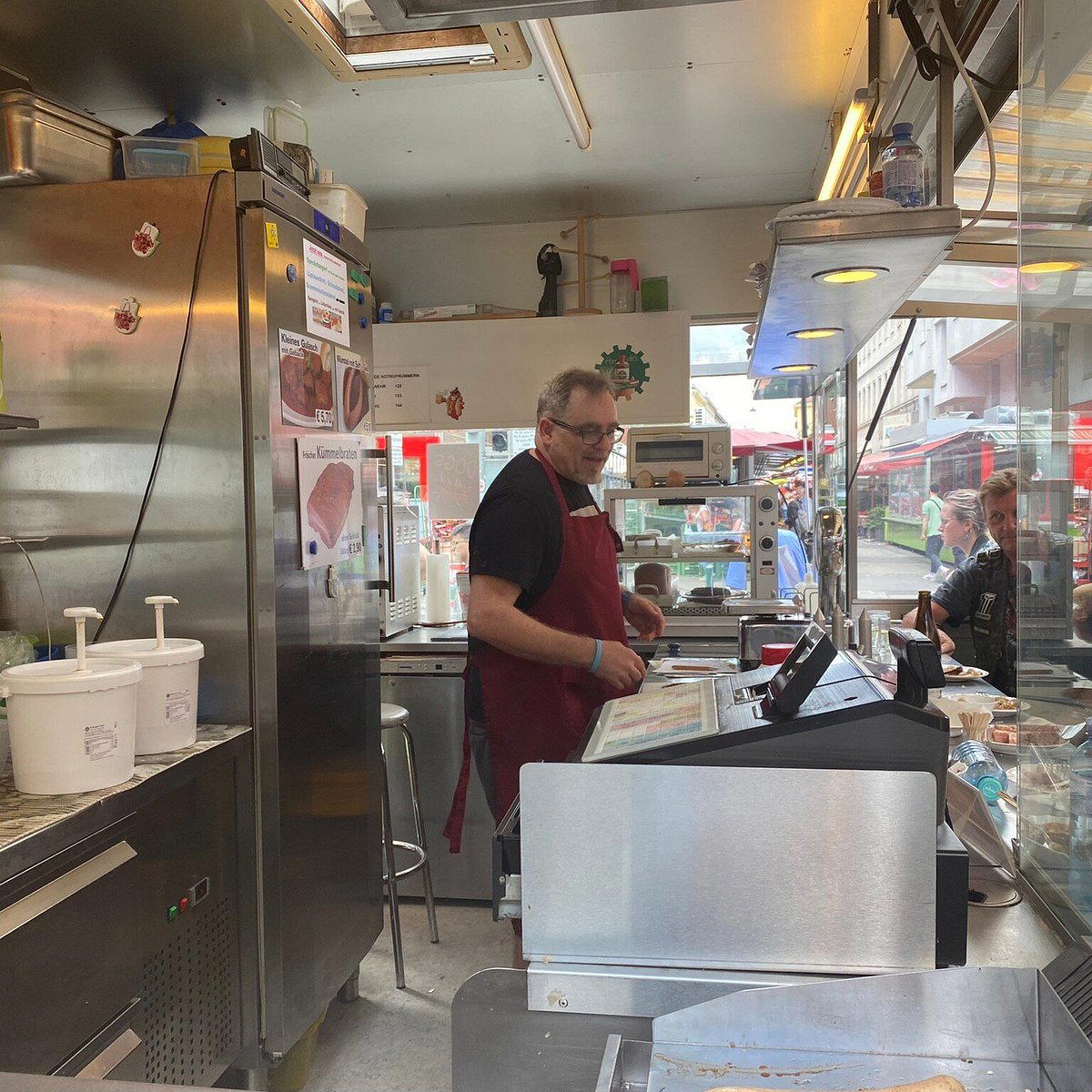
The Corner That Ottakring Runs On
Stand at the intersection of Brunnengasse and Neulerchenfelder Strasse on a weekday morning and you will understand immediately why Vienna's Würstelstand culture has outlasted every dining trend the city has absorbed since the Ringstrasse era. The smell arrives before the stand does: grilled casing, warm mustard, a faint curl of steam from the water bath keeping the Frankfurters at temperature. 16er Würstelstand occupies this corner in the 16th district, Ottakring, a neighbourhood that has never been particularly interested in performing for visitors. The clientele at this hour is construction workers, night-shift nurses finishing a long stretch, retirees with nowhere particular to be. The stand is their infrastructure, not their occasion.
This is worth stating plainly, because Vienna's dining conversation tends to cluster in the first district or along the Naschmarkt corridor, where restaurants like Steirereck im Stadtpark, Amador, and Konstantin Filippou anchor the city's high-end reputation. The Würstelstand exists in a completely different register, one that predates those restaurants by generations and will likely survive whatever comes after them. It is the format that fed Vienna when nothing else was open, and the 16th district iteration of it sits inside a neighbourhood that still treats eating standing up as perfectly normal adult behaviour.
What Goes Into a Viennese Sausage Stand
The editorial angle on any Würstelstand is sourcing, because the product range is narrow enough that quality differentials matter. Austria's sausage traditions are anchored in specific regional producers: Käsekrainer, the cheese-filled pork sausage that is probably Vienna's most debated street food item, depends on the fat-to-meat ratio in the casing and the melt behaviour of the cheese under grill heat. A Burenwurst, the coarser, darker sausage that older Viennese tend to prefer, has a completely different textural profile and is typically eaten with a hard roll rather than bread. The Frankfurter, slender and snappy-skinned, is the late-night default.
These are not interchangeable products. The difference between a Würstelstand that sources from serious Austrian producers and one running on industrial commodity sausages shows up immediately in the snap of the casing and the behaviour of the fat. Vienna's food culture understands this distinction implicitly, which is why regulars develop strong loyalty to particular stands in their own district rather than treating all Würstelstände as equivalent. The 16th district's food character, shaped by a working-class Viennese core and successive waves of migration from Central and Eastern Europe, has produced a palate that is hard to fool with inferior product. This is not a neighbourhood where a mediocre Käsekrainer goes unnoticed.
For context on how seriously Austria treats the provenance of its food traditions at the other end of the price spectrum, you need only look at Döllerer in Golling an der Salzach or Landhaus Bacher in Mautern an der Donau, where Austrian regional sourcing is the explicit editorial frame of the entire menu. The Würstelstand operates at the opposite price point but draws on the same underlying logic: Austrian-produced pork, Austrian mustard, Austrian bread, with an average spend of about $10 per person. The ingredient chain is short and local by default.
Ottakring and the Geography of Everyday Eating
The 16th district is not a food tourism destination in any conventional sense. Visitors who make it to Ottakring are usually there for the brewery, the Brunnenmarkt, or because they are staying outside the central districts. What they find is a neighbourhood that eats seriously without making a production of it. The Brunnenmarkt itself, one of the longer open-air markets in the city, runs along Brunnengasse and reflects the district's demographic mix: Turkish and Balkan produce vendors alongside Austrian butchers and cheese stalls, with prices that are markedly lower than what you encounter at the Naschmarkt.
The Würstelstand at the Brunnengasse corner fits this character precisely. It is positioned at a transit node where multiple tram lines and foot traffic from the market converge. The stand operates as a punctuation mark in the day, the place where you stop between errands or before catching a tram home. This is structurally different from a destination restaurant, and it is worth being clear about that distinction. Places like Mraz & Sohn or Doubek require planning, booking, and a degree of intentionality. The Würstelstand requires only that you are in the neighbourhood and hungry.
How It Works in Practice
No booking is required; the format is walk-up counter service. Payment is cash in the traditional Viennese model, though this varies by stand. The practical rhythm is: choose your sausage, specify how you want it (grilled or from the water bath, with or without bread), add mustard from the jar on the counter or request ketchup if you are willing to accept the mild social judgment that occasionally accompanies that choice. Senf, the Austrian mustard, is typically sharper and less sweet than German equivalents. Most regulars use it without prompting.
The stand is in the outer district of Vienna, which means it sits outside the U-Bahn grid that serves the inner city. Tram line 46 runs along Neulerchenfelder Strasse and connects to the U3 at Ottakring or toward the Ring. For visitors coming from the centre, the tram is the logical approach. The area around the stand is navigable on foot from the Brunnenmarkt in a few minutes. It is open Monday through Saturday from 10:30 AM to 7 PM and closed on Sunday.
For those building a broader Austrian itinerary that spans formats and price tiers, the contrast between a street-level Würstelstand and the formal dining rooms at Ikarus in Salzburg, Griggeler Stuba in Lech, or Obauer in Werfen is itself an argument about Austrian food culture: the same insistence on domestic product and clear technique runs through every tier. You can find the same logic at Kräuterreich by Vitus Winkler in Sankt Veit im Pongau, Schwarzer Adler in Hall in Tirol, Restaurant 141 by Joachim Jaud in Mieming, and Ois in Neufelden, each of them working from regional Austrian supply chains in ways that mirror, at a higher price point, what the Würstelstand does by default. The full spectrum of Vienna's restaurant scene is covered in our full Vienna restaurants guide.
For comparative reference outside Austria, the tension between street-level and fine-dining credibility is something New York has worked through at places like Le Bernardin and Atomix, where the sourcing conversation happens in a completely different register. Vienna's version of that conversation happens at both ends simultaneously, and the Würstelstand is the end most Viennese actually use every day. Gourmetrestaurant Tannenhof in Sankt Anton am Arlberg represents the alpine formal end of that same spectrum.
A Quick Peer Check
Comparable venues nearby, for context on price, style, and recognition.
| Venue | Cuisine | Price | Notes |
|---|---|---|---|
| 16er Würstelstand | Traditional Viennese Sausage Stand | $ | Josefstadt |
| Würstelstand Kupferschmiedgasse | Traditional Austrian Sausages | $ | Innere Stadt |
| Zum Goldenen Würstel II | Viennese Sausage Stand | $ | Innere Stadt |
| Zur Bosnarei | Austrian Sausage Stand | $ | Alsergrund |
| Duran | Austrian Open-Faced Sandwiches | $ | Favoriten |
| Würstelwaggon | Viennese Sausage Stand | $ | Simmering |
Continue exploring
More in Vienna
Restaurants in Vienna
Browse all →
Bars in Vienna
Browse all →

Hotels in Vienna
Browse all →
At a Glance
- Well Known
- Lively
- Classic
- Casual Hangout
- Late Night
- Standalone
- Beer Program
- Local Sourcing
Current opening hours
- Monday
- 10:30 AM–7 PM
- Tuesday
- 10:30 AM–7 PM
- Wednesday
- 10:30 AM–7 PM
- Thursday
- 10:30 AM–7 PM
- Friday
- 10:30 AM–7 PM
- Saturday
- 10:30 AM–7 PM
- Sunday
- Closed
Hours can change for holidays and private events. Last verified .
Casual street food atmosphere with quick service and lively Viennese street vibe.