박가네빈대떡
박가네빈대떡 sits in Jongno, the part of Seoul where the city's oldest eating traditions have held their ground against decades of redevelopment. The house speciality is bindaetteok, the mung bean pancake that has anchored this neighbourhood's street-food culture for generations. For a meal that connects directly to Seoul's pre-modern culinary identity, this address in Jongno-gu is the reference point.
Pearl is the En Primeur Club membership app — saves, bookings, and concierge access live there. Same editors, same standards.
- Address
- 종로구 종로32길 7, 종로1.2.3.4가동, 서울특별시, 서울특별시, 03195
- Directions
- Get directions
 Saves & bookings on Pearl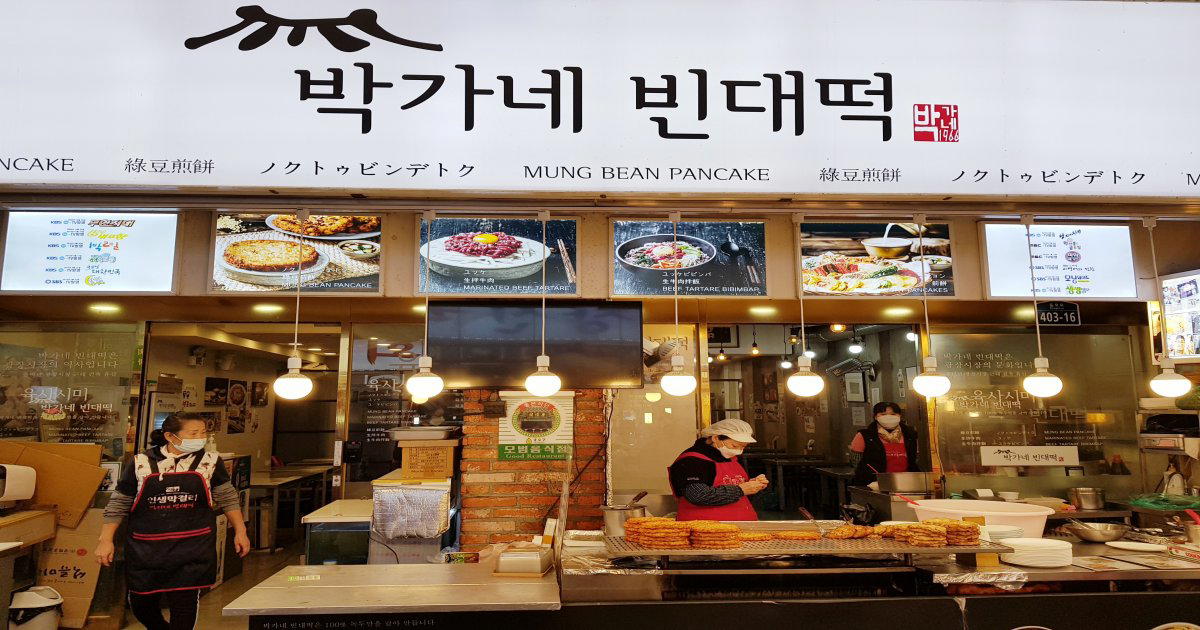
Jongno's Mung Bean Pancake Tradition and Where 박가네빈대떡 Sits Inside It
Gwangjang Market and the lanes branching off Jongno have long functioned as a living record of Seoul's working-class food culture. The stalls and small restaurants here did not survive because they were preserved as heritage attractions; they survived because the food remained useful, affordable, and good enough that locals kept returning across generations. Bindaetteok, the pan-fried mung bean pancake, is the dish most closely associated with this corridor. It is inexpensive to produce, filling, and deeply savoury in a way that owes nothing to refinement or technique-led innovation. 박가네빈대떡, at 종로구 종로32길 7, occupies a specific position in that tradition.
Jongno-gu is not the neighbourhood that Seoul's fine-dining circuit runs through. That circuit concentrates further south, in Gangnam and around Cheongdam, where Mingles, Jungsik, and Kwonsooksoo operate in an entirely different register of pricing, formality, and aspiration. The bindaetteok houses of Jongno are not in competition with those rooms, and they do not pretend to be. Their competitive set is each other, and the currency they trade in is consistency over time rather than innovation or critical recognition.
The Dish Itself: Why Bindaetteok Marks a Different Kind of Occasion
Bindaetteok is not a celebratory dish in the way that a tasting menu at Soigné or a reservation at alla prima might anchor a milestone evening. The occasion it marks is more informal: a return to the city after time away, a catch-up with someone you have known for decades, the kind of meal where the food itself is not the performance but the backdrop to something else. That makes it a meaningful choice for certain types of celebrations, specifically those where the point is familiarity rather than spectacle.
The pancake is made from ground mung beans, mixed with kimchi, pork, and green onion, then pressed flat on a cast-iron pan with enough oil to crisp the exterior while keeping the centre dense and slightly yielding. The result is not delicate. It is blunt, oily in a purposeful way, and leading eaten with makgeolli, the milky rice wine that has been served alongside it in this part of the city for as long as anyone can trace. That pairing is not incidental. The slight acidity and carbonation of makgeolli cuts through the richness of the pancake in a way that wine or beer does not replicate as cleanly. Eating bindaetteok in Jongno without makgeolli would be like ordering omakase tuna at one of Seoul's Japanese counters and asking for the rice on the side: technically possible, but missing the point of the format.
For comparison, Seoul's newer generation of Korean restaurants, such as alla prima and the innovation-focused rooms in Gangnam, have begun referencing traditional formats like bindaetteok as source material for reinterpreted dishes. That is a different project entirely from what 박가네빈대떡 does. This address is not reinterpreting anything. It is repeating something, with the consistency that repetition over time requires.
Jongno's Food Geography and the Case for Eating Here
The Jongno area around Gwangjang Market functions differently from Seoul's other food concentrations. Where Itaewon has become associated with imported formats and international dining, and where Gangnam carries the weight of fine dining ambition, Jongno's identity is rooted in continuity. The pojangmacha culture, the market stalls, and the small restaurants on the side streets represent a version of Seoul that predates the city's rapid economic transformation, and they have persisted not because they are untouched but because they have been consistently chosen.
That context matters when deciding where a particular kind of meal belongs. If the occasion calls for a room that signals status or effort, the bindaetteok houses of Jongno are not the answer. The rooms at Onjium or the contemporary Korean format at 7th Door serve that function. But if the occasion calls for a meal that connects to the city's longer memory, that can be explained to a visitor as something Seoul does that nowhere else does in quite the same way, then the calculation shifts. Bindaetteok in Jongno is the kind of meal that residents of the city tend to take visiting family to, not to impress them, but to show them something true about how the city eats when it is not trying to impress anyone.
Travellers who have spent time elsewhere in Korea will find regional parallels worth noting. Pork-focused meals in Jeju, such as those at 88돼지 or Black Pork BBQ, occupy a similar cultural role in their own geography: dishes that function as regional identifiers, eaten in rooms that have not been designed for visitors but have absorbed them anyway. The food traditions of Gyeongju operate similarly. These are not interchangeable experiences, but they share a structural characteristic: their value is inseparable from their location and continuity.
For a broader map of where 박가네빈대떡 sits within Seoul's full dining range, see our full Seoul restaurants guide. Those planning to extend the Korea itinerary beyond Seoul can cross-reference with Mori in Busan, Dining Room in Busan, or Doosoogobang in Suwon to round out the picture of how traditional Korean formats differ across cities.
Know Before You Go
- Address: 종로구 종로32길 7, Jongno-gu, Seoul (03195)
- Nearest area: Gwangjang Market corridor, Jongno
- Phone / Website: Not publicly listed; visit in person or check local platforms (Naver Map, Kakao Map) for current hours
- Booking: Walk-in format typical for this category; no reservation system confirmed
- Price tier: Budget to low-mid; bindaetteok houses in this area are among Seoul's most affordable sit-down options
- Pairing: Makgeolli (rice wine) is the conventional accompaniment; available on-site at most houses in this area
- Leading timing: Lunch and early evening see the highest foot traffic at Gwangjang-area spots; mid-afternoon tends to be quieter
Recognition, Side-by-Side
| Venue | Cuisine | Price | Awards |
|---|---|---|---|
| 박가네빈대떡This venue — the venue you are viewing | Not listed | Not listed | This venue |
| 7th Door | Korean, Contemporary | ₩₩₩₩ | Michelin 1 Star |
| Eatanic Garden | Contemporary | ₩₩₩₩ | Michelin 1 Star |
| Onjium | Korean | ₩₩₩₩ | Michelin 1 Star |
| L'Amitié | French | ₩₩₩ | Michelin 1 Star |
| Zero Complex | Korean-French, Innovative | ₩₩₩₩ | Michelin 1 Star |
Continue exploring
More in Seoul
Restaurants in Seoul
Browse all →
At a Glance
- Well Known
- Lively
- Classic
- Casual Hangout
- Solo
- Group Dining
- Standalone
- Street Scene
Busy, casual market atmosphere with a lively street-food feel and pancakes cooked to order.
Know Before You Go
- Getting there
- 종로구 종로32길 7, 종로1.2.3.4가동, 서울특별시, 서울특별시, 03195