





Open since 1903 and ranked #38 on the World's 50 Best Hotels list for 2025, The Taj Mahal Palace occupies the southern tip of Colaba with direct sightlines to the Gateway of India and the Arabian Sea. The Heritage Wing preserves the Moorish-Rajput architecture commissioned by Jamsetji Tata, while 285 rooms across two buildings place it at the top of Mumbai's luxury hotel tier. Rates from $456 per night.
 Discover on Pearl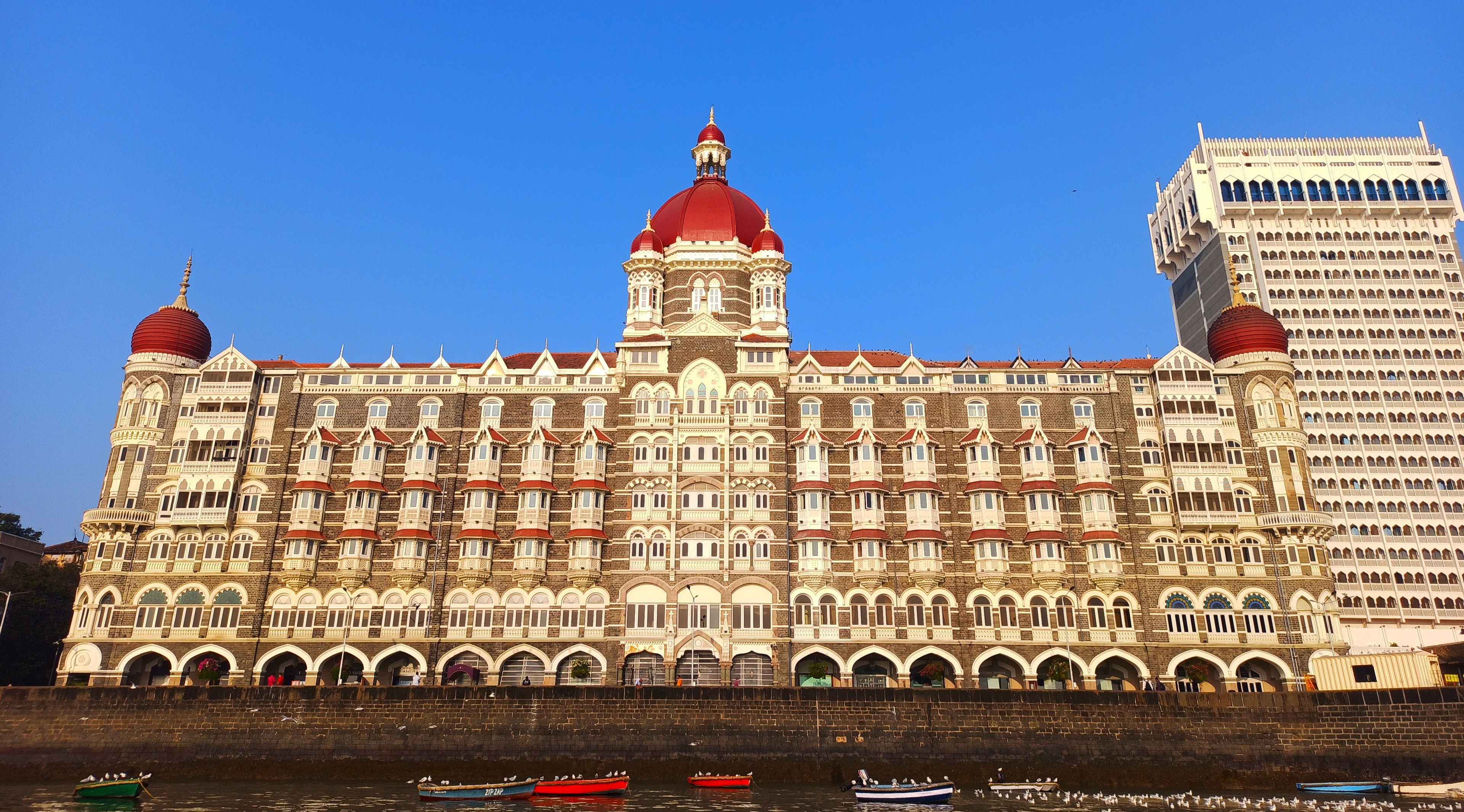
Where Colaba Meets the Arabian Sea
Approaching Apollo Bandar from the south, the silhouette you see across the water is technically the back of the building. That accident of orientation — the result, according to a story repeated in every account of the hotel's construction, of an architect who drew plans without visiting the site — means that nearly every guest-facing room in the Heritage Wing looks directly over the harbour rather than onto a service entrance. The actual front door is a discreet archway set back from the water, easy to miss if you arrive distracted by the noise and press of Colaba's streets. The layout is an anomaly in grand hotel design, and one that works entirely in the guest's favour.
The neighbourhood does a great deal of framing work before you even check in. Colaba is Mumbai's southernmost residential and commercial district, and the part of the city where the colonial administrative layer sits most visibly: the Gateway of India stands directly across the esplanade, and the surrounding streets hold a density of galleries, cafes, and small retailers that give the area a different register from the high-rise commercial districts to the north. Staying here means starting each day at the harbour and filtering into the city from its historic edge outward , a different orientation than properties near the airport clusters at Aurika Mumbai International Airport or the business-district positioning of ITC Grand Central, A Luxury Collection Hotel, Mumbai or ITC Maratha, A Luxury Collection Hotel, Mumbai.
Architecture as Historical Record
Mumbai's luxury hotel stock breaks into two broad categories: the historic grande dames with their colonial or early-nationalist architectural ambitions, and the post-liberalisation towers built for the business travel boom of the 1990s and 2000s. The Taj Mahal Palace sits firmly in the first group, and it is the property that defines the category's upper end. The dome, built on the same steel scaffolding system used for the Eiffel Tower, anchors a composition that borrows from Moorish, Rajput, and Oriental sources simultaneously , a mix that would read as incoherent in lesser hands but here reflects the particular ambition of its 1903 commissioning brief. Jamsetji Tata's founding intention was to create a property that could compete with the leading hotels in Europe without deferring to European aesthetics, and the exterior still communicates that argument.
Inside, the Heritage Wing preserves the logic of early-twentieth-century grand hotel design: high ceilings, wide corridors, materials that have aged into their surroundings rather than against them. The Tower Wing, added in 1973, operates on a different register , contemporary in finish and more straightforwardly functional. For guests whose priority is the historical character of the building, the Heritage Wing is the obvious choice, though it comes with older infrastructure. Both wings feed into the same pool courtyard, where the oval pool occupies what was reportedly the original planned entrance driveway, set within a leafy surround that functions as an effective buffer from the city outside.
What 122 Years of Operation Signals
Hotels of this age carry a specific kind of authority that newer properties cannot replicate through design alone. The Taj Mahal Palace has operated continuously since 1903, which means its guestbook covers the independence movement, Partition, the liberalisation era, and the city's transformation into a global financial centre. That continuity is verifiable in the building itself: the hotel claims a series of firsts for Mumbai, including the first electric elevators, the first telephones, and the first ice-making machine in the city. Harbour Bar, which still operates today, holds the distinction of being the first licensed bar in Mumbai and now runs speakeasy evenings from Wednesday through Sunday.
The recognition has tracked consistently into the contemporary awards cycle. In 2025, the property ranked 38th on the World's 50 Best Hotels list, and La Liste placed it at 98 points in 2026. Within the Indian luxury hotel tier, that positioning aligns it with a small group of properties that compete on historical prestige and location specificity rather than purely on room count or facilities breadth. Comparable debates about heritage versus modern luxury play out across India's hotel market , at Amanbagh in Ajabgarh, at The Oberoi Amarvilas in Agra, and at Ananda in the Himalayas in Narendra Nagar , but the Taj Mahal Palace makes the case on urban terms, embedded in the densest and most commercially active city in the country.
The Cultural Layer
Grand hotels in cities with strong art communities tend to become exhibition venues by proximity if not by design. The Taj Art Gallery operates within the hotel as a legitimate showing space for Indian artists, carrying experimental work, sculpture, and painting from emerging practitioners. The gallery occupies one of the more prestigious interior locations available to a Mumbai artist, and its programming connects the hotel to the contemporary art conversation in a city that takes that conversation seriously. The heritage walk, available daily in guided group format or privately by arrangement, maps the architectural and social history of the building in a way that makes the guest's own stay feel more legible.
During yachting season, the hotel offers sailing and harbour cruising facilities , from sunrise departures to speedboat excursions , which positions it as a departure point for the water as much as an address on the shore. The shopping arcade inside the property carries luxury retail, which compresses some of the brand access that would otherwise require travel into the commercial districts further north.
Placing It Against Mumbai's Luxury Field
Mumbai's leading hotel tier is competitive enough that positioning matters. Properties like InterContinental Marine Drive-Mumbai work the Marine Drive waterfront with a more contemporary format, while Soho House Mumbai targets a creative-industry membership-driven cohort that operates on entirely different terms. Within the Taj Hotels portfolio itself, Taj Lands End, Mumbai and the adjacent Taj Mahal Tower, Mumbai address different parts of the city and different guest priorities. The Leela Mumbai competes at a similar price point with a different architectural language and neighbourhood position.
What the Palace offers that none of these alternatives can replicate is the specific weight of the Colaba address combined with the 1903 building. For guests extending an India itinerary that includes properties like The Johri, Jaipur, Suján Jawai in Pali, Alila Fort Bishangarh in Manoharpur, or Aman-i-Khas in Ranthambore, the Palace functions as the logical urban anchor , a property that participates in the same conversation about Indian architecture and cultural identity as the smaller, more landscape-focused properties, but on the terms of a working city. For those arriving from or departing to international addresses , say, Aman New York, The Fifth Avenue Hotel in New York City, or Aman Venice , it holds its position in that tier with little difficulty.
Planning Your Stay
Rates start at $456 per night, with the property spread across 285 rooms divided between the Heritage Wing and the 1973 Tower Wing. Rooms facing the Arabian Sea and the Gateway of India are the clear priority booking , the harbour views are the primary spatial argument for the Colaba address. Traffic around Apollo Bandar can concentrate significantly during peak hours and around major events, so building extra time into any ground transfers is advisable. The Taj Mahal Palace operates under the Indian Hotels Company Limited (Taj Hotels). For context on how it fits within Mumbai's broader hotel and dining offer, see our full Mumbai hotels guide, full Mumbai restaurants guide, full Mumbai bars guide, full Mumbai experiences guide, and full Mumbai wineries guide. For guests planning a wider India circuit, Amaya in Solan and Aurika Udaipur - Luxury by Lemon Tree Hotels represent different price registers in the broader network.
Frequently Asked Questions
Comparable Options
A quick look at comparable venues, using the data we have on file.
Preferential Rates?
Our members enjoy concierge-led booking support and priority upgrades at the world's finest hotels.
Get Exclusive Access