


Michelin Guide New Hotels New Hotel · Michelin Selected · La Liste Top Hotels
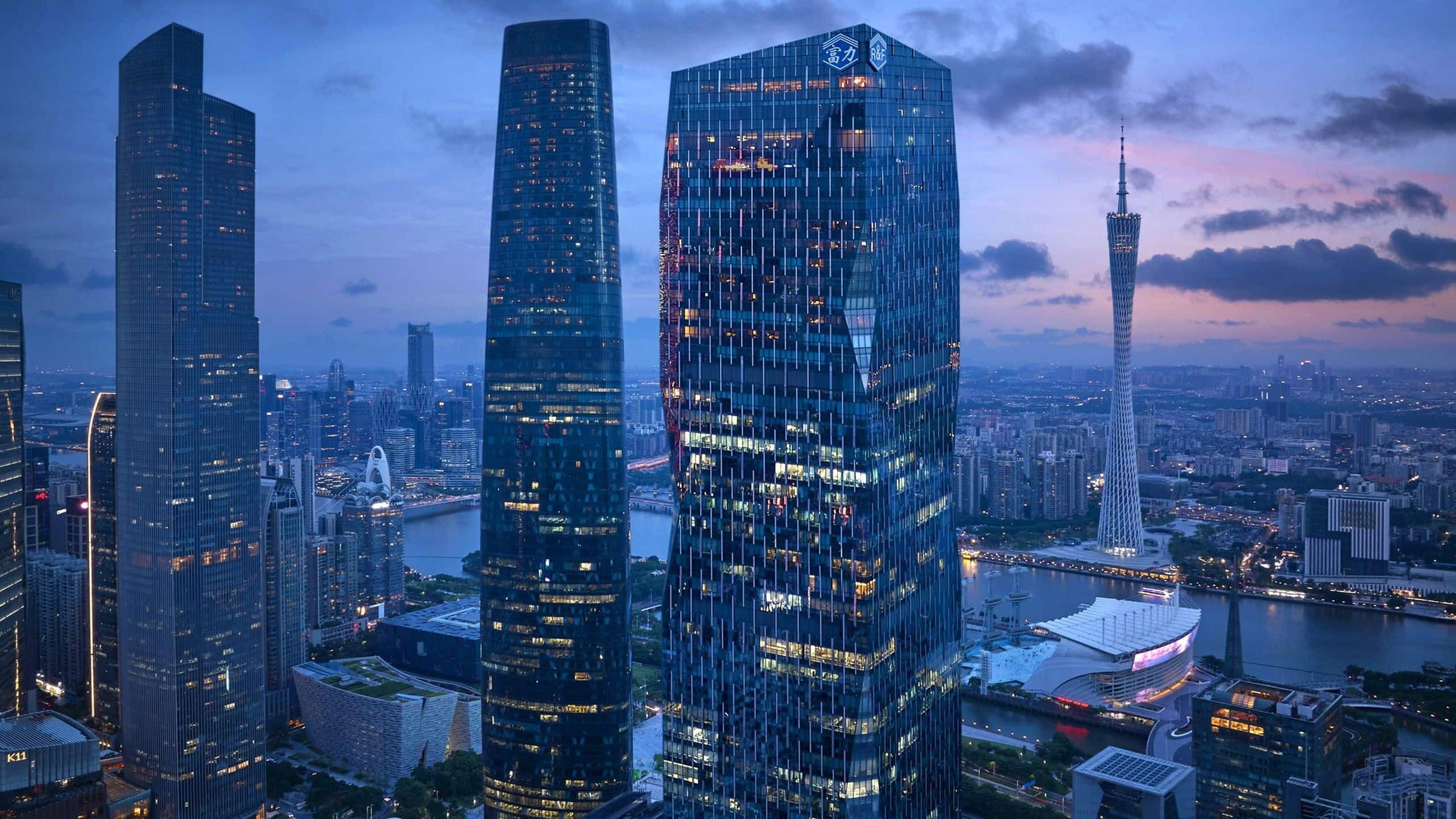
In Pearl River New City, Tianhe District, The Ritz-Carlton, Guangzhou positions classic European elegance against the district's hypermodern skyline, threading Chinese decorative detail through every public space and guest room. Rated 98 points on the La Liste Top Hotels 2026 ranking, it operates with a full-service spa, 24-hour fitness facilities, and the Cantonese dining room Lai Heen as its flagship. The property draws business travellers and families in roughly equal measure, with programming designed to accommodate both.

Pearl is the En Primeur Club membership app — saves, bookings, and concierge access live there. Same editors, same standards.
- Address
- 3 Xing An Lu, Tian He Qu, Guang Zhou Shi, Guang Dong Sheng, 510623
- Phone
- +86 20 3813 6688
- Directions
- Get directions
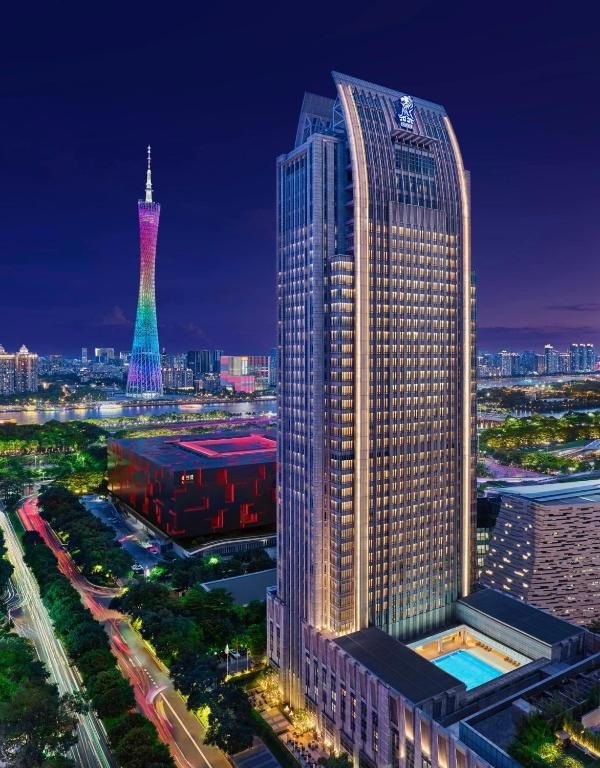
Where European Formality Meets Pearl River New City
Pearl River New City, Guangzhou's central business district in Tianhe, presents one of the more striking contrasts in contemporary Chinese urban hospitality: glass-and-steel towers climbing fast above a river that has anchored trade here for centuries. The international hotel brands that have planted flags in this district face a specific challenge — how to project international luxury without reading as simply generic. The Ritz-Carlton, Guangzhou, positioned steps from the Pearl River on Xing An Road, addresses that question through a deliberate layering of European classical structure with Cantonese decorative language, and the approach shows up at every scale, from the wallpaper patterns in corridors to the woodcarvings inside Lai Heen, its flagship dining room.
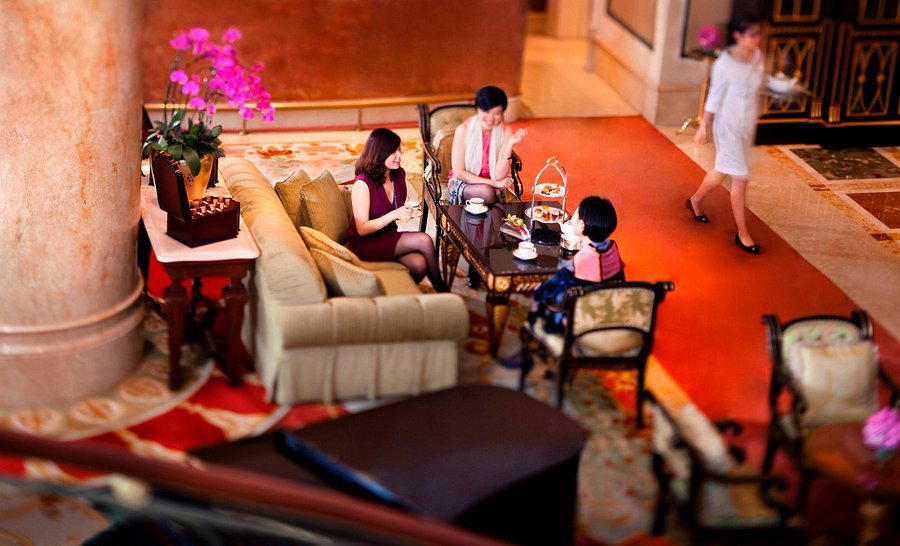
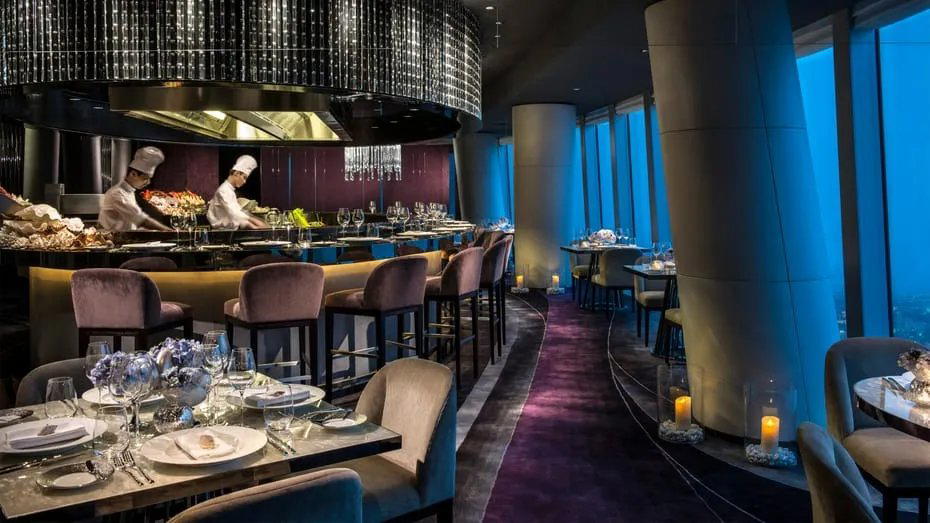
The lobby, anchored by the Pearl Lobby, signals the tone immediately. A piece of imperial embroidery on the wall is not a decorative afterthought — it functions as an orientation device, telling arriving guests that this is not a neutrally international space. Vases, lacquerwork, and woodcarvings are distributed across the public areas with enough specificity to reward attention. The property was also conceived with feng shui principles informing spatial arrangement, a consideration that places it in a different category from properties where Chinese aesthetic elements are applied purely at the surface level. Among the Four Seasons Hotel Guangzhou, the Mandarin Oriental, Guangzhou, and the Park Hyatt Guangzhou, the tier of full-service international luxury that competes for the same corporate and leisure traveller, the Ritz-Carlton's interiority is among the more consciously curated.
The Menu Architecture of Lai Heen
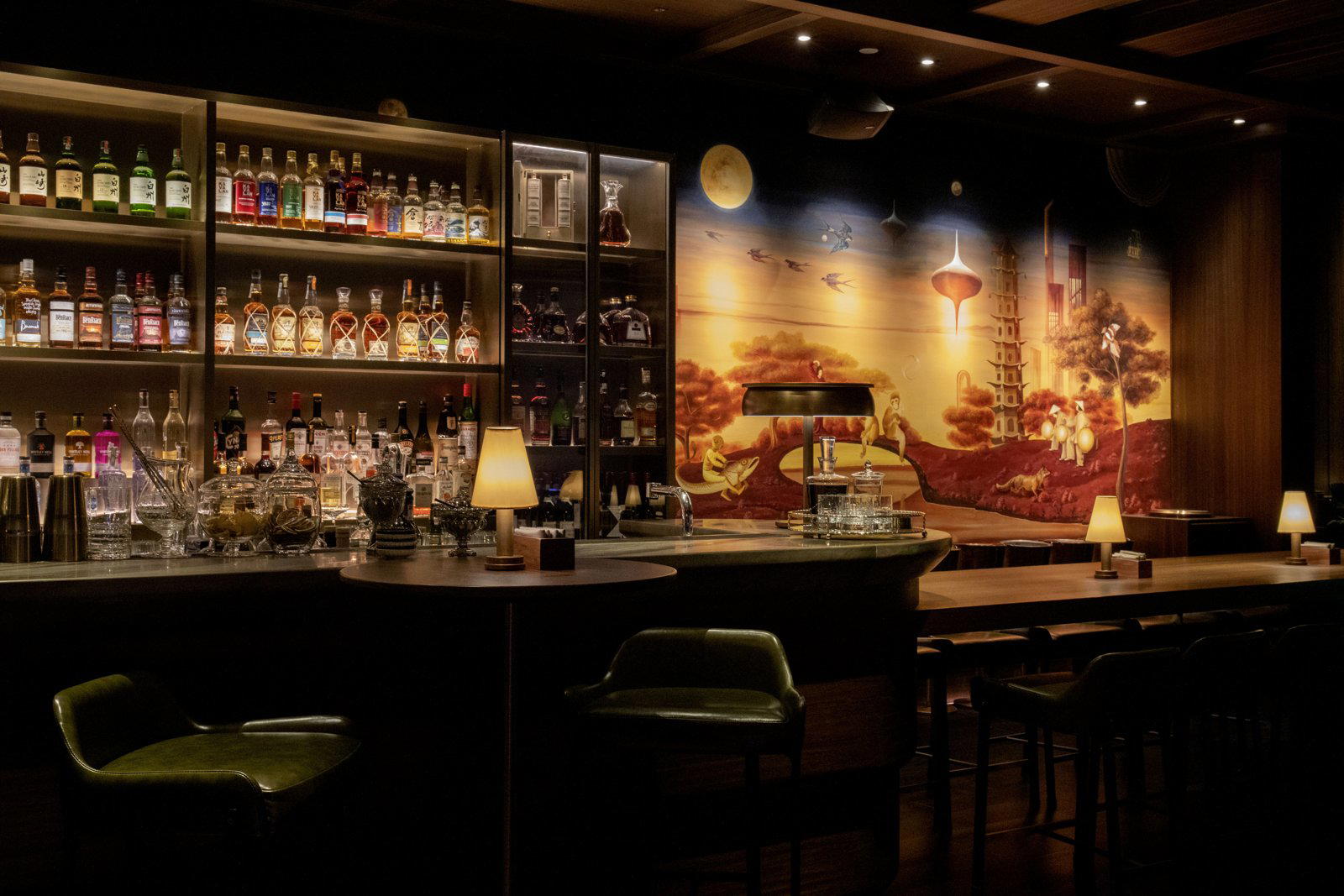
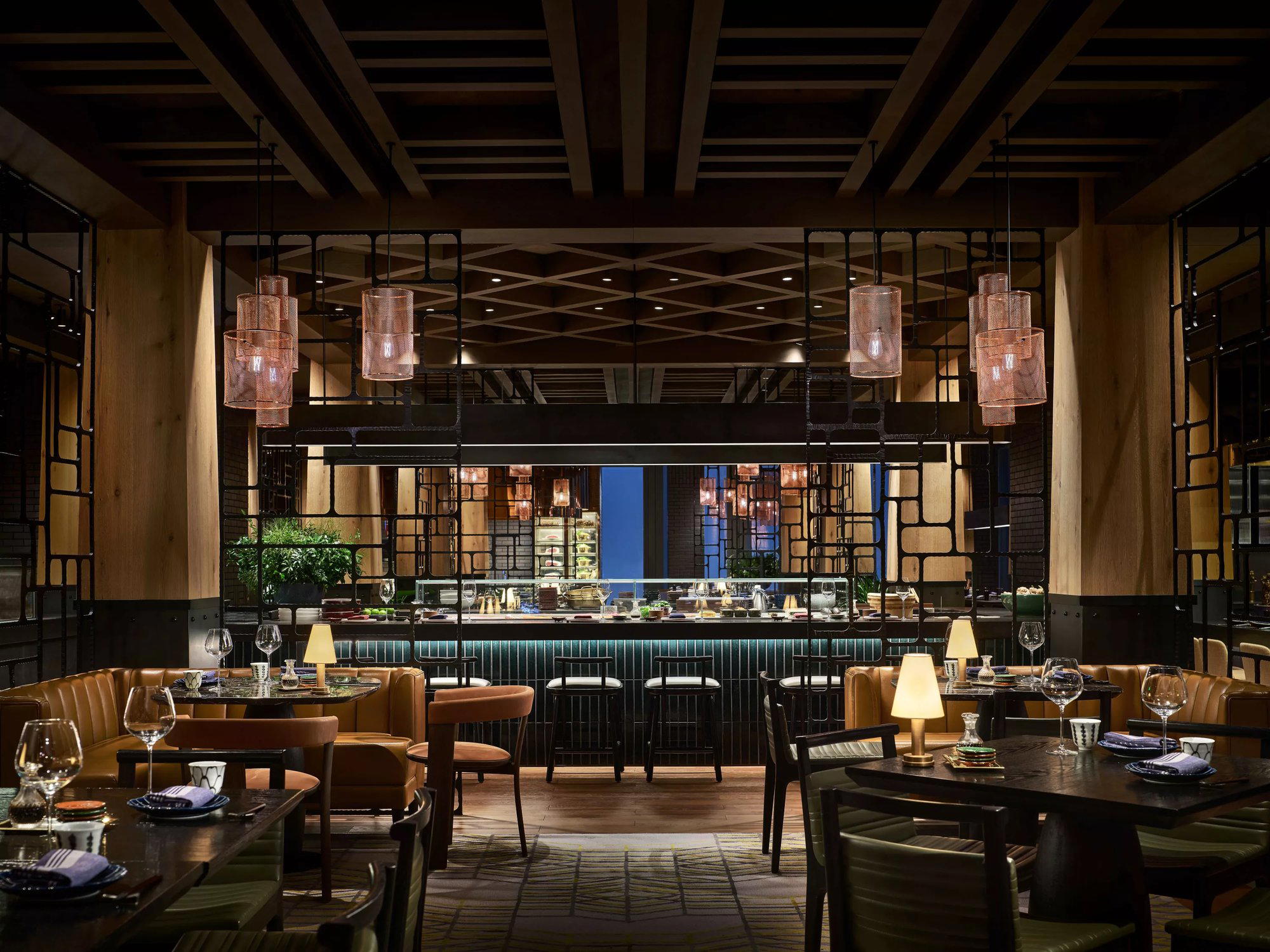
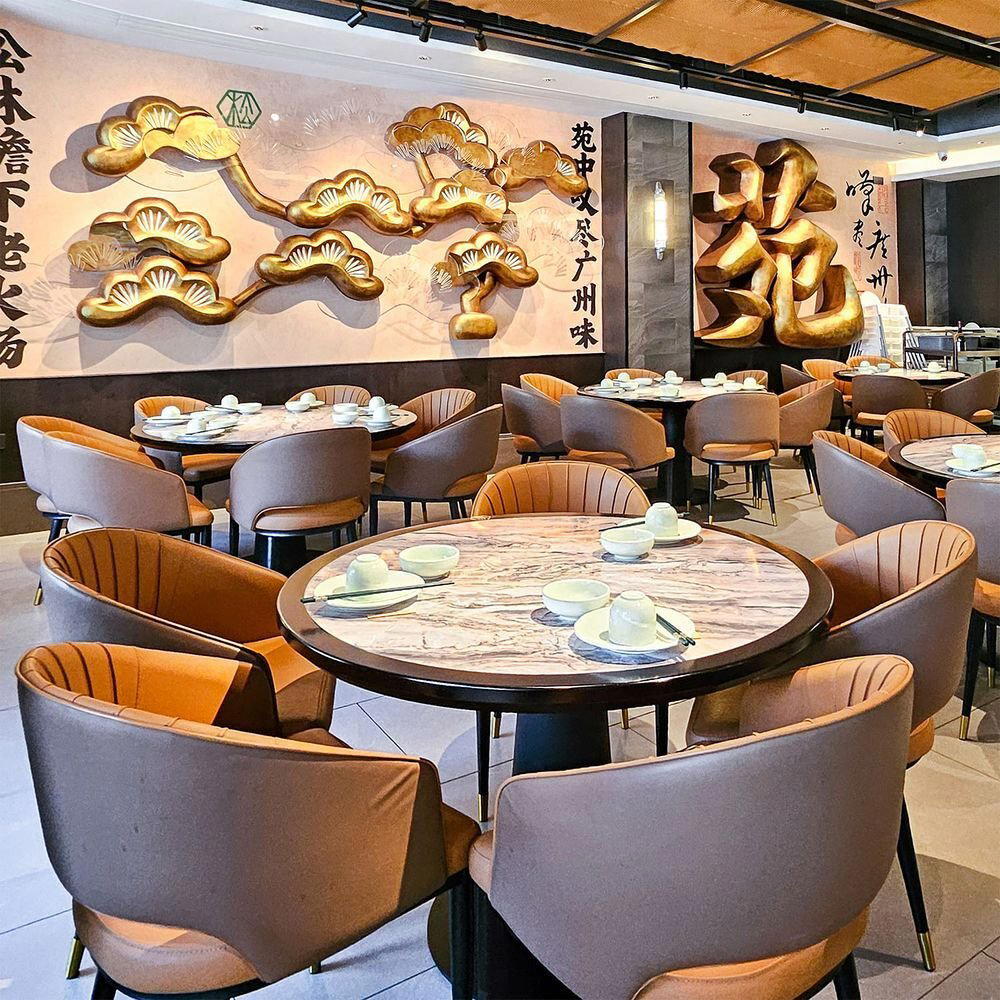
Cantonese cuisine in Guangzhou operates at a different register than its international diaspora versions. The city is the source, not the export, and the dining rooms that take it seriously here are judged by local diners who have grown up eating dim sum prepared by cooks trained across decades. Lai Heen, the Ritz-Carlton's Cantonese restaurant, occupies a position that places it inside that local conversation, not above it. The dining room's woodcarvings and Chinese landscape wallpaper position the space as an argument about seriousness, this is not a hotel restaurant offering pan-Asian cover, but a room designed around a specific culinary tradition.
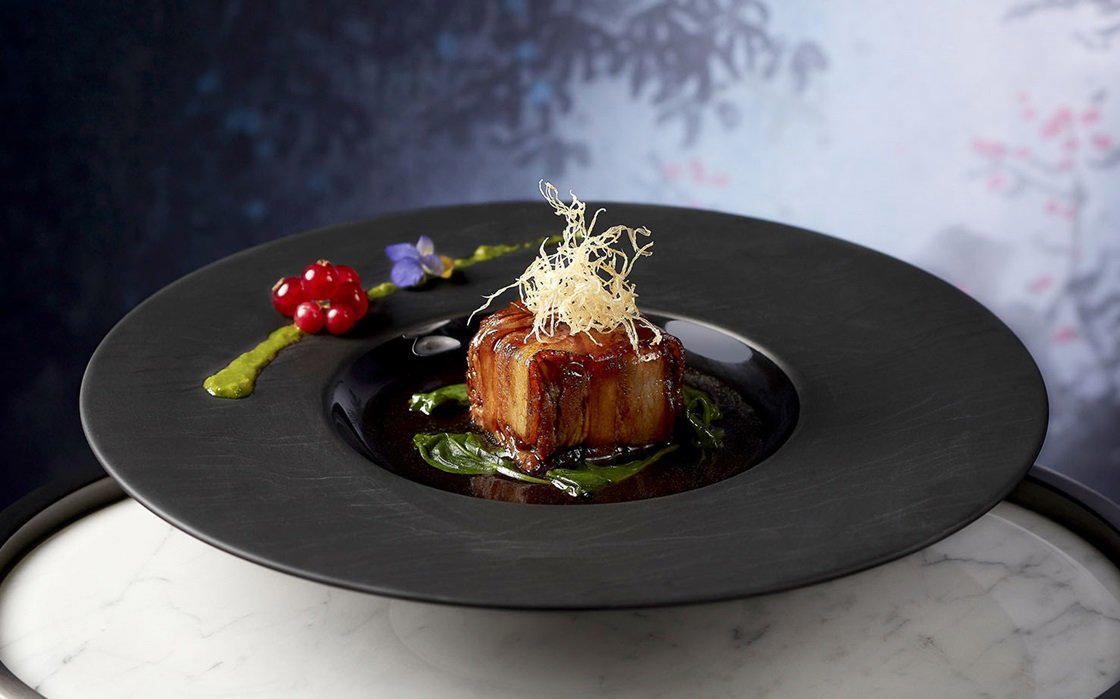
What the structure of a Cantonese menu in this tier typically reveals is a balance between classic preparations, roast meats, steamed whole fish, dim sum served from trolley or to order, and seasonal adjustments that reflect the market availability driving Guangdong cooking. The region's subtropical climate means produce and protein cycles move faster than in northern China, and menus in high-end Cantonese rooms tend to reflect that rhythm. For visitors travelling from abroad, the most useful framing is this: what you encounter at Lai Heen will be calibrated for Guangzhou's own standards, not for what a tourist audience might expect Cantonese food to be. That is, broadly speaking, a better position to be eating from.
The property also positions itself family-friendly with explicit infrastructure: children's menus, dedicated welcome amenities for younger guests, and curated activity options. This suggests that the food and beverage program, including Lai Heen, is designed to accommodate multi-generational tables, a format that aligns naturally with how many Chinese families approach hotel dining during peak travel periods.
The Rooms: Classical European Form with Cantonese Inflection
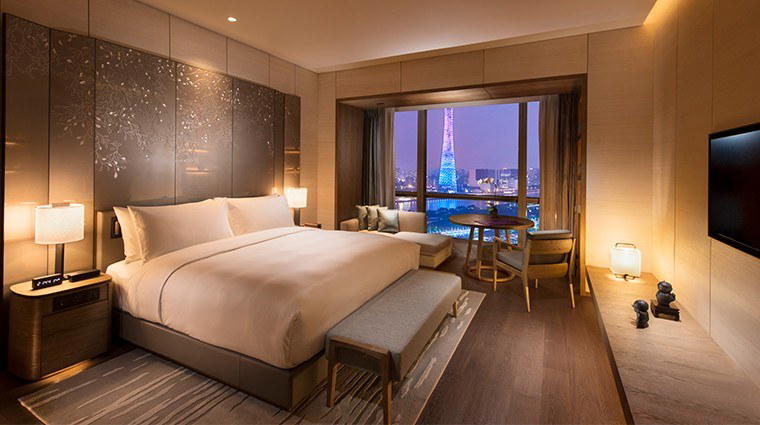
Guest rooms at the Ritz-Carlton, Guangzhou work from a base of ivory walls with crown molding, a palette that reads as European classical and provides the neutral ground against which Chinese-inflected detail registers clearly. The colour range across rooms, running through gold, rust, muted green, and light blue, means no two rooms are identical in atmosphere, even where floor plans repeat. Beds sit high against wooden headboards with crisp white linens, striped bolsters, and coverlets carrying Chinese-style embroidery. Swag drapery with tassel trim frames windows that run close to floor-to-ceiling height, and the outlook is either the Tianhe city grid or the Pearl River depending on aspect.
In October 2018, to mark the property's tenth anniversary, the hotel unveiled a Premium Room category with 400-thread-count linens, mahogany-lined walk-in closets, and 55-inch smart televisions. All rooms include walk-in closets as standard, along with marble bathrooms offering double sinks, a separate shower, and a deep soaking tub. Bedside control panels manage temperature, lighting, and audio, which matters in a city where business guests arrive late and need to recalibrate quickly.
Travellers choosing between this property and peers such as the Conrad Guangzhou or the Jumeirah Guangzhou will find the Ritz-Carlton's room design the most overtly referential to Chinese material culture, which is either a differentiator or a detail of neutral significance depending on the traveller. For guests staying multiple nights, the texture of those choices accumulates.
Facilities and the Physical Program
The fitness and wellness offer at the Ritz-Carlton, Guangzhou runs through a 24-hour fitness centre with an outdoor heated pool and a yoga studio, plus a spa rated Four Stars and operating across 11 private treatment rooms. The 24-hour gym access is a practical consideration in a city where corporate schedules skew late and early, and where business travel from Southeast Asia and Hong Kong means arrivals at irregular hours. The outdoor heated pool extends the property's usable outdoor time past the cooler winter months that Guangzhou occasionally produces, though the city's humid subtropical climate makes the pool a reasonable bet for most of the calendar year.
The Langham Place, Guangzhou and Hilton Guangzhou Baiyun Airport represent different points in the market, the Langham sitting squarely in the Tianhe luxury tier, the Hilton positioned for airport transit rather than city-centre stays. Among the city-centre luxury set, the Ritz-Carlton's wellness footprint, dedicated yoga studio, 11 treatment rooms, is proportionally generous, suggesting a guest profile that treats the spa as a functional part of a longer stay rather than an amenity used once.
Timing, Location, and Planning
Lunar New Year period, typically spanning late January into February, compresses movement across Guangdong Province into one of the world's largest annual human migrations. Guangzhou's airports and train stations during this window operate at capacity, and arrivals and departures need more buffer time than at any other point in the year. For travellers whose Guangzhou visit overlaps with this period, the hotel itself becomes more central to the experience, Pearl River New City is walkable to significant parts of the Tianhe commercial district, and the property's position on Xing An Road puts it within reach of the river promenade without requiring transit.
For broader context on dining and city orientation, our full Guangzhou restaurants guide covers the city's dining scene at neighbourhood level. Travellers using Guangzhou as a transit point between other Chinese cities may find useful reference points in the Mandarin Oriental Qianmen in Beijing, JW Marriott Hotel Shanghai at Tomorrow Square in Shanghai, or further afield at properties like the Amanfayun in Hangzhou and the Amandayan in Lijiang for a different register of Chinese luxury. Those travelling internationally before or after might consider the Aman Venice or Aman New York for the same general price category in different contexts, or the The Fifth Avenue Hotel in New York City for a classical-luxury comparison point. Within China's wider hotel scene, the Xiamen Yunding Resort, 1 Hotel Haitang Bay, Sanya, and the Altira Macau each represent distinct regional hospitality registers worth understanding in relation to a Guangzhou base.
Among the Guangzhou luxury hotels that compete on similar criteria, it sits consistently in the reference group alongside the LN Hotel Five and others that approach city-centre luxury with different ownership philosophies. For China-wide travellers building a longer itinerary, properties like the Hyatt Place Nanjing Xuanwu, Vanke Lake Songhua Yunlu Hotel in Jilin, or the Mohe Youran Mountain Residence and Beidahu Asian Games Village illustrate how far the country's hospitality register shifts across geographies. The Green Lake Hotel Kunming and Huyi District in Xi'an offer further reference points for travellers building a multi-city China circuit.
Comparable Spots, Quickly
Comparable venues nearby, for context on price, style, and recognition.
| Venue | Cuisine | Price | Awards | Notes |
|---|---|---|---|---|
| The Ritz-Carlton, GuangzhouThis venue — the venue you are viewing | Modern luxury high-rise with renovated Club Lounge and suites | $300–500 | Michelin Guide New Hotels New Hotel · Michelin Selected | Not listed |
| White Swan Hotel | Luxurious urban resort with heritage charm on Shamian Island | Not listed | Star Wine List | Shamian Island |
| ME Guangzhou | Lifestyle luxury hotel positioned as a cultural hub within Guangzhou’s emerging second CBD. | Not listed | Not listed | Guangzhou International Financial City–Huangpu Bay Business Circle |
| Mandarin Oriental, Guangzhou | Contemporary luxury with spacious accommodations and integrated shopping access | $300–500 | Michelin Selected · La Liste Top Hotels | Guangzhoushi |
| Conrad Guangzhou | Contemporary luxury urban hotel blending cutting-edge technology with traditional Guangzhou architectural heritage, positioned as a stylish oasis in the CBD. | $100–200 | Michelin Selected · Forbes Recommended | Guangzhoushi |
| Shangri-La Hotel, Guangzhou | Contemporary luxury with Oriental-inspired decor | $200–300 | Forbes Recommended | Guangzhoushi |
Recognition history
Dated appearances from independent guides and award organizations, with the underlying list record or original source where available.
Michelin Guide New Hotels New Hotel
Michelin Guide New Hotels
Michelin Selected
Michelin
La Liste Top Hotels
La Liste
Forbes 5-Star
Forbes
Full recognition history (5 entries)
Forbes 5-Star
Forbes
Details
- Elegant
- Sophisticated
- Ornate
- Classic
- Business Trip
- Romantic Getaway
- Anniversary
- Rooftop Pool
- Panoramic View
- Butler Service
- Pool
- Spa
- Fitness Center
- Room Service
- Concierge
- Business Center
- Valet Parking
- Skyline
- Waterfront
- Wheelchair Accessible
- Elevator
- Step Free Entrance
- Accessible Parking
Elegant and sophisticated with plush furnishings, marble bathrooms, and city/river views from floor-to-ceiling windows.