


1 Michelin Key · La Liste Top Hotels · Forbes Recommended
Four Seasons Hotel Guangzhou occupies floors 74 to 100 of the 103-story Guangzhou International Finance Centre, directly above the Pearl River in the Tianhe District. Its five dining venues span Cantonese dim sum, Japanese cuisine, and a seafood restaurant on the 100th floor. The hotel earned 90.5 points on La Liste's Top Hotels 2026 ranking and holds 344 rooms with floor-to-ceiling Pearl River views.

Pearl is the En Primeur Club membership app, where members save venues, book tables and use the concierge.
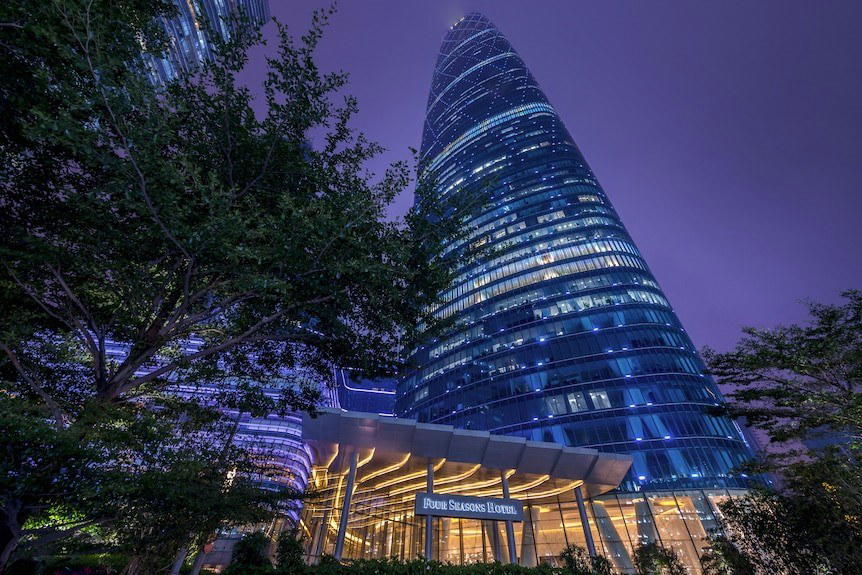
Above the Pearl River: Dining at Altitude in Guangzhou's Tianhe District
The Guangzhou International Finance Centre rises 103 stories above Pearl River New City, and the Four Seasons Hotel Guangzhou occupies its leading thirty floors, from the 74th to the 100th. Approaching from street level, the tower reads as one vertical statement in a district that has assembled, over the past two decades, one of China's more concentrated clusters of high-rise architecture: the Guangzhou Opera House sits within walking distance, the Canton Tower rises directly across the water. The hotel does not compete with these landmarks so much as it places itself inside the same conversation. Every guest room has floor-to-ceiling windows oriented to the Pearl River or the broader cityscape, and at this altitude the distinction between interior and exterior begins to feel nominal.
Guangzhou's luxury hotel market has deepened considerably since this district's development began. The Rosewood Guangzhou, the Mandarin Oriental, Guangzhou, and the Park Hyatt Guangzhou all operate within a similar tier, each staking a position through design, F&B; programming, or address. The Four Seasons places its claim largely through vertical positioning and the breadth of its dining programme, which spans five distinct venues across multiple floors. La Liste's 2026 Leading Hotels ranking placed the property at 90.5 points, a data point that situates it comfortably within the upper bracket of Guangzhou luxury options.
The Dining Programme: Five Venues, Three Culinary Traditions
In Chinese luxury hotels, the dining programme is rarely an afterthought. It functions as a primary signal of the property's seriousness, and the Four Seasons Guangzhou has assembled one that covers considerable range. The five venues do not attempt to be everything, they are organised around distinct culinary traditions with enough spatial and conceptual separation to feel like genuinely different experiences rather than variations on a hotel-restaurant formula.
Yu Yue Heen: Cantonese at the Core
Cantonese cuisine, and dim sum specifically, is not incidental to Guangzhou, the city is its origin point, and any serious hotel in this market needs a credible Cantonese address. Yu Yue Heen occupies that position here, designed in black and red lacquer with a visual register that signals formality without heaviness. Dim sum service is the draw that inspectors consistently single out, and in a city where the standard for this format is set by dedicated teahouses that have been operating for generations, that is a meaningful endorsement. For context on Guangzhou's broader dining scene, see our full Guangzhou restaurants guide.
Kumoi: Japanese Precision on a High Floor
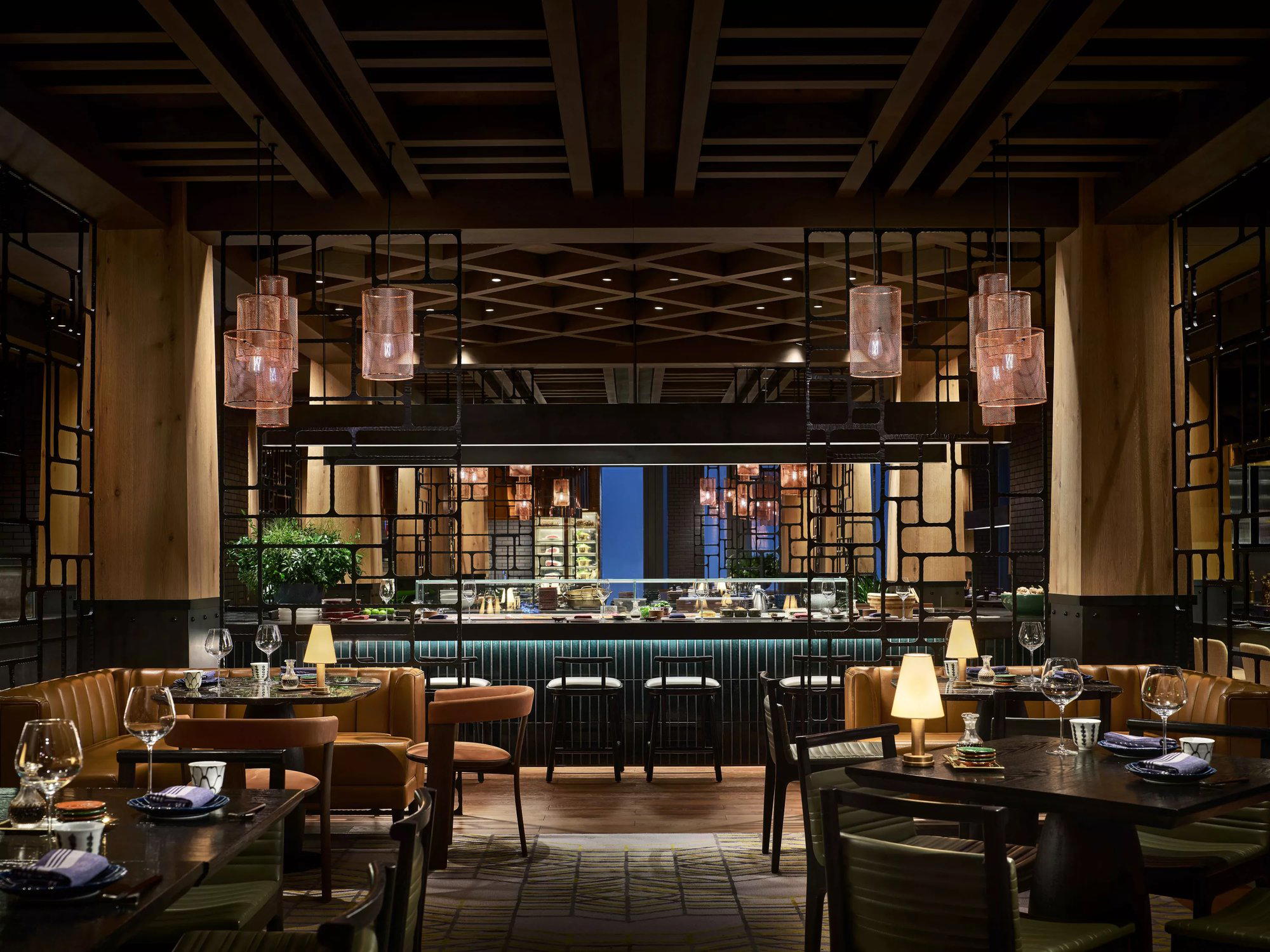
Japanese hotel restaurants at this level in mainland China tend to follow a predictable formula: sushi counter, teppanyaki, a few signature rolls. Kumoi, which operates under chef Masannobu Hoshina, moves past that baseline. The format covers sushi, grilled items, and tempura within a modernist setting, and Hoshina's presence gives the programme a named culinary anchor that places it within a more accountable tradition. This kind of Japanese-at-altitude positioning appears at comparable properties across Chinese gateway cities, the JW Marriott Hotel Shanghai at Tomorrow Square and the Mandarin Oriental Qianmen in Beijing operate with similar F&B; ambitions, but execution at individual properties varies substantially.
Catch: Seafood on the 100th Floor
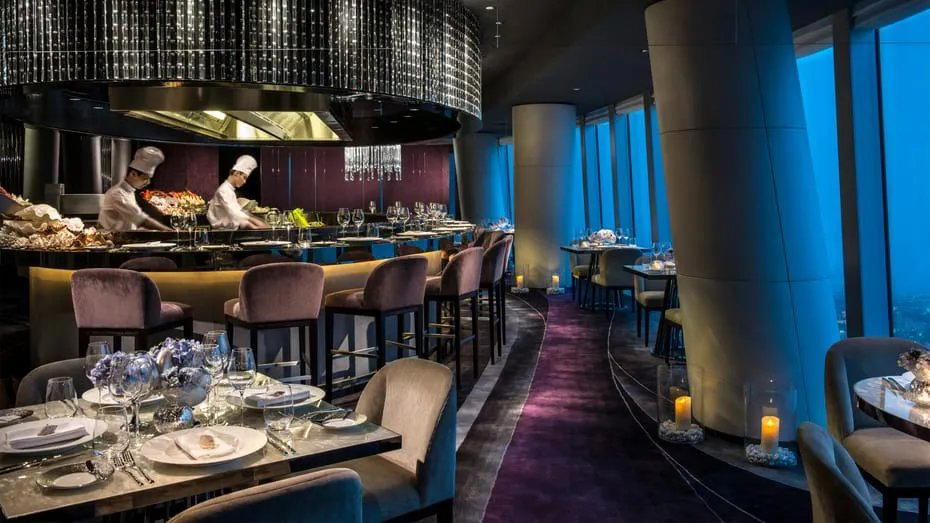
Catch sits on the 100th floor and functions as the hotel's headline dining room. In a building that has no shortage of refined perspectives, the 100th floor still registers differently: at this height, the Pearl River reads as a navigational line through the city rather than a body of water. The dining room is done in gold, grey, and purple, and the menu centres on seafood sourced internationally. The altitude is not incidental to the concept, it is the concept, and the kitchen programme is designed to hold up to the view rather than compete with it. This puts Catch in a specific category of destination dining where address and experience are inseparable from the food itself.
Caffe Mondo and the Atrium Bars
The remaining venues operate at a different register. Caffe Mondo is the all-day dining room, positioned as the casual option in the hotel's F&B; mix, with a predominantly Western menu anchored in Italian cooking and a modernist white interior that reads as deliberately low-key by comparison to the hotel's other rooms. It is, according to inspector notes, the appropriate destination for families with children.
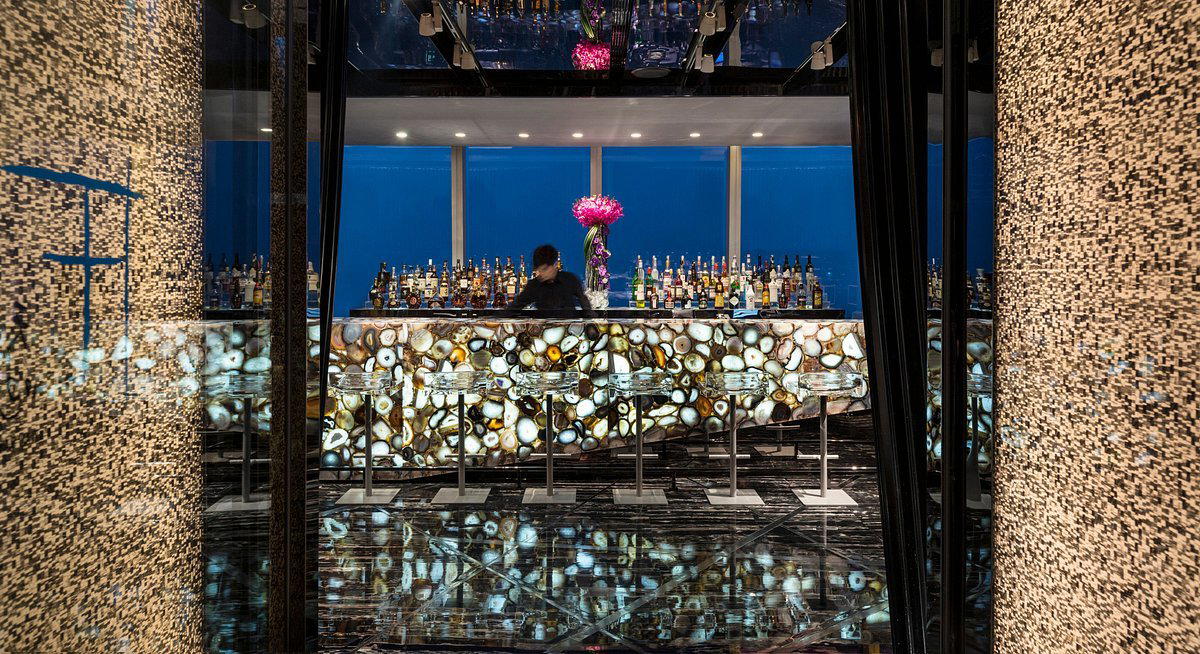
The bar programme splits across two floors. The Atrium Lounge on the 70th floor handles drinks, coffee, and afternoon tea service, occupying a transitional position between the lobby experience and the upper-floor dining venues. Tian Bar, on the 99th floor, is the evening destination: a high-altitude room with cold and warm tapas on the menu, though most guests arrive primarily for the views. The positioning of Tian Bar one floor below Catch creates a natural F&B; sequence for guests who want to move through the evening rather than commit to a single destination.
The Rooms: Skybox Logic
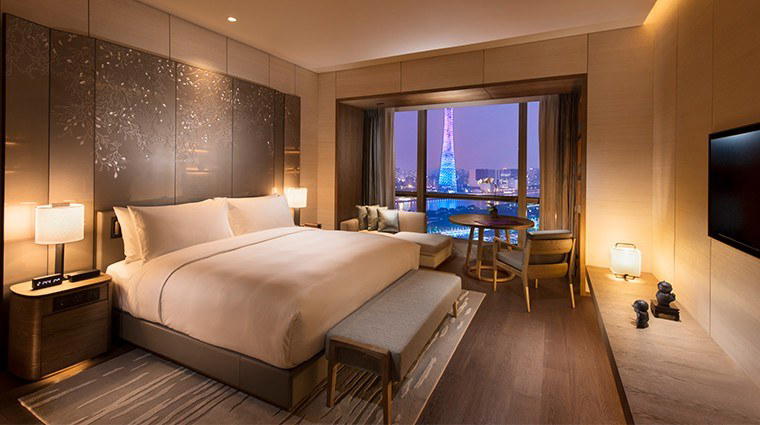
344 guest rooms occupy floors 74 through 98, with every room oriented to floor-to-ceiling windows. The interior palette runs to grey, ivory, and taupe, with teal or plum upholstery providing the accent layer in seating areas and a layered blue carpet that draws an explicit reference to traditional Chinese landscape painting. Grey leather headboards frame beds dressed in ivory cotton. Workspaces include glass writing desks and swivel chairs. A black lacquered console conceals the minibar. The bathrooms are finished in marble and include a deep soaking tub, sized and positioned to make the most of the floor-height windows.
Most comparable approach to rooms-as-viewpoints appears at high-rise properties in other Chinese megacities, including the 1 Hotel Haitang Bay, Sanya, where the relationship between room and horizon is similarly central to the guest proposition. Properties with a more grounded, materials-led design philosophy, such as Amandayan in Lijiang or Amanfayun in Hangzhou, operate from a fundamentally different premise about what luxury accommodation should feel like in China.
The Neighbourhood and When to Come
Pearl River New City is Guangzhou's principal contemporary district, it is where the significant architecture has landed, where the financial institutions operate, and where the city's newer cultural infrastructure has been placed. The Guangzhou Opera House is within reach, and the Canton Tower, across the river, provides an orientation point from most rooms. The surrounding area reads as a construction-in-progress in the leading sense: dense, purposeful, and still accumulating. Older city neighbourhoods, including the historic centre with its different architectural character and street-level dining density, are approximately ten minutes by taxi, giving the hotel useful proximity to a contrasting urban register.
Guangzhou's climate demands some planning. Late autumn is the most comfortable window: lower humidity and moderate temperatures make exterior movement easier. Summer months bring heat, humidity, and a rain-heavy period in late spring and early summer; typhoons from the South China Sea are a seasonal consideration. Lunar New Year produces significant airport congestion at Baiyun International, which sits 30 to 45 minutes from the hotel by car. Guangzhou East Railway Station is approximately ten minutes away, and the Metro connects directly from the surrounding district, making the property accessible without car dependency for those arriving from within the Pearl River Delta network.
Other Guangzhou options at different price points or with distinct positioning include the Conrad Guangzhou, the Jumeirah Guangzhou, the Langham Place, Guangzhou, and the LN Hotel Five. For travellers whose itinerary involves the airport rather than the city centre, the Hilton Guangzhou Baiyun Airport serves a different logistical need. Elsewhere in China, properties with notable vertical ambition or similarly complex F&B; programmes include the Xiamen Yunding Resort in Xiamen and, for a very different climate and setting, the Vanke Lake Songhua Yunlu Hotel in Jilin. Further afield, the Mohe Youran Mountain Residence in Da Hinggan Ling, the Green Lake Hotel Kunming, and the Beidahu Asian Games Village represent the range of Chinese hospitality at distinct ends of the landscape spectrum. For international reference points in high-rise urban luxury, the Aman New York, the The Fifth Avenue Hotel, and the Aman Venice each illustrate different configurations of the same fundamental proposition: that address and altitude are, in premium hospitality, a product in themselves. The Altira Macau and the Hyatt Place Nanjing Xuanwu round out the regional comparison set. Finally, for those whose Guangzhou stay connects to a broader southwest China itinerary, the Huyi District in Xi An offers a useful gateway to the interior.
Planning Notes
The hotel holds 344 rooms across thirty floors. Baiyun International Airport is 30 to 45 minutes by car; Guangzhou East Railway Station is ten minutes. Metro access is direct from the Pearl River New City area. Late autumn (October through early December) represents the most dependable weather window. Avoid the Lunar New Year period if flight connections are part of the trip, given the airport volume that the holiday generates regionally.
Price and Recognition
Comparable venues nearby, for context on price, style, and recognition.
| Venue | Price | Awards | Notes |
|---|---|---|---|
| Four Seasons Hotel GuangzhouThis venue (the venue you are viewing) | $300–500 | 1 Michelin Key · La Liste Top Hotels | Not listed |
| Park Hyatt Guangzhou | $200–300 | Michelin Selected · Forbes Recommended | Guangzhoushi, Contemporary luxury high-rise with residential design elements and art deco influences; positioned as an urban sanctuary above the city. |
| Rosewood Guangzhou | $200–300 | 2 Michelin Keys · La Liste Top Hotels | Guangzhoushi, ultra-luxury urban tower hotel blending modern sophistication with Chinese artistry |
| White Swan Hotel | Not listed | Star Wine List | Shamian Island, Luxurious urban resort with heritage charm on Shamian Island |
| Vaperse Hotel | $1–100 | Michelin Selected | Zhujiang New Town, condo design style fashion elegant refined and comfortable |
| The Ritz-Carlton, Guangzhou | $300–500 | Michelin Guide New Hotels New Hotel · Michelin Selected | Guangzhoushi, Modern luxury high-rise with renovated Club Lounge and suites |
Recognition history
Dated appearances from independent guides and award organizations, with the underlying list record or original source where available.
Michelin 1 Key
Michelin
La Liste Top Hotels
La Liste
Forbes Recommended
Forbes
Full recognition history (5 entries)
Forbes Recommended
Forbes
Michelin 1 Key
Michelin
Continue exploring
More in Guangzhou
Hotels in Guangzhou
All hotels in Guangzhou →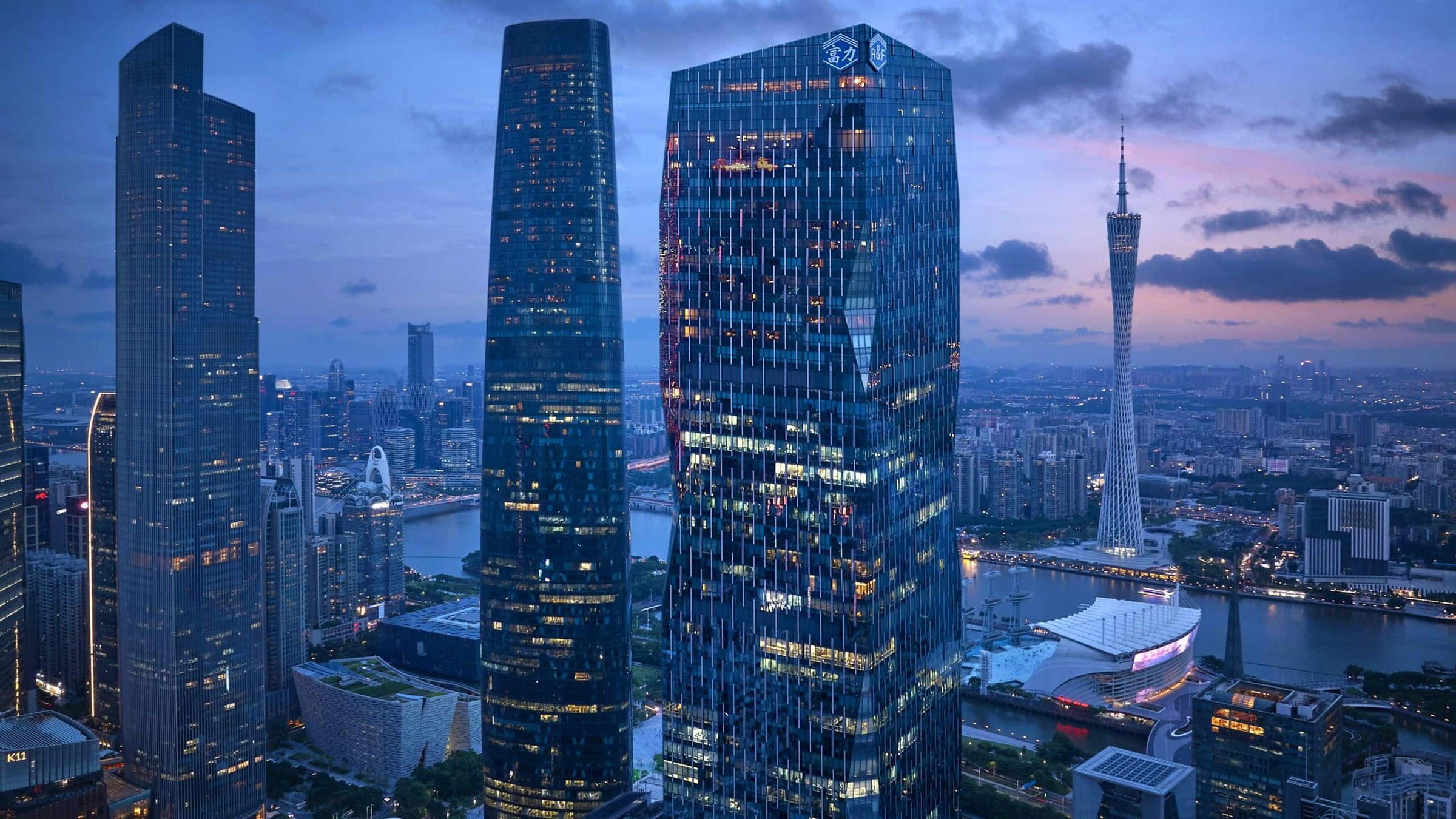
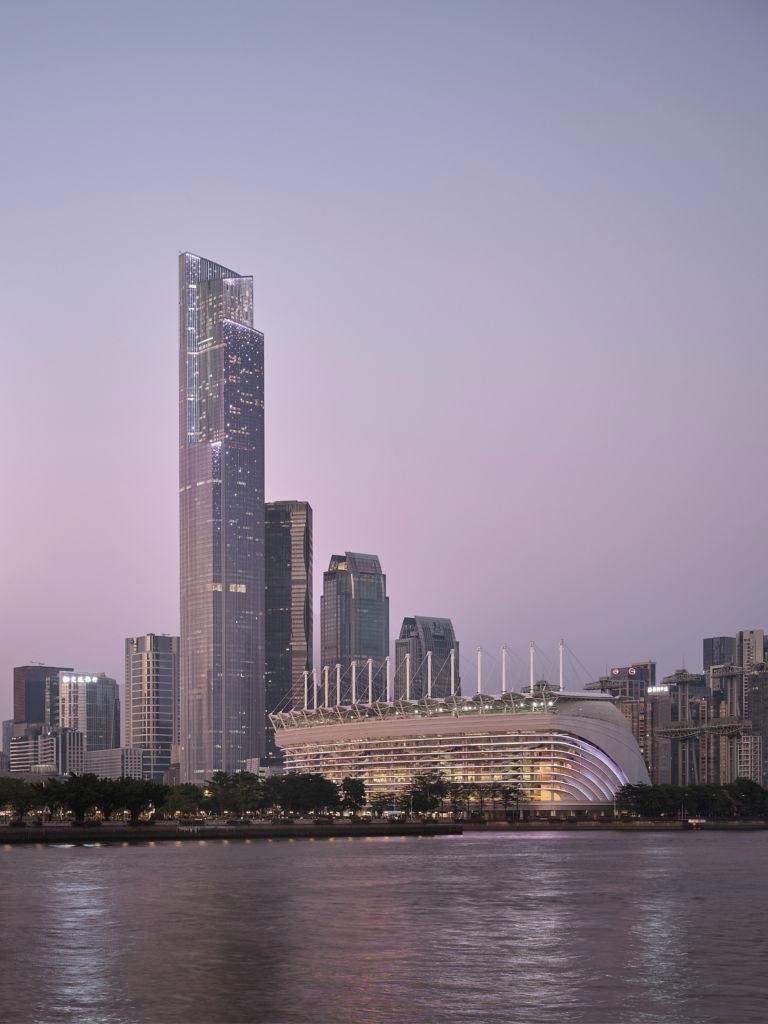
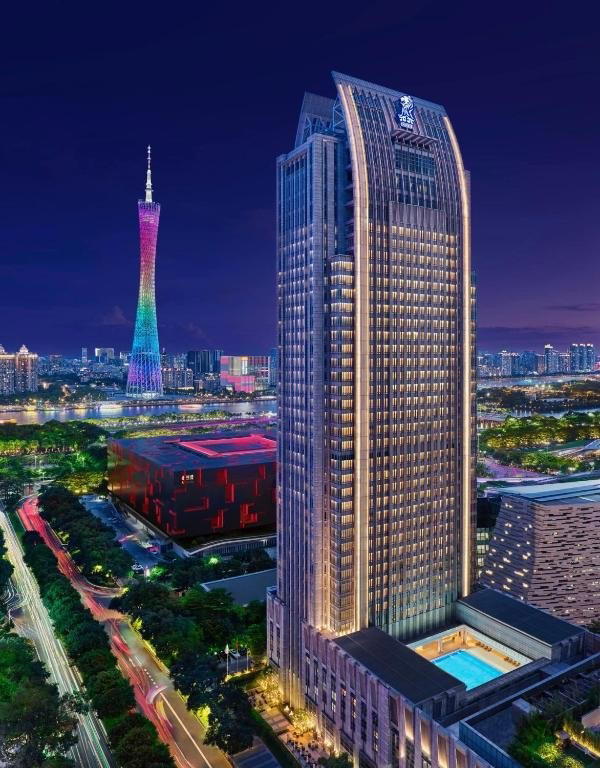
Bars in Guangzhou
All bars in Guangzhou →
Details
- Elegant
- Sophisticated
- Modern
- Ornate
- Business Trip
- Romantic Getaway
- Family Vacation
- Infinity Pool
- Rooftop Pool
- Panoramic View
- Wi Fi
- Pool
- Spa
- Fitness Center
- Room Service
- Concierge
- Business Center
- Valet Parking
- EV Charging
- Wheelchair Accessible
- Elevator
- Step Free Entrance
- Accessible Parking
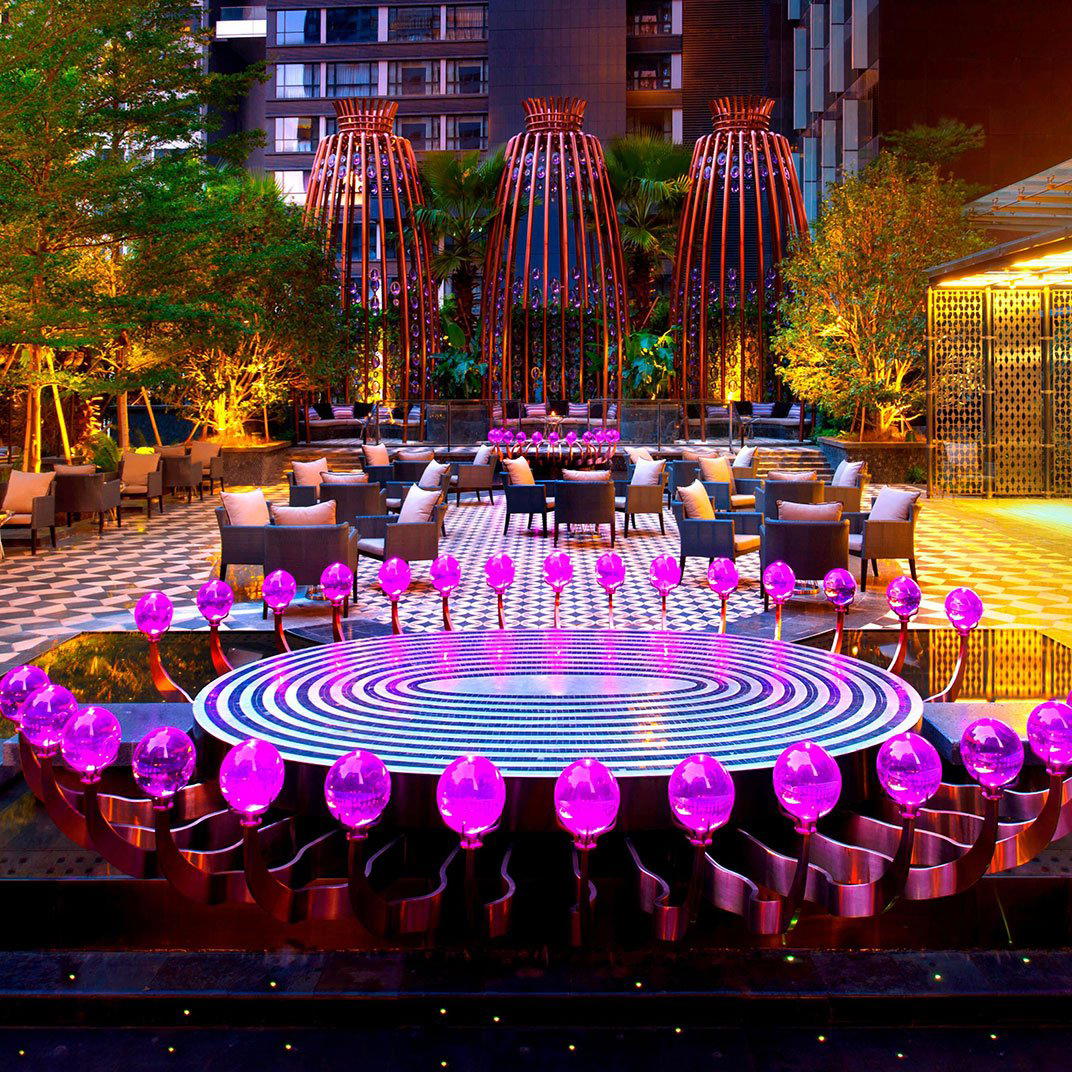
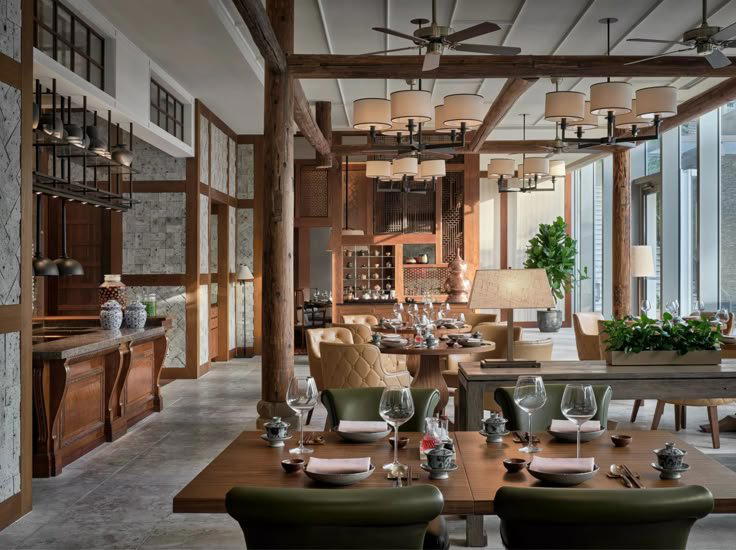
Elegant and modern with floor-to-ceiling windows offering dramatic city and river views, sophisticated lighting in ultramodern interiors.