
Small Luxury Hotels of the World Member
Established in 1899 within the ancient oak and rhododendron forests of Binsar Wildlife Sanctuary, Mary Budden Estate occupies one of the few remaining tracts of undisturbed Himalayan wilderness in Uttarakhand. With a handful of rooms set against oak canopy and Himalayan ridge views, this colonial-era property sits apart from the resort-heavy trail of hill station tourism, offering a quieter, slower register of mountain travel.

Pearl is the En Primeur Club membership app, where members save venues, book tables and use the concierge.
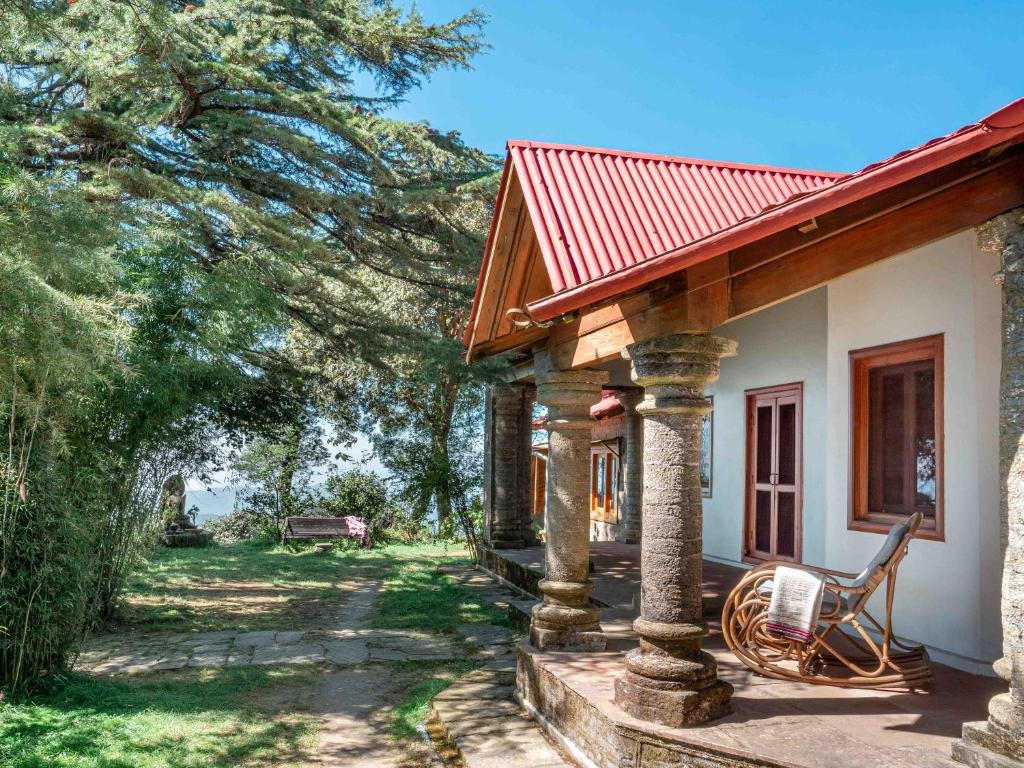
A Colonial Footprint in the Binsar Forest
The Kumaon Hills have accumulated two distinct types of retreats over the past century: the resort-scaled properties that orbit Nainital and Mussoorie, and a much smaller category of estate stays where the forest does most of the work. Mary Budden Estate, established in 1899 inside the Binsar Wildlife Sanctuary in Uttarakhand, belongs firmly to the second category. The approach road through Binsar's oak and rhododendron canopy is, in practical terms, a decompression chamber. By the time the estate appears, the altitude has already done its part, Binsar sits at roughly 2,420 metres, and the silence is structural rather than incidental.
What colonial-era hill properties in the Kumaon tend to share is an architecture of restraint: stone walls, low rooflines, verandahs built for sitting rather than spectating. Mary Budden's built form is consistent with that lineage. The estate dates to the late Victorian period, and the physical structure carries the proportions of a private house rather than a hotel, a distinction that shapes the experience as much as any deliberate design choice. In the Indian Himalayas, this is a relatively rare configuration. Most properties that trade on colonial heritage do so at a remove, renovating around a historical theme. Here the fabric itself is historical.
The Architecture of Wilderness Stays
Across India's premium hill station segment, the design conversation has shifted in the past decade. Properties like The Kumaon in Almora, a more recent arrival, have pushed the discourse toward contemporary materials and cantilevered concrete, using the landscape as a visual argument. Mary Budden Estate sits at a different point on the timeline, where the argument is made through persistence rather than intervention: the building has been here for more than 125 years, and the forest around it has grown accordingly.
The Binsar Wildlife Sanctuary, which surrounds the estate, provides a different kind of design envelope than a curated garden or a managed resort ground. The oak forest is protected and largely uninterrupted, which means the estate's immediate context, what you see from windows, what you hear at dawn, is determined by ecology rather than landscaping. In high-altitude Himalayan stays, this distinction matters. The leading views of the Greater Himalayan range, including Nanda Devi, Trishul, and Kedarnath peaks on clear days, are visible from Binsar in a way that few comparable elevations in Uttarakhand can match. The estate's position within the sanctuary puts it inside that sightline rather than adjacent to it.
Stays like Ananda in the Himalayas in Narendra Nagar operate in the wellness-resort register with international infrastructure. Chapslee in Shimla occupies a similar colonial-house niche but in a more urbanised hill station context. Mary Budden occupies a position where the primary offering is the sanctuary itself, the building is the entry point, not the destination.
Scale, Format, and What That Means in Practice
The estate accommodates a small number of guests, a configuration that shapes the rhythms of a stay as much as any amenity list. In the Indian hill station category, low-capacity properties occupy a different operational logic than resort-scale developments: meals are more likely to be communal or semi-communal affairs, schedules are informal, and the relationship between staff and guests compresses quickly. For travellers accustomed to the anonymity of larger properties, the managed distance of, say, The Leela Palace New Delhi or The Taj Mahal Palace, Mumbai, this is a meaningful recalibration.
The estate's address within a wildlife sanctuary also imposes a productive discipline on itineraries. Binsar has no commercial strip, no market to wander, no restaurant alternative a short walk away. What it has is forest trails, birding routes, and the Zero Point viewpoint from which the Himalayan panorama opens on clear mornings. Travellers who arrive expecting hill station tourism, the chai stalls and walking markets of Mukteshwar or Ranikhet, will find Binsar demands a different tempo. The estate format suits those already prepared to slow down.
Planning logistics into Binsar requires some advance thought. The nearest city of scale is Almora, roughly 33 kilometres from Binsar, and road travel in the Kumaon hills is non-trivial regardless of distance on paper. Most guests arrive via Kathgodam railway station or Pantnagar Airport, with onward road journeys that can run three to four hours depending on traffic and season. The spring months, March to June, and the post-monsoon clarity of October and November are when the Himalayan views are most defined. The monsoon period, July through September, brings heavy rainfall that can affect road access in the sanctuary.
Where Mary Budden Sits in the Broader India Travel Picture
India's premium travel segment has expanded considerably, and the range of experiences now on offer reflects that. Tented camp operators like Aman-i-Khas in Ranthambore and Suján Jawai in Pali have established the wildlife-adjacent luxury model in Rajasthan. Heritage palace conversions, Amanbagh in Ajabgarh, Alila Fort Bishangarh in Manoharpur, represent a different approach to historical architecture, one that involves significant investment in contemporary comforts layered into old stone. Mary Budden's position is quieter and less marketed than either of those categories. The estate's longevity, operating in some form since 1899, is itself a form of credential, though one that sits outside the formal award and rating systems that govern most premium travel curation.
For those building itineraries through Uttarakhand, Mary Budden pairs naturally with Gateway Dehradun as a starting or finishing point in the western Garhwal, or can be combined with an Almora town stay for those wanting to contrast the sanctuary quiet against the Kumaon's market culture. Our full Almora restaurants guide covers the broader Almora scene for those planning time in the town proper.
Elsewhere in India's hill station and heritage niche, Amaya in Solan and Haveli Dharampura in Delhi represent the spectrum between contemporary hill design and urban heritage restoration. Mary Budden sits at neither pole, it is neither a renovated palace nor a design-led contemporary build. Its category is closer to what might be called a working estate that has outlasted the era that produced it, which is a rarer and, for certain travellers, more persuasive proposition than either.
Planning a Stay
Direct enquiries for Mary Budden Estate are leading made through travel specialists familiar with Kumaon properties, as the estate does not appear to maintain a public-facing booking platform. Given the limited room count and the estate's reputation within the boutique Himalayan travel circuit, lead times of several months are advisable for peak season windows, October-November and March-May fill earliest. Guests travelling from Delhi should budget a full day of travel each direction; the distance is manageable but the mountain roads demand patience.
A Quick Peer Check
| Venue | Price | Awards |
|---|---|---|
| Mary Budden EstateThis venue (the venue you are viewing) | $200–300 | Small Luxury Hotels of the World Member |
| The Oberoi Amarvilas | $200–300 | 2 Michelin Keys · World's 50 Best #45 |
| The Taj Mahal Palace, Mumbai | $300–500 | 1 Michelin Key · World's 50 Best #30 |
| InterContinental Marine Drive-Mumbai | Not listed | Forbes Recommended |
| ITC Grand Central, A Luxury Collection Hotel, Mumbai | Not listed | Forbes 4-Star |
| ITC Maratha, A Luxury Collection Hotel, Mumbai | $200–300 | Forbes 4-Star |
Recognition history
Dated appearances from independent guides and award organizations, with the underlying list record or original source where available.
Small Luxury Hotels of the World Member
Small Luxury Hotels of the World
Continue exploring
More in Almora

Details
- Romantic
- Quiet
- Scenic
- Rustic
- Cozy
- Elegant
- Romantic Getaway
- Honeymoon
- Wellness Retreat
- Weekend Escape
- Panoramic View
- Garden
- Historic Building
- Private Dining
- Wi Fi
- Restaurant
- Room Service
- Garden
- Mountain
- Garden
Cozy and tranquil with crackling log fireplaces, antique furnishings, and serene forest surroundings.