

Mr & Mrs Smith Seal of Approval
At 7,500 feet on a remote Uttarakhand ridge, Shakti 360° Leti operates at the intersection of minimal-footprint design and high-altitude immersion. Four luxury tents, panoramic views of Nanda Devi, and a program built around Kumaoni trekking and village culture place it in a specialist tier where capacity constraints and landscape access define the offer more than amenities alone.

Pearl is the En Primeur Club membership app, where members save venues, book tables and use the concierge.
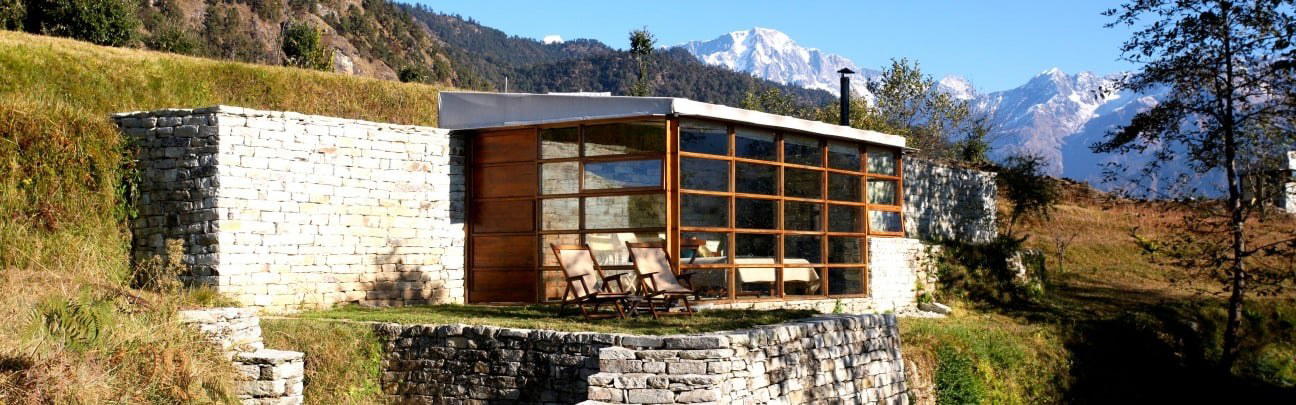
A Ridge Above the Valley Floor
The approach to Shakti 360° Leti sets the terms of engagement before arrival. The property sits at 7,500 feet on a remote ridge in Uttarakhand's Bageshwar district, in the Kumaon Himalaya, accessible only on foot or by mule from the nearest road head. That physical threshold is not incidental to the experience, it is the architecture. By the time a guest reaches the ridge line, the panorama of snow-capped peaks including Nanda Devi has already displaced the noise of the lowlands entirely.
In the broader category of high-altitude luxury camps across India, the split runs between large-format resort operations with extensive built infrastructure and small-capacity specialist properties that trade scale for precision of access. Shakti 360° Leti belongs firmly to the latter group, with just four tents positioned across the ridge to maximise both privacy and sightlines. At that count, the property competes less with resort-scale mountain lodges and more with a handful of high-altitude camps globally where the constraint of capacity is itself a design decision.
The Tent as Architectural Statement
Luxury tented accommodation in India has expanded considerably over the past decade, from desert camps in Rajasthan, represented by properties like Aman-i-Khas in Ranthambore and Suján Jawai in Pali, to increasingly ambitious mountain formats. What distinguishes the mountain tent category is the relationship between the structure and its topographic context. Floor-to-ceiling windows and private decks at Shakti 360° Leti are not decorative choices; they are how the building resolves the tension between shelter and exposure at altitude. The tent frame contains you while the glazing refuses to cut you off from the ridge environment.
This approach places each tent in a specific spatial conversation with the Himalayan skyline. The unobstructed views of peaks including Nanda Devi, at 7,816 metres the highest peak entirely within India, are not a backdrop but a primary spatial element of the room itself. That's a different design logic from, say, a heritage palace like The Leela Palace Jaipur or a city anchor like The Taj Mahal Palace, Mumbai, where architecture mediates between guest and city rather than dissolving the boundary between interior comfort and mountain exposure.
The Programme as Structure
The property's design logic extends into its programming. All-inclusive access to guided trekking, village visits, and cultural exchanges with Kumaoni communities is not an amenity layer on top of a conventional stay, it is the structural skeleton of the experience. Routes range from valley walks suitable for moderate fitness levels to high-altitude ascents for experienced trekkers, all led by expert local guides whose knowledge of the terrain determines what is actually possible at a given altitude and season.
In this sense, the property functions more like a base camp with considered comfort infrastructure than a retreat that happens to offer activities. The comparison set here is less with urban luxury properties such as The Leela Palace New Delhi or The Oberoi Amarvilas in Agra and more with a small international cohort of properties, in Nepal, Bhutan, and parts of Patagonia, where physical access to a specific landscape is the core product and accommodation exists to make extended engagement with that landscape viable.
For visitors considering northern India's mountain options, properties like Ananda in the Himalayas in Narendra Nagar, Chapslee in Shimla, or Gateway Dehradun offer accessible Himalayan proximity with conventional hotel infrastructure. Shakti 360° Leti sits in a different register: remoteness is the offer, not a trade-off.
Kumaoni Table and Healing Traditions
Kumaoni cuisine occupies a specific position in the broader spectrum of Indian regional food. Shaped by high-altitude agriculture and limited lowland imports, it draws on buckwheat, lentils, turmeric, local greens, and seasonal mountain produce. The culinary programme at Shakti 360° Leti works from organic ingredients sourced from local farmers and the property's own organic gardens, which positions it within a well-established mountain lodge tradition of tight farm-to-kitchen loops rather than a modernist tasting menu format.
The spa programme similarly draws from the immediate environment, using indigenous herbs and mountain spring water in treatments informed by traditional Himalayan healing practices. Neither the food nor the wellness programme is designed to replicate what a guest could access in Delhi or Mumbai. They are legible only in the context of this specific landscape, altitude, and agricultural tradition, which is, again, an architectural decision about how the property relates to its site.
Sustainability as Site Ethics
At this altitude and in this ecosystem, operational choices carry ecological weight that they would not carry at a plains-based property. Solar power systems and rainwater harvesting at this scale are not marketing credentials; they are practical responses to the limitations of off-grid mountain infrastructure. The property's stated partnerships with local communities to preserve traditional culture and protect mountain ecosystems align it with a model of site stewardship that is increasingly required of remote high-altitude properties operating in fragile environments.
This distinguishes Shakti 360° Leti from properties that carry sustainability credentials largely through efficiency upgrades to conventional infrastructure. The operating context here, four tents, no road access, a ridge ecosystem, makes the connection between design choices and ecological consequence direct rather than aspirational.
Planning a Stay
Shakti 360° Leti is located in the Bageshwar district of Uttarakhand at Hamit Katri, Kapkot 263632. The nearest major gateway is Kathgodam railway station, from which road access reaches the valley below the ridge. Given the property's remote position and four-tent capacity, advance planning through the Shakti Himalaya booking system is essential; last-minute access is structurally implausible at this scale. The trekking season in Kumaon runs broadly from late March through June and again from September through November, with monsoon conditions between July and August making many high-altitude routes impractical. Guests whose itineraries include wider Indian travel will find strong logistical anchors in properties like Amanbagh in Ajabgarh or Haveli Dharampura in Delhi before or after the mountain leg.
For a broader look at travel options in the region, our full Kottakuppam restaurants guide maps additional context across the area. Those building India itineraries that move between mountain and other terrain might also consider the programming approaches at Alila Fort Bishangarh in Manoharpur or Amaya in Solan as reference points for how different properties in the northern Indian specialist tier handle the relationship between site and guest programme.
At-a-Glance Comparison
| Venue | Price | Awards |
|---|---|---|
| Shakti 360° LetiThis venue (the venue you are viewing) | Not listed | Mr & Mrs Smith Seal of Approval |
| The Oberoi Amarvilas | $200–300 | 2 Michelin Keys · World's 50 Best #45 |
| The Taj Mahal Palace, Mumbai | $300–500 | 1 Michelin Key · World's 50 Best #30 |
| InterContinental Marine Drive-Mumbai | Not listed | Forbes Recommended |
| ITC Grand Central, A Luxury Collection Hotel, Mumbai | Not listed | Forbes 4-Star |
| ITC Maratha, A Luxury Collection Hotel, Mumbai | $200–300 | Forbes 4-Star |
Recognition history
Dated appearances from independent guides and award organizations, with the underlying list record or original source where available.
Mr & Mrs Smith Seal of Approval
Mr & Mrs Smith
Robb Report The 50 Greatest Luxury Hotels on Earth #34
Robb Report
Continue exploring
More in Kapkot
Details
- Quiet
- Scenic
- Romantic
- Intimate
- Rustic
- Elegant
- Romantic Getaway
- Wellness Retreat
- Honeymoon
- Weekend Escape
- Panoramic View
- Private Villa
- Wi Fi
- Room Service
- Concierge
- Massage
- Airport Transfer
- Mountain
Cozy and serene with warm fireplaces, candlelit dining, and panoramic mountain vistas through glass walls, fostering peace without modern distractions.