On Via Madama Cristina in Turin's San Salvario district, Bistrot Torrefazione Samambaia occupies the productive overlap between coffee culture and aperitivo bar. The torrefazione format, roastery-as-venue, gives the drinks programme a distinctive raw-material focus that separates it from the neighbourhood's broader bar scene. For visitors mapping Turin's drinking culture, it sits in a category worth understanding on its own terms.

Pearl is the En Primeur Club membership app, where members save venues, book tables and use the concierge.
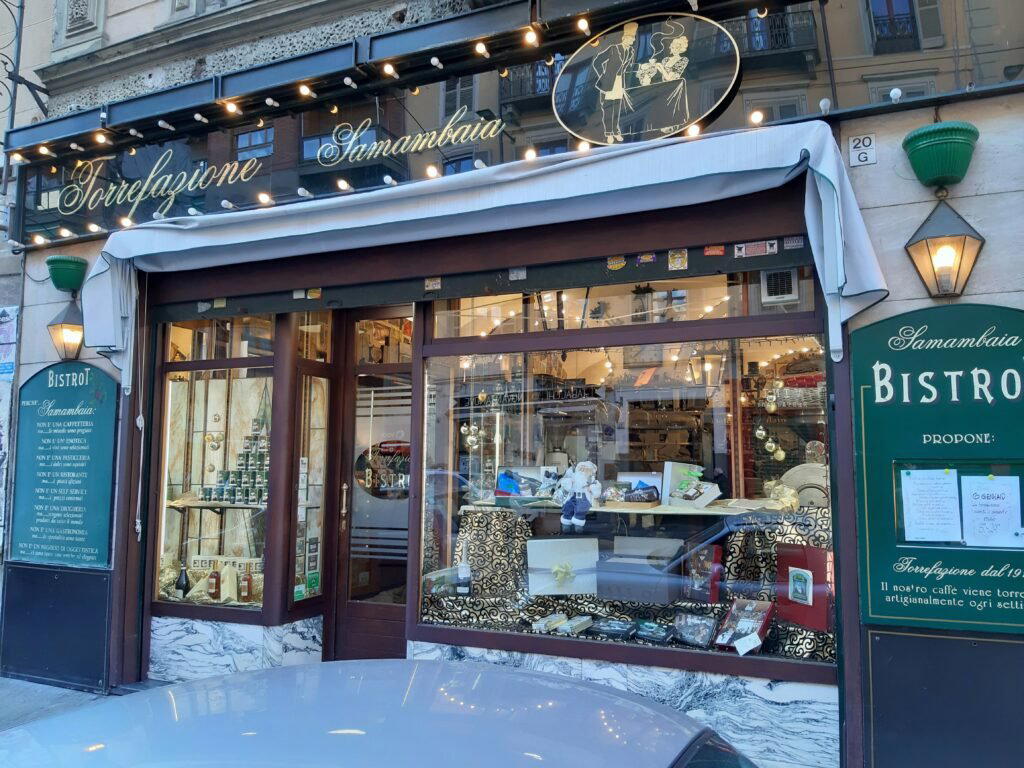
Where Coffee Roasting and the Aperitivo Hour Converge
San Salvario, the district that stretches south of Porta Nuova station along Via Madama Cristina, has developed into one of Turin's most active bar corridors over the past decade. The street itself runs through a neighbourhood that mixes student apartments, independent food shops, and a growing concentration of venues that take their sourcing seriously. Bistrot Torrefazione Samambaia sits at number 20/c, and the torrefazione designation in its name signals something specific: this is not simply a bar that sells coffee, but a venue organized around the roasting tradition, where the raw material of coffee anchors both the daytime programme and, by extension, the evening one.
The torrefazione format has deep roots in northern Italian city life. In Turin, where coffee culture runs alongside one of Italy's most codified aperitivo traditions, venues that position themselves at the intersection of both disciplines occupy a small and coherent niche. The logic is direct: a roastery that controls its own supply chain from green bean to finished cup has a considered relationship with ingredient quality that tends to carry over into how it approaches everything else on the counter.
The Drinks Angle: Coffee as Raw Material, Not Just Category
Italian cocktail culture in 2024 has moved away from purely spirit-forward menus toward programmes that treat non-alcoholic ingredients with the same rigour applied to aged rum or single-malt whisky. Coffee, in that context, is no longer just an espresso at the end of a meal, it is a flavour compound with provenance, processing method, and roast profile, all of which affect how it behaves in a glass. Venues in Turin that understand this have a meaningful advantage when constructing aperitivo-adjacent drinks or post-dinner options built around the bean.
Samambaia's torrefazione identity places it in that more considered category. Where a standard bar might reach for commercial espresso as an ingredient, a roastery-bistrot has direct access to beans at different roast stages, which opens up a range of applications: cold brew concentrates, flash-chilled preparations, or bitter-forward house syrups that can anchor drinks the way a good amaro does. For visitors who have been tracking the technical evolution of Italian bar programmes, in cities like Milan at 1930 in Milan, or Rome at Drink Kong in Rome, the roastery-led approach at Samambaia represents a different, quieter kind of precision.
Turin's aperitivo tradition is itself worth contextualising. The city claims a legitimate historical role in the development of vermouth, and the pre-dinner ritual here tends to be more restrained than the Milanese version, less about volume, more about the quality of what arrives alongside a glass. Bars on Via Madama Cristina and through San Salvario have absorbed that civic habit, and the best of them frame their early-evening offer around it. In that sense, a torrefazione-bistrot that brings ingredient seriousness to the aperitivo hour is a coherent local evolution, not an imported concept.
Positioning Within Turin's Bar Scene
Turin's current bar culture spans a fairly wide range of formats. At one end, historic caffè with marble counters and century-old service traditions, Caffè Platti and Caffé Al Bicerin represent that lineage with documented histories. At the other, newer venues with natural wine lists and contemporary small-plate programmes, like Banco Vini e Alimenti. Samambaia's torrefazione framing places it in a distinct sub-category: ingredient-led, roastery-anchored, and operating across a longer daily arc from morning coffee through evening drinks.
That dual-format model, roastery by day, bistrot by aperitivo, appears in other Italian cities but remains relatively uncommon in Turin, where the categories of caffè and bar have historically stayed separate. Dora In Poi represents another part of San Salvario's bar offer, and the neighbourhood's density makes it worth planning a proper circuit rather than a single-venue visit. For the broader Turin drinking context, our full Turin restaurants and bars guide maps the city's key formats and neighbourhoods.
Internationally, the roastery-to-bar crossover has precedents in venues like Gucci Giardino in Florence, where food and drink are treated as an integrated material rather than separate departments, or in the kind of format discipline that defines Bar Leather Apron in Honolulu, where sourcing rigour shapes every element of the programme. Closer within Italy, L'Antiquario in Naples and Al Covino in Venice demonstrate how ingredient specificity can define a bar's identity across different Italian city contexts. Lost and Found in Nicosia extends that same logic into the broader Mediterranean.
Planning a Visit: What to Know Before You Go
Via Madama Cristina 20/c is accessible on foot from Porta Nuova, Turin's main rail hub, in under ten minutes, the address places Samambaia in the southern stretch of San Salvario, which is the neighbourhood's more residential and locally-oriented end. The torrefazione format typically means the venue opens early for coffee service, which makes it a functional morning stop as well as an evening one.
Visitors combining Samambaia with the broader San Salvario circuit are advised to move through the area in the late afternoon, when the aperitivo hour is at its fullest and the coffee programme transitions into something more drink-forward. The street's concentration of independently-run food and drink venues means an afternoon of grazing is realistic without extensive planning.
In Context: Similar Options
| Venue | Cuisine | Price | Awards |
|---|---|---|---|
| Bistrot Torrefazione Samambaia TorinoThis venue (the venue you are viewing) | This venue | Not listed | Not listed |
| La Drogheria | Not listed | $10–20 | Top 500 Bars Best Bars #401 |
| Luogo Divino | Not listed | Not listed | Star Wine List · Falstaff Wine Bar - Listed |
| Piano 35 Lounge Bar | Not listed | $30–50 | Top 500 Bars Best Bars #464 |
| Orso Laboratorio del Caffè | Not listed | $1–10 | Not listed |
| Caffé Al Bicerin | Not listed | $10–20 | Not listed |
Continue exploring
More in Turin
Bars in Turin
All bars in Turin →
Restaurants in Turin
All restaurants in Turin →
Details
- Cozy
- Casual Hangout
Current opening hours
- Monday
- 7:30 AM–7:30 PM
- Tuesday
- 7:30 AM–7:30 PM
- Wednesday
- 7:30 AM–7:30 PM
- Thursday
- 7:30 AM–7:30 PM
- Friday
- 7:30 AM–7:30 PM
- Saturday
- 7:30 AM–7:30 PM
- Sunday
- Closed
Hours can change for holidays and private events. Hours as of .