Wiener Kebap serves Turkish Döner Kebab at Erdbergstraße 78 in Vienna, with counter service and a quick-bite setup for lunch, dinner, or late night.
Pearl is the En Primeur Club membership app — saves, bookings, and concierge access live there. Same editors, same standards.
- Address
- Erdbergstraße 78, 1030 Wien, Austria
- Phone
- +4369917100105
- Website
- wiener-kebap.eatbu.com
- Directions
- Get directions
 Saves & bookings on Pearl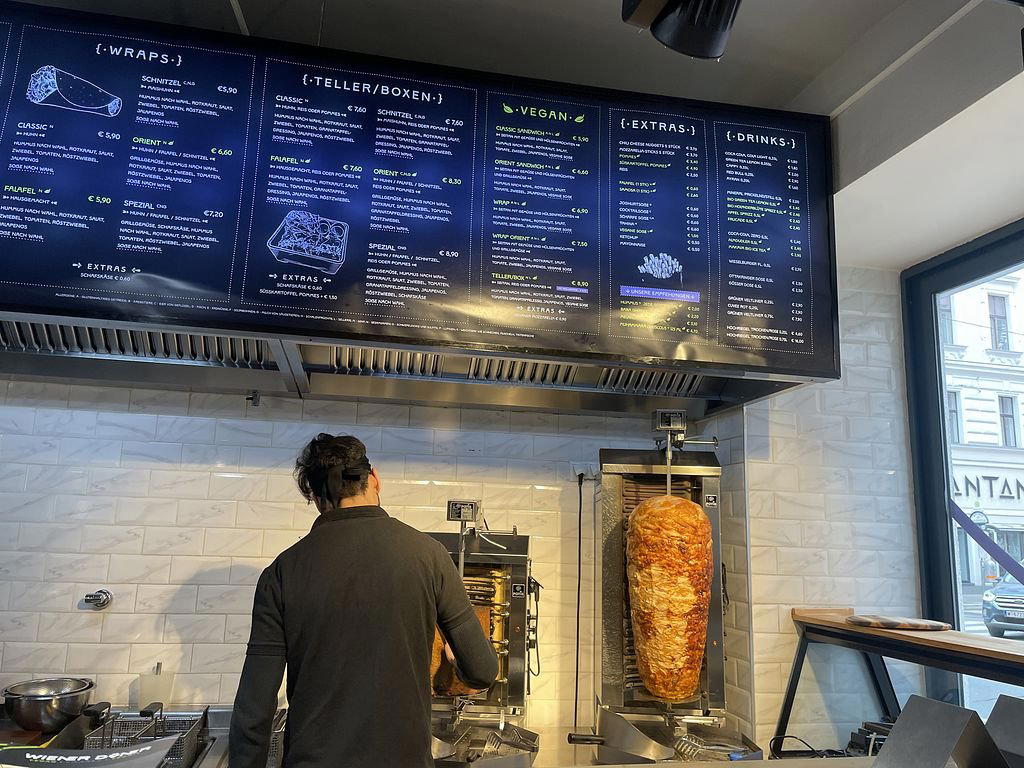
Erdberg's Everyday Counter
Wiener Kebap is a Turkish döner kebab restaurant at Erdbergstraße 78 in Vienna's 3rd district. The third district of Vienna is not where most food tourists point their maps. Erdberg is a transit neighbourhood, the long-distance bus terminal sits nearby, tram lines cut through it, and the streets around Erdbergstraße run more to hardware suppliers and mid-century apartment blocks than to anything that attracts a reservation. That functional, unremarkable character is precisely what makes a place like Wiener Kebap legible: this is a street-level kebap counter operating in the register that feeds the city rather than performing for it. In Vienna's food culture, that register has its own long tradition.
Austrian cities have absorbed döner and kebap formats since the late 1970s and early 1980s, when Turkish-Austrian communities established a counter presence that has since become as structurally embedded in everyday urban eating as the Würstelstand. The Würstelstand, Vienna's well-known sausage kiosk, protected in some cases by municipal heritage status, occupies the fast, standing, cash-in-hand tier of the city's food economy. Kebap counters in neighbourhoods like Erdberg occupy the same functional tier, and the comparison is useful: both formats prize consistency, speed, and a kind of democratic accessibility that the city's celebrated fine-dining rooms, from Steirereck im Stadtpark to Konstantin Filippou, explicitly do not. The two ends of Vienna's eating spectrum coexist without much anxiety about the distance between them.
What the Format Tells You
A kebap counter at this address operates within a format that is highly legible to anyone who has spent time in Vienna, Berlin, or Istanbul. The vertical spit, the flatbread or dürüm wrap, the salad bar of pickled vegetables and sauces: these are not variables left to individual creativity but structural features of the format itself. What differentiates individual counters within this category is sourcing discipline, the quality of the meat blend and its fat ratio, the freshness of the bread, the calibration of the sauce, rather than menu invention. Regulars at counters like this one tend to develop strong opinions about those variables precisely because the format is stable enough to make them matter.
In Vienna specifically, the kebap counter exists alongside a dense market in schnitzel, Gulasch, and Brettljause. The city's everyday eating is not monolithic. A neighbourhood like Erdberg, with its mix of long-term residents, transit workers, and students from nearby facilities, generates the kind of consistent foot traffic that sustains a counter through reliability rather than novelty. The collaboration between a well-run counter and its neighbourhood is less visible than the collaboration between a chef and a sommelier at Amador or Mraz & Sohn, but it is structurally similar: the venue tunes itself to the expectations and rhythms of its specific audience, and the audience returns when it does so consistently.
Vienna's Casual End, Mapped
Understanding where a place like Wiener Kebap sits in the broader Vienna food picture requires accepting that the city's restaurant scene is not a single ladder running from cheap to expensive. It is closer to several parallel tracks. The fine-dining track, anchored by Michelin-starred rooms, multi-course tasting menus, and wine programs built around Austrian Grüner Veltliner and Blaufränkisch, runs through the first, fourth, and ninth districts with particular density. The everyday track runs everywhere else, and it includes the kebap counters, the Beisl (traditional Viennese taverns), the Vietnamese soup kitchens near the Naschmarkt, and the bakery counters selling Semmel and Kipferl from early morning. Both tracks are essential to the city's food identity, and a visitor who spends all their time on one misses the other entirely.
For those building a broader Austrian itinerary, the fine-dining contrast is well-documented elsewhere in the country. Döllerer in Golling an der Salzach, Ikarus in Salzburg, and Obauer in Werfen represent the alpine end of Austrian gastronomy, where regional produce and seasonal discipline drive long-form menus. Griggeler Stuba in Lech, Gourmetrestaurant Tannenhof in Sankt Anton am Arlberg, and Schwarzer Adler in Hall in Tirol extend that alpine fine-dining footprint into the Tyrol. Back in the city, Doubek represents the kind of neighbourhood bistro that occupies the middle tier. The counter format the restaurant operates within sits below that middle tier, closer to the transactional and functional end of the spectrum. That is not a criticism, it is a description of what the format is designed to do.
Further afield, Landhaus Bacher in Mautern an der Donau, Kräuterreich by Vitus Winkler in Sankt Veit im Pongau, Ois in Neufelden, and Restaurant 141 by Joachim Jaud in Mieming complete a picture of Austrian gastronomy that stretches well beyond Vienna's city limits. For international reference points on what a tightly focused, technically serious counter operation can become at the highest level of the format, Le Bernardin in New York City and Atomix in New York City illustrate the discipline required when a format commits entirely to its own logic, though the price tier and register could not be further apart.
Planning a Visit
The restaurant is located at Erdbergstraße 78 in the third district, accessible via the Erdberg U-Bahn station on the U3 line, which also serves as the main hub for long-distance coaches arriving from Central and Eastern Europe. The area draws a working crowd, which means the counter's busiest periods tend to align with lunch service and early evening rather than late-night dining. No booking infrastructure applies to a counter format of this kind; the model is walk-in, order at the counter, and eat standing or at simple seating if available. Visitors should verify hours and menu details on arrival or via local listings.
Booking and Cost Snapshot
Comparable venues nearby, for context on price, style, and recognition.
| Venue | Cuisine | Price | Notes |
|---|---|---|---|
| Wiener KebapThis venue — the venue you are viewing | Wien-Mitte, Turkish Döner Kebab | $ | Not listed |
| Dönermeister | Josefstadt, Turkish Döner Kebab | $ | Not listed |
| SALOOT Kebap | Doebling, Turkish Kebab & Street Food | $ | Not listed |
| Nar | Not listed | $$ | Rudolfsheim, Turkish & Levantine Kebab House |
| Würstelstand am Hohen Markt | Not listed | $ | Stephansdom, Austrian Street Food Sausages |
| Elif Döner | Favoriten, Turkish Döner Kebab | $ | Not listed |
Continue exploring
More in Vienna
Restaurants in Vienna
Browse all →
Bars in Vienna
Browse all →

Hotels in Vienna
Browse all →

At a Glance
- Lively
- Casual Hangout
- Late Night
- Standalone
Casual street food spot with fast-paced, energetic atmosphere.