

Tabelog 100 #72
Our verdict
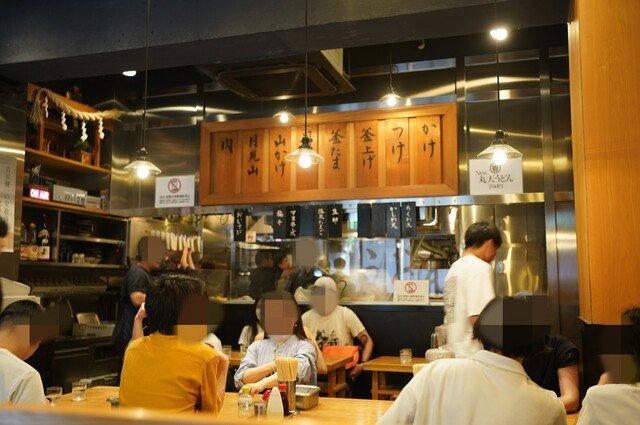
Udon Maruka in Tokyo's Kanda Ogawamachi district has held a place on the Opinionated About Dining Casual Japan list since 2024, moving from #94 to #113 across the two most recent editions. Operating on split lunch and dinner shifts six days a week, it represents the precise, repetition-driven end of Tokyo's udon scene, where bowl composition and broth discipline matter as much as the noodle itself.

Pearl is the En Primeur Club membership app, where members save venues, book tables and use the concierge.
The menu
What to order
- Kake Udon
- Niku Udon
- Shrimp Tempura
- Kashiwa Tempura
Kanda's Udon Discipline: Where a Bowl Is a Complete Argument
Tokyo's udon scene divides along a familiar fault line. On one side sit the fast, casual chains that treat the noodle as a vehicle for toppings and throughput. On the other sits a smaller cohort of specialist shops where the bowl is assembled with the kind of precision more commonly associated with sushi or ramen, and where OAD recognition signals a peer-reviewed standard among serious eaters.
The restaurant earned a place on the Opinionated About Dining Casual Japan list at #94 in 2024, then appeared again at #113 in 2025, a slight repositioning within a competitive field rather than a decline, and a signal that the broader ranking pool for serious casual Japanese dining has grown. Holding two consecutive years of OAD recognition in the casual tier is a meaningful credential: the list draws from a network of experienced eaters rather than institutional guides, which means repeat appearances reflect consistent execution rather than a single strong meal caught on a good day.
The Arc of a Udon Meal: How the Bowl Builds
Udon, at its most considered, follows a progression that mirrors the logic of a composed tasting menu, even when it arrives in a single bowl. The opening is always the noodle itself: its temperature, texture, and the resistance it offers on the first bite establish the register for everything that follows. Tokyo-style udon, influenced by the city's long preference for stronger, darker dashi than the pale Sanuki tradition of Kagawa, tends to lean on a richer soy-forward broth that announces itself immediately. The question a serious udon shop must answer is whether that broth deepens across the bowl or flattens as it cools.
The middle of the meal is defined by how the kitchen manages contrast. Cold udon served zaru-style against warm broth on the side, or kake udon with toppings introduced in a deliberate order, both rely on the eater moving through textures and temperatures in sequence. A piece of tempura placed on the broth's surface changes the liquid as it dissolves, thickening and seasoning it, a timed interaction that rewards eating at pace rather than grazing. Shops that understand this structure tend to be the ones that earn sustained recognition from eaters who compare notes across the country's udon traditions.
The finish of a udon meal is often the broth remaining in the bowl. In a well-calibrated preparation, it should have evolved from the first sip, concentrated slightly, shifted by the residue of toppings, and still coherent enough to drink as a final gesture. This is where the discipline of the kitchen either holds or breaks. Maruka's continued presence on the OAD list suggests its execution reads as consistent to the kind of eater who measures exactly this.
Kanda Ogawamachi and the Logic of the Neighbourhood Lunch Counter
Chiyoda City's Kanda area has a different culinary rhythm from Tokyo's more photographed districts. Lunch here is purposeful: office workers, students from nearby institutions, and a steady layer of food-aware visitors who have done their research all move through the narrow streets between 11am and 2pm. The density of small specialist restaurants in this zone, particularly those focused on noodles, tonkatsu, and traditional Japanese formats, means that sustained local reputation carries real weight. A shop that survives and accumulates recognition in Kanda is competing in a market that holds it to a daily standard.
The split-shift format Maruka operates (lunch through to 4pm, then an evening sitting that closes at 7:30pm, with Saturday lunch only and Sunday closure) fits the neighbourhood's working rhythm and limits covers in a way that keeps the kitchen manageable. This is the structural logic common to serious specialist noodle shops across Tokyo: controlled volume protects the quality of the product, and the short evening window creates a secondary tier of access for those who cannot arrive at lunch. For visitors, the practical implication is that Saturday lunch is the single most convenient window, and the early part of the weekday lunch service tends to be quieter than the peak hour.
Udon in the Context of Tokyo's Noodle Hierarchy
Tokyo is primarily coded as a ramen city in the international imagination, but its udon establishments occupy a distinct and increasingly recognised tier. Where ramen has expanded into fine-dining register with pairing menus and reservation-only counters, udon has largely held its position as the more restrained, broth-focused tradition, valued by eaters who appreciate technique that does not announce itself. The comparison cohort for Maruka is not the high-end kaiseki venues on the OAD list, not RyuGin or Harutaka, operating at ¥¥¥¥ with reservation windows measured in months, but rather the city's small, technically serious lunch counters that the OAD casual tier was built to surface.
For context across the country, the udon tradition in Osaka is represented by Aozora Blue, while Kyoto's version has its own register at Gion Yorozuya. Each city inflects the format differently: Osaka's dashi-forward lightness, Kyoto's restrained umami architecture, and Tokyo's heavier broth character are genuinely distinct. Eating across all three builds a comparative vocabulary that makes any single bowl more legible. If your Japan itinerary reaches beyond Tokyo, the contrast is worth building in.
Elsewhere in Japan's serious dining circuit, HAJIME in Osaka, Gion Sasaki in Kyoto, akordu in Nara, Goh in Fukuoka, and 1000 in Yokohama all operate in very different registers, but collectively indicate how wide the range of serious eating in Japan has become. Maruka's position in that ecosystem is specific: it is a technically held lunch-format specialist that does not cross into the fine-dining conversation, and is stronger for staying in its lane.
For Tokyo visitors building a fuller picture of the city's dining, the EP Club guides cover restaurants, hotels, bars, wineries, and experiences. For those planning higher-register evenings after a Maruka lunch, L'Effervescence and Sézanne represent the French-in-Tokyo tier that the city has developed with particular seriousness over the past decade, operating at ¥¥¥¥ and requiring advance reservations. The register shift from a Kanda udon counter to a Michelin-level French table is large, but Tokyo handles that kind of contrast better than almost any other city, and a single day can hold both without contradiction. 6 in Okinawa extends the broader Japan circuit for those moving further afield.
Know Before You Go
- Address: 3 Chome-16-1 Kanda Ogawamachi, Chiyoda City, Tokyo, NEW SURUGADAI Building, 1F
- Hours: Monday to Friday: 11am–4pm and 5pm–7:30pm; Saturday: 11am–2:30pm; Sunday: Closed
- Cuisine: Udon (specialist lunch counter format)
- Awards: Opinionated About Dining Casual Japan, #94 (2024), #113 (2025)
- Leading access window for visitors: Saturday lunch or early weekday lunch sitting
- Booking: No booking information available; walk-in format likely given the casual tier and lunch-counter style
Frequently asked questions
What's the address for Udon Maruka?
Udon Maruka is located at Japan, 〒101-0052 Tokyo, Chiyoda City, Kanda Ogawamachi, 3 Chome−16−1 NEW SURUGADAI bld. 1F, Tokyo.
Is Udon Maruka Michelin-listed?
Udon Maruka has received recognition including: Opinionated About Dining Casual in Japan Ranked #113 (2025); Opinionated About Dining Casual in Japan Ranked #94 (2024).
What's the must-try dish at Udon Maruka?
No single dish is confirmed in verified sources for Udon Maruka, but the kitchen's focus is udon in its most considered form, the noodle itself, its texture and broth, rather than elaborate toppings. Udon Maruka has appeared on the Opinionated About Dining Casual Japan list in both 2024 (#94) and 2025 (#113), which tracks execution at the bowl level. Ordering whatever the counter is running that day, particularly any cold preparation in warmer months, reflects how OAD-ranked udon specialists are typically assessed.
Budget and Context
| Venue | Cuisine | Price | Awards | Notes |
|---|---|---|---|---|
| Udon MarukaThis venue (the venue you are viewing) | Sanuki Udon | $1–10 | Tabelog 100 #72 | Not listed |
| Harutaka | Edo-Style Omakase Sushi | $200–300 | 3 Michelin Stars · World's 50 Best #76 | Sushi |
| RyuGin | Modern Kaiseki | $500+ | 3 Michelin Stars · World's 50 Best #41 | Kaiseki, Japanese |
| L'Effervescence | Modern French with Japanese Influences | $200–300 | 3 Michelin Stars · World's 50 Best #69 | French |
| HOMMAGE | Modern French with Japanese Influences | $150–200 | 2 Michelin Stars · World's 50 Best #78 | Innovtive French, French |
| MAZ | Innovative Peruvian-Japanese Fusion | $150–200 | 2 Michelin Stars · World's 50 Best #28 | Innovative |
Recognition history
Dated appearances from independent guides and award organizations, with the underlying list record or original source where available.
Opinionated About Dining Casual in Japan Ranked #96
Opinionated About Dining
Tabelog 100 #72 · No. 72
Tabelog · Tabelog 100 - Udon - EAST - 2024
Full recognition history (4 entries)
Opinionated About Dining Casual in Japan Ranked #113
Opinionated About Dining
Opinionated About Dining Casual in Japan Ranked #94
Opinionated About Dining
Continue exploring
More in Tokyo
More from Chef Various
Browse all →
Restaurants in Tokyo
All restaurants in Tokyo →



Bars in Tokyo
All bars in Tokyo →




Details
- Casual
- Solo
- Casual Hangout
- Sake Program
- A La Carte
Current opening hours
- Monday
- 11 AM–4 PM, 5–7:30 PM
- Tuesday
- 11 AM–4 PM, 5–7:30 PM
- Wednesday
- 11 AM–4 PM, 5–7:30 PM
- Thursday
- 11 AM–4 PM, 5–7:30 PM
- Friday
- 11 AM–4 PM, 5–7:30 PM
- Saturday
- 11 AM–2:30 PM
- Sunday
- Closed
Hours can change for holidays and private events. Hours as of .
Clean and atmospheric with communal long tables, jam-packed seating, and a no-frills, efficient vibe.