
Tsukemen Shigeta belongs to Kobe’s compact, serious noodle circuit rather than the city’s beef-and-view dining stereotype. Its reputation rests on tsukemen, abura-soba, maze-soba and ramen, with Tabelog Ramen WEST “Tabelog 100” selections across 2018, 2021, 2022, 2023, 2024 and 2025, placing it in a narrow group of Kansai noodle shops with sustained public recognition.
Pearl is the En Primeur Club membership app — saves, bookings, and concierge access live there. Same editors, same standards.
- Address
- 兵庫県神戸市灘区桜口町5-1-1 ウェルブ六甲道5番街1番館 103
- Phone
- +81788425539
- Website
- tabelog.com
 Saves & bookings on Pearl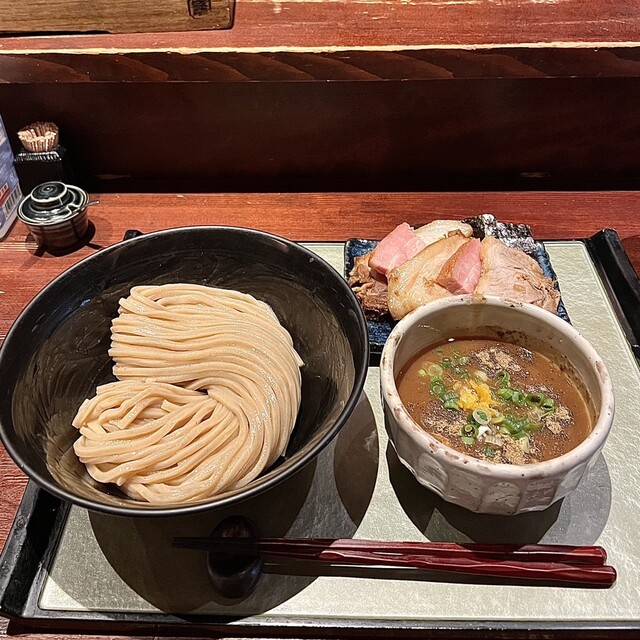
Rokkomichi is not the Kobe of harbor postcards. Around the station, the mood is commuter rhythm rather than destination theatre: apartment blocks, local shopping arcades and quick meals built around habit, not ceremony. That setting matters for ramen. Serious noodle shops in Japan often feel less like restaurants than small technical workshops, reduced to steam, counter movement and noodles being lifted, drained and served. Tsukemen Shigeta fits that grammar: compact, counter-led and focused on dipping noodles and close relatives rather than a broad casual menu.
Kobe’s dining identity is often flattened into beef, but its everyday eating culture is much wider. For visitors mapping an itinerary, a steak address such as Aburi Niku Kobo Wakkoku Shinkobe ten or Aburi Niku Kobo Wakkoqu Kitano Sakamoto Ten explains one part of the city; a noodle counter in Nada explains another. The latter is faster, smaller and more dependent on repetition. Its pleasures come from heat management, texture and the discipline of a short format.
Rokkomichi's noodle-counter register is spare, close and technical
Tsukemen changes ramen’s rhythm. Instead of broth and noodles arriving together, the format separates them: noodles on one side, concentrated dipping broth on the other. That puts more pressure on noodle texture and temperature, and makes the meal feel more deliberate than quick soup ramen. Abura-soba and maze-soba move further into sauce-coated territory, focusing on mixing, chew and seasoning rather than broth-forward structure.
That category mix places Tsukemen Shigeta within a Kansai noodle tradition that rewards precision over décor. The counter format reinforces it. A small counter makes the experience direct: orders move quickly, the work is visible, and little distance separates cooking from eating. This is not leisurely Kobe dining. It is the part of the city where a meal is judged by concentration and execution, not the length of the evening.
The recognition is not incidental. The shop was selected for Tabelog Ramen WEST “Tabelog 100” in 2018, then again from 2021 through 2025. In a crowded category of regional specialists, that continuity signals more than a single burst of attention. It places the shop among western Japan ramen addresses that have held public interest across multiple cycles, useful in a genre where new openings can draw short-lived queues before attention shifts.
Why the price tier matters in Kobe's broader dining mix
Kobe has a wide spread of casual and specialist dining, and the comparison is instructive. Moriguchi sits in a higher everyday-spend bracket at JPY 3,000 to JPY 3,999, while BARMOS and Ipposhi occupy JPY 1,000 to JPY 1,999. Menya Isshin shares the sub-JPY 999 bracket with Tsukemen Shigeta, though the choice is less about price than format. For a traveler, this is the difference between a destination dinner and a focused noodle stop that can anchor a day without taking over the schedule.
The low spend also sharpens expectations. At this level, a place must argue through repetition, category credibility and local demand rather than luxury signals. Tabelog’s repeated Ramen WEST selections give the shop a public benchmark, while the categories make clear what to expect: dipping noodles, soupless ramen variations and ramen rather than a general izakaya spread. That specificity is a virtue. Noodle specialists lose focus when menus try to cover every mood; here, the interest is a narrow lane executed consistently enough to remain visible in western Japan’s competitive ramen field.
There is a useful contrast with Kobe’s broader eating map. Akari and Ali's Halal Kitchen point to other everyday modes in the city, while Akaneya Coffee Ten belongs to a slower café register. Noodle counters run on a different clock: brisk pace, utilitarian room, and one main decision, broth-adjacent tsukemen, oil-slicked abura-soba, mixed maze-soba or ramen.
How to place it in a Kobe itinerary
For travelers who use food to understand a city, the restaurant is better read as a corrective to Kobe clichés than as a standalone trophy stop. The city’s premium image leans on wagyu, Kitano-era cosmopolitanism and port scenery. A Rokkomichi noodle counter shows the municipal texture beneath that image: station-adjacent, compact, inexpensive and built for repeat local use. That is often where Japanese cities become clearest.
The practical decision is sequencing. Tsukemen or maze-soba suits a day moving through Nada or eastern Kobe, especially when the evening is reserved for a longer dinner elsewhere. It also works as a counterweight to beef-heavy planning. Visitors building a larger route can scan Our full Kobe restaurants guide, then separate quick specialist meals from higher-spend dinners and late-night drinking. The same trip may pull in Our full Kobe bars guide, Our full Kobe hotels guide, Our full Kobe wineries guide or Our full Kobe experiences guide, but the noodle stop should stay simple: arrive hungry, order within the core categories, and treat the counter as the point.
Japan-wide comparisons clarify the appeal. A seafood-and-charcoal address such as. 鮪と炭火焼き うお炭 秋葉原店 in Tokyo, a café like.cafe in Osaka, a regional restaurant such as.know in Kumamoto, or a specialist curry shop like [Curry Senmon Ten] Maruyama Kyoju. in Sapporo each expresses a different Japanese casual-dining logic. Tsukemen belongs to the noodle branch: narrow, repeatable, sensory in mechanics rather than decoration. Even overseas Japanese formats, from Jōdo Saké Bar in Los Angeles to Onigiri Time in Pasadena, show how much depends on format discipline. In Kobe, this counter makes that discipline local, compact and legible.
For a side trip beyond the Kansai frame, -Grilled beef Sukiyaki- KAMAKURA TANUKIAN 鎌倉 たぬき庵 in Kamakura sits in a different register, built around sukiyaki rather than noodles. The contrast is useful: Kobe should not be planned as a single-cuisine city. Its strongest itineraries mix the acclaimed beef narrative with smaller, sharper meals that locals can fold into ordinary life. The restaurant earns its place in that second category.
Quick Comparison
Nearby venues at a similar price tier for orientation.
| Venue | Cuisine | Price | Notes |
|---|---|---|---|
| Tsukemen ShigetaThis venue — the venue you are viewing | Tsukemen & Ramen Shop | $ | Not listed |
| 北野坂木下 | Japanese Restaurant | $ | Chūō |
| Pan Yakidokoro RIKI | Japanese artisan bakery | $ | Chūō |
| Fuji | Okonomiyaki (Japanese savory pancakes) | $ | Chūō |
| Kinton Koube ten | Tonkatsu (Japanese pork cutlet) | $ | Chūō |
| Gyoza no Mise Hyotan Sannomiya ten | Kobe-style gyoza specialty shop | $ | Chūō |
Recognition history
Dated appearances from independent guides and award organizations, with the underlying list record or original source where available.
Tabelog 100 #97 · No. 97
Tabelog · Tabelog 100 - Ramen - WEST - 2025
Continue exploring
More in Kobe
Restaurants in Kobe
Browse all →


Bars in Kobe
Browse all →



Hotels in Kobe
Browse all →



At a Glance
- Cozy
- Lively
- Intimate
- Solo
- Casual Hangout
- After Work
- Standalone
- Beer Program
A small, non-smoking counter-only ramen shop with 9 seats, simple decor and a relaxed but energetic atmosphere driven by constant lines of noodle fans.