SÒNG JHAO
.png)
Operating from a dim alley off Fuxing Street in Yonghe District since 2022, SÒNG JHAO delivers a concise menu of Taiwanese classics and Sichuan-inflected dishes prepared by a young, focused team. The cold chicken in mala sauce has drawn consistent attention, and the upstairs counter seating lets solo diners watch service unfold in real time. A compact, carefully run neighbourhood spot in New Taipei's less-trafficked residential south.
 Discover on Pearl
Pearl is the En Primeur Club membership app — saves, bookings, and concierge access live there. Same editors, same standards.
Yonghe's Quiet South and What It Produces
New Taipei's dining conversation tends to cluster around Banqiao's night markets or the riverside districts closest to Taipei proper. Yonghe District, positioned just south of the Xindian River, operates at a different register: residential, dense, and largely indifferent to trend cycles. The small alleys branching off streets like Fuxing produce a particular category of restaurant — places that survive on neighbourhood loyalty and word-of-mouth repetition rather than platform algorithms or tourism traffic. SÒNG JHAO, open since 2022 at 72 Fuxing Street, sits squarely in that category. The dimly lit alley setting is less a design decision than a geographic fact, and the restaurant wears it without apology.
For readers building a wider picture of New Taipei's food scene, our full New Taipei restaurants guide maps the district's range from night-market staples to this quieter residential tier. Those looking beyond food can also find the city's full range through our New Taipei hotels guide, bars guide, and experiences guide.
Two Traditions on One Menu
Taiwan's neighbourhood restaurant culture has always been comfortable holding multiple culinary lineages simultaneously. The Sichuan influence that arrived with mid-twentieth-century migration never fully separated from local Taiwanese cooking; instead it folded in, producing hybrid dishes that carry mala heat alongside the gentler, soy-forward profiles of traditional Taiwanese fare. SÒNG JHAO works in this overlap deliberately. The menu is concise, which in this context is a structural choice rather than a limitation: a shorter list of dishes signals that each one has been tested and refined rather than assembled for range.
The cold chicken preparation anchors the menu in both culinary traditions at once. Cold chicken dishes in Taiwan span a spectrum from the poached simplicity of three-cup variations to more heavily seasoned Sichuan-style presentations. SÒNG JHAO's version occupies the latter end: silky, carefully cooked meat served cold in a sauce built around mala seasoning and a nutty base. The sauce formula is not published, which is standard practice for dishes that function as a restaurant's primary draw. What distinguishes it editorially is the textural contrast — the meat handled to preserve moisture against a sauce with considerable depth , rather than heat alone. This is the kind of dish that defines whether a small restaurant justifies a repeat visit.
Elsewhere in Taiwan, restaurants working at higher price points and with broader recognition , JL Studio in Taichung and logy in Taipei among them , approach the question of Taiwanese-international fusion at a fine dining register. SÒNG JHAO makes no argument at that level. Its peer set is the neighbourhood restaurant category, where the measure of success is consistency and daily relevance rather than tasting-menu ambition. For similar regional contrast, GEN in Kaohsiung and Zhu Xin Ju in Tainan illustrate how different cities in Taiwan approach local cooking at varying registers.
How the Team Runs the Room
Small restaurants with young teams carry a particular operational risk: enthusiasm without coordination reads as chaos, and precision without warmth reads as anxiety. The team at SÒNG JHAO appears to have solved this at the front-of-house level before it becomes a guest-facing problem. The preparation of each dish is described as careful and attentive, which in a restaurant of this scale means that the kitchen's pace and the floor's pace are aligned. When that alignment holds, a small dining room functions more smoothly than a larger one with more staff, because communication paths are short and accountability is direct.
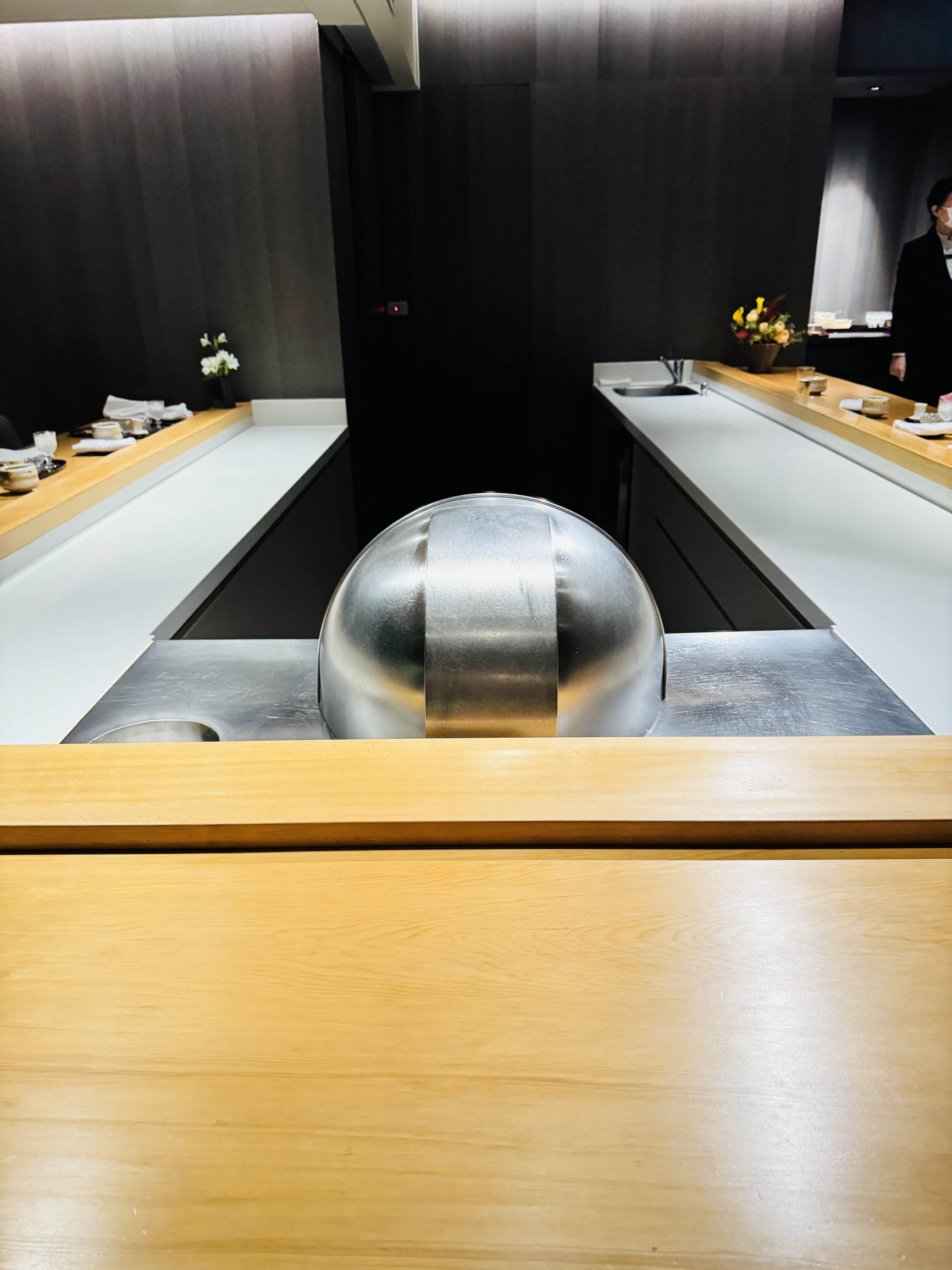
The upstairs counter seating arrangement reinforces this dynamic. Counter positions in neighbourhood restaurants serve a different function than counter seats in high-end omakase formats , they are less about theatrical access to the chef and more about creating a zone where solo diners are integrated rather than isolated. A solo visitor at the counter at SÒNG JHAO watches prep and plating happen in real time, which in a concise-menu kitchen means observing the same dishes executed repeatedly with consistent technique. That repetition, visible from the counter, is itself a form of quality signal.
The division between ground-floor entry and the upstairs main dining room also creates a natural separation between the bar or waiting area and seated service, a layout common in smaller Taiwanese restaurants where square footage is managed vertically rather than horizontally. Guests heading to the main room should expect a compact space sized for neighbourhood use rather than large-group dining.
Where SÒNG JHAO Sits in New Taipei's Broader Picture
New Taipei contains multitudes in its food culture, and not all of them receive equal attention. Taro-ball specialists like A Gan Yi Taro Balls and A-ba's Taro Ball represent the dessert and snack tier that defines a lot of visitor itineraries. Restaurants like Amajia, BAK KUT PAN, and Chi Yuan cover different points across the local dining spectrum. SÒNG JHAO occupies a specific gap: a sit-down restaurant in a residential district with a focused kitchen approach, where neither the category nor the neighbourhood is engineered for visibility.
That positioning matters for the reader making a genuine decision about whether to travel to Yonghe. The honest answer is that this is a restaurant for people who are already in the neighbourhood, for those who find the Taiwanese-Sichuan overlap genuinely interesting, or for solo diners who want a counter seat and a focused meal without the formality of a reservation-heavy room. It is not positioned against Akame in Wutai Township or Volando Urai Spring Spa and Resort in terms of destination draw. The comparison that matters is with the category of small, earnest neighbourhood restaurants that Taiwan produces in quantity but that rarely get mapped for international visitors.
For reference points from beyond Taiwan's borders, the contrast with destination-format restaurants like Le Bernardin in New York City or Emeril's in New Orleans clarifies what SÒNG JHAO is not attempting. This is neighbourhood cooking executed with care, not a platform for culinary statement-making. Those are different projects, and conflating them serves neither.
Planning a Visit
SÒNG JHAO has been operating at 72 Fuxing Street in Yonghe District since 2022. The restaurant is accessible from central Taipei via the MRT to Dingxi or Yonghe stations, with a short walk or taxi ride into the residential grid. Because phone and website details are not publicly listed in available sources at time of writing, walk-in or contact via local dining platforms is the most reliable approach for current hours and table availability. Solo diners should ask specifically for counter seating upstairs if they want the kitchen-view option. Groups should account for the compact room size when booking. The broader New Taipei wineries guide and bars guide can help structure the rest of an evening in the area.
Style and Standing
A quick peer snapshot; use it as orientation, not a full ranking.
| Venue | Cuisine | Awards | Notes |
|---|---|---|---|
| SÒNG JHAO | Tucked away in a small, dimly lit alley, this cosy spot has been serving up Taiw… | This venue | |
| A Gan Yi Taro Balls | |||
| A-ba's Taro Ball | |||
| Amajia | |||
| BAK KUT PAN | |||
| Chi Yuan |
Continue exploring
More in New Taipei
Restaurants in New Taipei
Browse all →
Bars in New Taipei
Browse all →
Hotels in New Taipei
Browse all →
Wineries in New Taipei
Browse all →
At a Glance
- Cozy
- Trendy
- Intimate
- Casual Hangout
- Open Kitchen
Dimly lit, cozy two-story hipster-style space tucked in a small alley with counter seating for watching chefs.