Our verdict
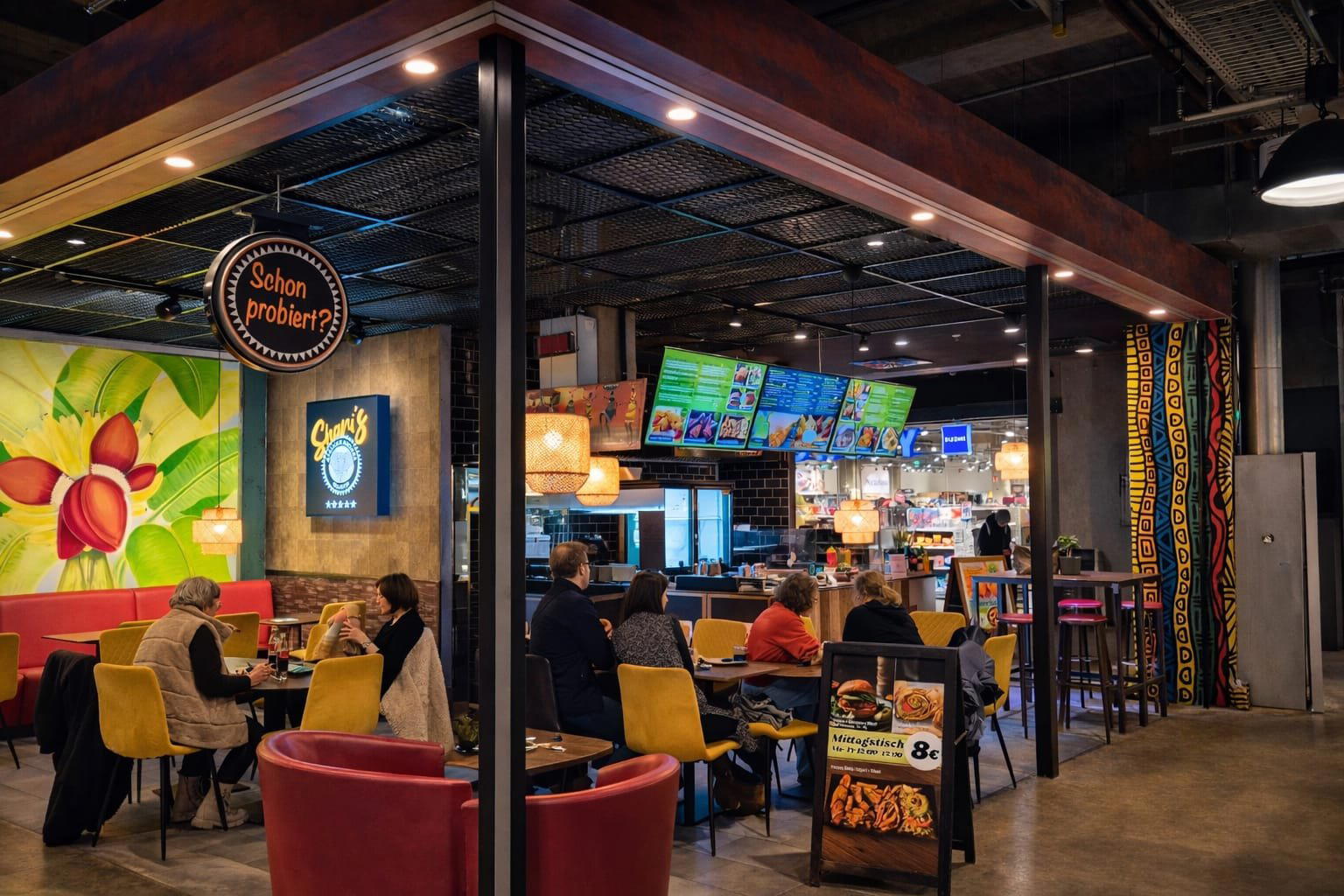
Shani's African Snacks occupies a stall inside Hamburg's Rindermarkthalle in St. Pauli, one of the city's most animated covered market halls. It represents a category of cooking largely absent from Hamburg's fine-dining map: African street food served in a communal, market-hall setting. For visitors tracking how the city eats beyond its Michelin circuit, this is a useful reference point.

Pearl is the En Primeur Club membership app — saves, bookings, and concierge access live there. Same editors, same standards.
The menu
What to order
- Ugandischer Rolex
- Kelewele
- African Burger
St. Pauli's Market Hall and the Informal Dining Tier
Hamburg's food scene is most legibly divided not by cuisine type but by format. At one end sit the white-tablecloth tasting-menu rooms — Restaurant Haerlin, The Table Kevin Fehling, and 100/200 Kitchen — where multi-course menus, elaborate wine pairings, and extended service rituals define the experience. At the other end, and in many ways more representative of how most Hamburgers actually eat on a weekday, are the city's covered markets and street-food stalls. The Rindermarkthalle in Neuer Kamp 31, St. Pauli, sits squarely in that second category, and Shani's African Snacks is one of its tenants.
The Rindermarkthalle itself is worth understanding as a building before any individual stall inside it. Originally a 19th-century livestock market hall, it was repurposed over successive decades into a food and retail space serving one of Hamburg's most ethnically mixed districts. St. Pauli's reputation is built on density and variety: it is simultaneously a nightlife quarter, a working-class residential neighbourhood, and a destination for the kind of international food that does not survive long in higher-rent postcodes. The covered market format creates a different social contract from a restaurant, you arrive without a reservation, you share tables with strangers, and the transaction is fast. That is context, not criticism.
African Street Food in a Northern European Port City
Hamburg's African food offer is small relative to its size as a port city. That may seem counterintuitive, port cities historically absorb the cuisines of their trading partners, but the German north has built its international food identity primarily around Turkish, Vietnamese, and pan-Asian cooking, with African cuisine occupying a much smaller share of the informal dining market. Stalls and small operations like Shani's African Snacks therefore represent a category with limited local competition rather than a crowded field. That positioning matters for understanding what the venue is doing within the broader Hamburg eating picture.
African street food as a category spans an enormous geographic and technical range, from West African suya and jollof rice to East African mandazi and nyama choma to North African harissa-laden flatbreads. What the name and format suggest is an operation focused on snack-scale portions and quick service, consistent with the rhythm of a market-hall setting. For context on how African cooking sits within the broader German fine-dining conversation, it is instructive to note that venues pushing boundaries at the tasting-menu level, such as CODA Dessert Dining in Berlin, operate in an entirely different register, and the comparison is less useful than looking at how informal African food fits into a city's daily-eating infrastructure.
The Rindermarkthalle Setting
Approaching the hall from Neuer Kamp, the building reads immediately as a working space rather than a curated food destination. The high ceilings, the mix of permanent stalls and rotating vendors, and the general noise level position this as a neighbourhood resource first. That atmosphere, concrete floors, communal tables, the smell of multiple cuisines overlapping, is characteristic of the covered market format that cities across northern Europe have been either preserving or redeveloping in recent decades. Hamburg has held onto its market-hall culture more successfully than some comparable German cities, and the Rindermarkthalle functions as a daily-use space rather than a tourist attraction dressed in market clothing.
Within that setting, a stall like Shani's African Snacks operates on the logic of foot traffic, repeat custom from local residents, and curiosity from visitors who arrive at the hall to eat broadly rather than to seek out a specific reservation. The format sits at the opposite end of the Hamburg dining spectrum from, say, bianc or Lakeside, both of which operate at the €€€€ tier with full table service and structured menus. Neither is a better way to eat, they are answers to completely different questions.
Where This Fits in Hamburg's Broader Eating Picture
For readers who come to Hamburg tracking the full range of what the city eats, from three-Michelin-star tasting menus to neighbourhood market stalls, the Rindermarkthalle and its vendors are a useful counterweight to the fine-dining circuit. Germany's Michelin-recognised restaurants, including operations far afield like Aqua in Wolfsburg, Schwarzwaldstube in Baiersbronn, and Victor's Fine Dining by Christian Bau in Perl, represent one pole of German gastronomy. The informal, market-hall tier represents another, and it is in that tier that African cooking in Germany is most often found.
Internationally, the contrast is even sharper. A venue like Le Bernardin in New York City or Atomix in New York City operates within an entirely different set of expectations about price, format, and critical recognition. Hamburg's own fine-dining cohort, including Vendôme in Bergisch Gladbach, JAN in Munich, or ES:SENZ in Grassau, sits in that recognisable tasting-menu bracket. Shani's African Snacks is not competing with any of them, nor should it be measured by the same criteria. See our full Hamburg restaurants guide for a map of where the city's eating divides by format and price tier.
Planning a Visit
| Venue | Format | Price Tier | Booking |
|---|---|---|---|
| Shani's African Snacks | Market stall, counter service | Street food () | Walk-in |
| The Table Kevin Fehling | Tasting menu, counter | €€€€ | Advance reservation required |
| bianc | Full-service restaurant | €€€€ | Reservation recommended |
| Lakeside | Full-service restaurant | €€€€ | Reservation recommended |
Frequently asked questions
Is Shani's African Snacks suitable for children?
A counter-service stall inside the Rindermarkthalle on Neuer Kamp suits children well: no table reservations, no formal service, and a market-hall setting that absorbs noise and movement without friction. The format is walk-in and self-paced, which removes the pressure of a timed sitting.
What's the overall feel of Shani's African Snacks?
The Rindermarkthalle reads as a working market rather than a designed food hall, and Shani's fits that register: a counter stall in a high-ceilinged space at Neuer Kamp 31, St. Pauli, with the informality that format implies. Expect communal or shared seating and counter-service logistics, not table service.
Is Shani's African Snacks one of the few places in Hamburg serving African street food?
African street food occupies a small share of Hamburg's informal dining market, where Turkish, Vietnamese, and pan-Asian counters are considerably more numerous. That makes a stall like Shani's, operating inside the Rindermarkthalle in St. Pauli, a relatively uncommon format in the city's street-food offer, even if no formal claim to being the sole option can be confirmed.
What should I eat at Shani's African Snacks?
African street food as a category spans West, East, and Central African traditions, and availability at a market stall tends to shift with supply and the day of the week.
What's the address for Shani's African Snacks?
Shani's African Snacks is located at St. Pauli, Rindermarkthalle, Neuer Kamp 31, 20359 Hamburg, Germany, Hamburg.
Do they take walk-ins at Shani's African Snacks?
Yes. Counter stalls in Hamburg's covered markets operate entirely on walk-in logic — there is no booking system attached to a format like this. The Rindermarkthalle at Neuer Kamp 31 is accessible during standard market hours without advance contact.
What do critics highlight about Shani's African Snacks?
That absence is itself informative: this is a neighbourhood market counter in St. Pauli, not a venue tracked by Hamburg's restaurant press.
Fast Comparison
Comparable venues nearby, for context on price, style, and recognition.
| Venue | Cuisine | Price | Awards | Notes |
|---|---|---|---|---|
| Shani's African SnacksThis venue — the venue you are viewing | Authentic African Snacks | $10–20 | Not listed | Not listed |
| Äthiopische Spezialitäten Ethio Restaurant | Authentic Ethiopian | $30–50 | Not listed | Ottensen |
| Bullerei | Modern German Grillhouse | $30–50 | Michelin Plate | Sternschanze |
| La Locanda | Italian Pizza & Pasta | $20–30 | Not listed | Neustadt |
| Saliba | Authentic Syrian | $20–30 | Not listed | Neustadt |
| Afrikanisches Bistro by Hadjia | West African Bistro | Not listed | Not listed | Hammerbrook |
Continue exploring
More in Hamburg
Restaurants in Hamburg
All restaurants in Hamburg →
Bars in Hamburg
All bars in Hamburg →
Hotels in Hamburg
All hotels in Hamburg →
Wineries in Hamburg
Browse all →
Details
- Cozy
- Lively
- Casual Hangout
- Open Kitchen
- Local Sourcing
- A La Carte
- Vegan Options
Current opening hours
- Monday
- 10 AM–8 PM
- Tuesday
- 10 AM–8 PM
- Wednesday
- 10 AM–8 PM
- Thursday
- 10 AM–8 PM
- Friday
- 10 AM–8 PM
- Saturday
- 10 AM–8 PM
- Sunday
- Closed
Hours can change for holidays and private events. Last verified .
Warm and welcoming with a wholesome vibe that highlights the love in the food and service.