
Sengyo Toridashi Men Sawamura belongs to Fujisawa’s serious ramen circuit rather than its coastal leisure-dining lane. Its Tabelog 100 - Ramen - KANAGAWA - 2025 selection, compact 16-seat format, and ramen-tsukemen focus place it in the local category where broth identity matters more than décor or ceremony.
Pearl is the En Primeur Club membership app — saves, bookings, and concierge access live there. Same editors, same standards.
- Address
- 999-8 Daigiri, Fujisawa, Kanagawa 251-0002, Japan
- Phone
- +81 466-23-0200
- Website
- brown504102.studio.site
 Saves & bookings on Pearl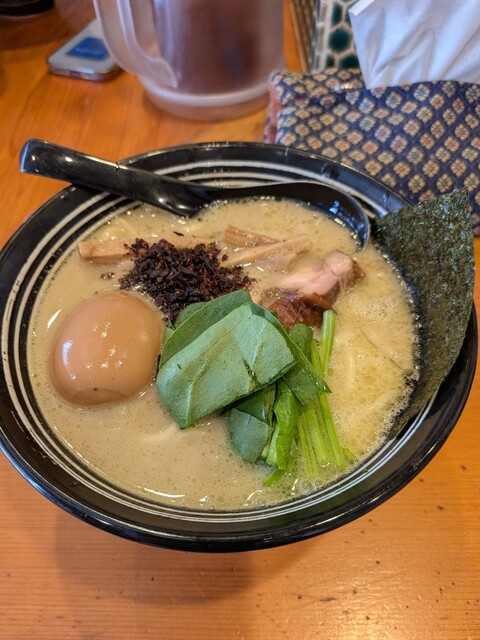
Daigiri is not the postcard side of Fujisawa. The city’s better-known image points toward Enoshima, sea air, and day-trip seafood, but its ramen culture often works inland, in compact rooms where the counter does the heavy lifting and the queue, not the view, sets the mood. Sengyo Toridashi Men Sawamura fits that pattern: a small Fujisawa ramen shop built around the meeting point of fresh-fish stock and chicken broth, the kind of combination that signals a sharper sourcing argument than the standard pork-bone shorthand many visitors associate with Japanese ramen.
That distinction matters in Kanagawa. The prefecture has enough ramen density to reward specialization, and Tabelog’s 2025 Ramen KANAGAWA 100 selection places this address inside a competitive local conversation rather than a tourist checklist. In Fujisawa, where budgets range from sub-JPY 999 bowls at Ramen Jiro Shounan fujisawa ten to multi-course dining at elarte and Chinese Shunsai Chaamaen, ramen occupies a democratic but demanding middle ground. The spending band here sits with Men Dokoro Rajuku rather than with Fujisawa’s formal restaurants, yet the award signal suggests a shop judged on precision, not comfort.
Fresh-fish stock changes the ramen argument in Fujisawa
Ramen built on seafood and chicken stock asks a different question from the heavy, emulsified styles that dominate many overseas ideas of the genre. Fish-based broths can turn thin, salty, or monotone when handled without control; chicken stock adds structure, body, and a quieter sweetness. The appeal is not excess. It is calibration: enough marine depth to distinguish the bowl, enough poultry richness to keep it from reading as soup with noodles.
The menu category listed for the shop is ramen and tsukemen, which also matters. Tsukemen, served with noodles and dipping broth as separate components, tests concentration differently from a standard bowl. A broth can be bolder because it is not consumed in the same ratio, and the noodle texture becomes more exposed. In a city associated by outsiders with the coast, a fresh-fish broth has an obvious regional logic, but the serious point is technical: seafood sourcing only counts when the kitchen can translate it into balance rather than novelty.
That is why this address belongs in a broader Fujisawa itinerary rather than a single-purpose ramen detour. A traveller comparing the city’s food scene might move from casual local anchors such as Asahi Honten to grill-led dining at COOKER'S GRILL, coastal Italian at clarita da marittima, or the broader listings in Our full Fujisawa restaurants guide. Ramen is the category that compresses cost, craft, and speed into the smallest frame. Sawamura’s case for attention is that its broth identity is unusually explicit.
A compact room, a counter-led format, and no ceremony
The room runs to 16 seats: counter seating, tables, and a raised seating area. That scale shapes the experience more than any decorative language could. Small ramen shops in Japan are built for turnover, focus, and audible kitchen rhythm; they rarely need formality to communicate seriousness. The counter is where broth temperature, noodle timing, and service pace become visible, while the tables make the format workable for pairs and small family groups.
The casual register should not be confused with looseness. Tabelog’s 2024 and 2025 Ramen KANAGAWA 100 selections put the shop in a Kanagawa bracket where repeat local approval matters. A 3.71 Tabelog score is not a universal verdict, but in Japan’s conservative rating culture it is a meaningful signal for a ramen specialist. For visitors used to Michelin-led restaurant hierarchies, this is a different kind of trust marker: granular, category-specific, and heavily shaped by local diners.
Fujisawa’s dining range helps explain the appeal. -Grilled beef Sukiyaki- KAMAKURA TANUKIAN 鎌倉 たぬき庵 in Kamakura represents the nearby ceremonial end of the region’s dining map;. 鮪と炭火焼き うお炭 秋葉原店 in Tokyo points toward urban seafood-and-grill drinking culture; (Shoku) Vietnam in Kawasaki shows how Kanagawa absorbs international casual formats. Ramen sits apart because the proposition is narrow and unforgiving. If the broth lacks identity, the whole meal has little else to hide behind.
How to place it in a Fujisawa food day
The strongest use of Sengyo Toridashi Men Sawamura is as a focused ramen stop inside a wider Fujisawa plan, not as a long lunch built around courses. The city rewards that approach. Visitors can treat ramen as the high-information, low-time meal between coastal walking, shopping around Fujisawa Station, or a later dinner at a higher-spend address. Compared with elarte or Chinese Shunsai Chaamaen, the price category lowers the barrier; compared with sub-JPY 999 ramen, the Tabelog 100 recognition suggests a more scrutinized bowl.
The practical character is part of the editorial recommendation. Reservations are unavailable, payment is cash-only across cards, electronic money, and QR payments, and the shop is non-smoking. Children are marked as welcome, which broadens its usefulness beyond solo ramen hunting. The opening date, April 2016, also gives it enough tenure to read as an established Fujisawa specialist rather than a passing trend.
For a broader Japan-and-beyond comparison of casual specialist formats, note how compact concepts travel in different directions at.cafe in Osaka.know in Kumamoto, [Curry Senmon Ten] Maruyama Kyoju. in Sapporo, Jōdo Saké Bar in Los Angeles, and Onigiri Time in Pasadena. The useful conclusion is simple: this is a casual Fujisawa ramen address with a defined broth thesis, credible local recognition, and enough logistical clarity to work into a serious day of eating without turning the schedule around it.
Comparison Snapshot
Comparable venues by cuisine and price in the same metro.
| Venue | Cuisine | Price | Notes |
|---|---|---|---|
| Sengyo Toridashi Men SawamuraThis venue — the venue you are viewing | Japanese Ramen | $ | Not listed |
| Sushi Tomi | Traditional Sushi Counter | $$$ | Fujisawa |
| The Market SE1 | Gelato Cafe | $ | Katase Kaigan / Enoshima |
| POURQUOI | European-style bakery & cafe | $ | Fujisawa |
| Men Dokoro Rajuku | Japanese Ramen | $ | Fujisawa |
| Hilo Homemade Ice Cream | Hawaiian-style Ice Cream Shop | $ | Kugenumakaigan |
Recognition history
Dated appearances from independent guides and award organizations, with the underlying list record or original source where available.
Tabelog 100 #15 · No. 15
Tabelog · Tabelog 100 - Ramen - KANAGAWA - 2025










At a Glance
- Cozy
- Casual
- Solo
- Casual Hangout
- Standalone
Current opening hours
- Monday
- 11 AM–2:30 PM, 5:30–9 PM
- Tuesday
- 11 AM–2:30 PM
- Wednesday
- Closed
- Thursday
- 11 AM–2:30 PM, 5:30–9 PM
- Friday
- 11 AM–2:30 PM, 5:30–9 PM
- Saturday
- 11 AM–2:30 PM, 5:30–9 PM
- Sunday
- 11 AM–2:30 PM, 5:30–9 PM
Hours can change for holidays and private events. Last verified .
Casual, compact ramen-shop atmosphere focused on quick noodle service.