Scharffs Schlossweinstube
Our verdict
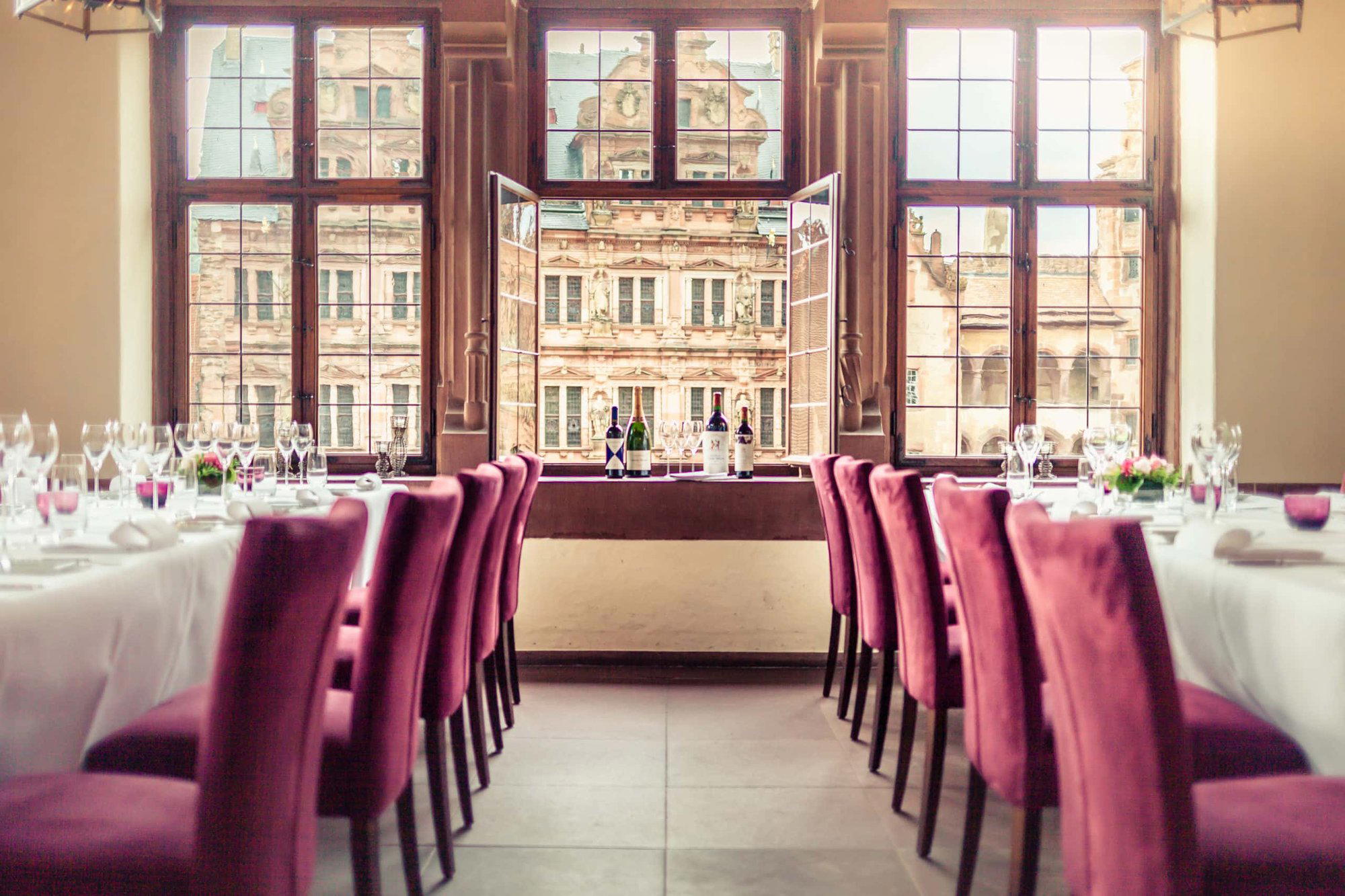
Scharffs Schlossweinstube occupies one of the most geographically charged dining addresses in Germany, set within the courtyard of Heidelberg Castle. The restaurant sits at the intersection of historic architecture and regional cuisine, where the Neckar valley and Baden wine country converge. For visitors to Heidelberg, it represents the castle precinct's most direct encounter with serious German cooking.

Pearl is the En Primeur Club membership app, where members save venues, book tables and use the concierge.
The menu
What to order
- Swabian ravioli
- Roast duck
Dining Inside the Castle Walls
There are few dining addresses in Germany where the physical setting does as much editorial work as the food. Scharffs Schlossweinstube, positioned within the courtyard of Heidelberg Castle at Schlosshof 1, belongs to a category of restaurant defined almost entirely by location first. The castle itself dates to the 13th century and was transformed into a Renaissance residence by the Electors Palatine, which means that arriving for dinner involves passing through one of the most architecturally layered ruins in Central Europe. That context shapes the experience before anyone sits down.
Heidelberg's dining scene has evolved considerably in recent years. The city now supports a range of price tiers and cuisines, from the contemporary European cooking at Oben to the more accessible international format at Chambao. What positions Scharffs Schlossweinstube differently from peers like 959 or [CANTINACCIA] is not primarily a matter of cuisine style but of placement. No other restaurant in the city operates from inside the castle precinct itself, which changes the terms of the meal entirely.
What the Location Means for the Experience
Dining rooms with historic pedigree often lean on atmosphere as a substitute for culinary ambition. The more interesting question at a venue like this is whether the setting and the cooking form a coherent argument, or whether one overwhelms the other. For restaurants occupying landmark buildings across Germany, the pattern is familiar: the room sells itself and the kitchen operates in its shadow. Venues that resist that dynamic tend to anchor their offer in regional produce and wine, using the geography to give the food a sense of place that matches the architecture.
Heidelberg sits at the northern edge of Baden, one of Germany's warmer and more diverse wine regions, and close enough to the Rhineland-Palatinate to draw from that tradition as well. A restaurant in the castle's Weinstube format, as the name signals, is organized around wine alongside food rather than treating the cellar as an afterthought. The Weinstube tradition in southern Germany occupies a distinct tier between the casual Straußwirtschaft and the full formal restaurant, and it tends to privilege regional bottles and seasonal cooking over the architectural ambition of the room. That framing matters for setting expectations.
For comparison, consider how Germany's most recognized fine dining addresses handle the relationship between setting and substance. Schwarzwaldstube in Baiersbronn and Waldhotel Sonnora in Dreis both operate from deeply atmospheric locations while sustaining multi-Michelin-star kitchens. Schanz in Piesport and ES:SENZ in Grassau take a different approach, grounding serious cooking in quieter regional contexts. Scharffs Schlossweinstube operates outside that Michelin-starred tier, but the question of how a kitchen uses its location remains the same regardless of accolades.
Heidelberg Castle as a Dining Address
The castle sits above the old town on the Königstuhl hillside, reached most directly by the Bergbahn funicular from Kornmarkt or on foot via the Burgweg path. This access dynamic means that dinner here involves a degree of intentionality that a street-level restaurant in the Altstadt does not require. Guests who make the journey, particularly in the evening when the old town crowd has thinned, find a precinct that reads very differently from its daytime tourist mode.
That shift in character is worth noting for planning purposes. The castle grounds draw significant visitor numbers during daylight hours, particularly in summer, and the restaurant operates within that environment. An evening reservation changes the calculation, offering the courtyard at a quieter register. The castle's position above the Neckar also means that the views across the river to the Neuenheim and Handschuhsheim districts are available to those seated near the windows or outside during the warmer months.
Within Heidelberg's broader dining picture, the castle address occupies a position that few domestic or international equivalents can replicate. Germany has a handful of restaurants embedded in historic castle or palace complexes, but the combination of a partially ruined Romantic-era landmark, a functioning Weinstube, and a city with a genuine university and cultural identity makes Heidelberg a specific case. Visitors working through the full range of what the city offers should consult our full Heidelberg restaurants guide for context on how Scharffs fits into the wider scene alongside venues like Akam's Heidelberg.
German Fine Dining Beyond the Castle
For those whose trip extends beyond Heidelberg, the broader German fine dining circuit rewards planning. Aqua in Wolfsburg and Vendôme in Bergisch Gladbach represent the country's upper tier. JAN in Munich, Victor's Fine Dining by Christian Bau in Perl, and Restaurant Haerlin in Hamburg complete a picture of a national dining culture that has moved well past its post-war reputation for heaviness. For those extending to Berlin, CODA Dessert Dining offers a technically distinct format worth understanding. International reference points at the highest level, such as Le Bernardin in New York City and Atomix in New York City, illustrate how the global fine dining conversation has shifted toward tighter, more focused formats that German kitchens are engaging with in their own terms.
Planning Your Visit
Reaching Scharffs Schlossweinstube requires arriving at the castle, which sits on the hillside above Heidelberg's Altstadt. The Bergbahn funicular from Kornmarkt runs regularly and is the most practical option for those not on foot. The address, Schlosshof 1, places the restaurant within the castle's inner courtyard. Given the location's popularity and the limited number of dining options within the precinct itself, booking ahead is advisable, particularly for weekend evenings and the summer months when the castle draws its highest visitor volumes.
Frequently asked questions
Where is Scharffs Schlossweinstube located?
Scharffs Schlossweinstube is located at Schlosshof 1, 69117 Heidelberg, Germany, Heidelberg.
Is Scharffs Schlossweinstube inside Heidelberg Castle itself, and how does that affect the dining experience?
The restaurant's address, Schlosshof 1, places it within the castle precinct on the Königstuhl hillside above Heidelberg's Altstadt, not in the city below. That position means the setting does structural work that no interior design budget could replicate: guests eat against a backdrop of partial Baroque ruin that has defined Heidelberg's identity since the German Romantic movement. Reaching the venue requires either the Bergbahn funicular from Kornmarkt or the uphill walk via the Burgweg, so factor in travel time when planning arrival.
What should I order at Scharffs Schlossweinstube?
The Weinstube format, combined with Heidelberg's position on the edge of Baden wine country, points strongly toward regional German cooking, expect dishes that pair with local Spätburgunder and Grauburgunder rather than an international carte. Arriving with appetite for seasonal German cuisine and an interest in Baden-area wines is the sensible approach.
At a Glance
Comparable venues nearby, for context on price, style, and recognition.
| Venue | Cuisine | Price | Awards | Notes |
|---|---|---|---|---|
| Scharffs SchlossweinstubeThis venue (the venue you are viewing) | Classic German Fine Dining | $100–150 | Not listed | Not listed |
| Weinstube Schnitzelbank | Traditional German Regional | $20–30 | Not listed | Altstadt, Traditional German Regional |
| Traube | Modern Regional German Fine Dining | Not listed | Michelin Plate | Rohrbach, Modern Regional German Fine Dining |
| Restaurant zur Herrenmühle | Modern French Crossover Gourmet | Not listed | Not listed | Altstadt, Modern French Crossover Gourmet |
| Weisser Bock | Traditional German Fine Dining | $50–100 | Michelin Plate | Altstadt, Traditional German Fine Dining |
| [CANTINACCIA] | Authentic Italian Trattoria | Not listed | Not listed | Handschuhsheim, Authentic Italian Trattoria |
Continue exploring
More in Heidelberg
Restaurants in Heidelberg
All restaurants in Heidelberg →
Bars in Heidelberg
All bars in Heidelberg →
Hotels in Heidelberg
All hotels in Heidelberg →

Scharffs Schlossweinstube
The wine
- Wine program
- Deep wine list
- Extensive wine list
Details
- Romantic
- Elegant
- Classic
- Cozy
- Sophisticated
- Date Night
- Special Occasion
- Celebration
- Historic Building
- Terrace
- Extensive Wine List
- A La Carte
- Prix Fixe
- Wine
- Vegetarian Friendly
- Vegan Options
Current opening hours
- Monday
- Closed
- Tuesday
- Closed
- Wednesday
- Closed
- Thursday
- 6 PM–12 AM
- Friday
- 6 PM–12 AM
- Saturday
- 6 PM–12 AM
- Sunday
- Closed
Hours can change for holidays and private events. Hours as of .
Romantic and refined with classic parquet flooring, sparkling chandeliers, and stucco ceilings in a historic Baroque setting.