Our verdict
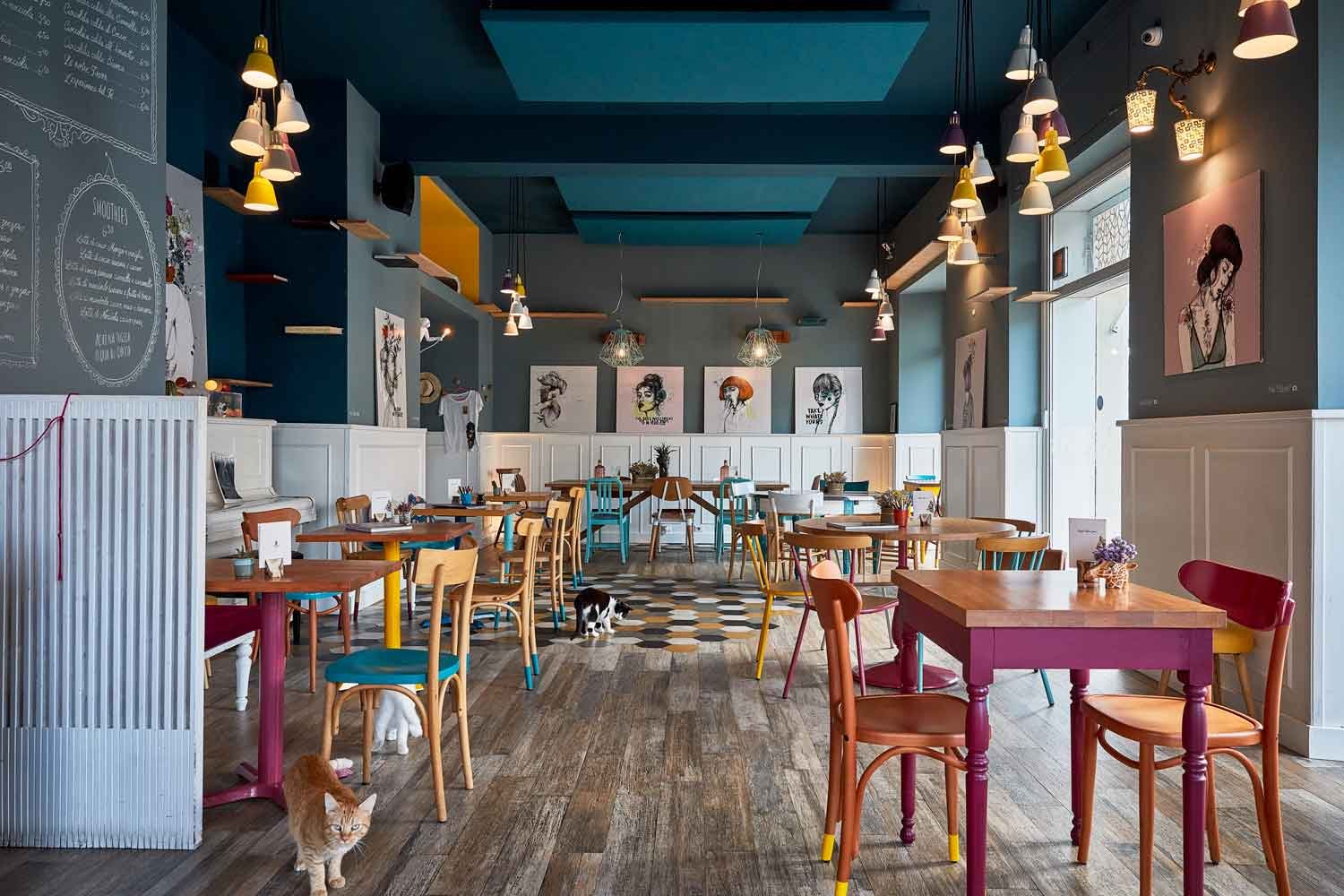
A plant-based bistrot and cat sanctuary on Via Francesco Negri in Rome's Ostiense quarter, Romeow Cat Bistrot occupies an unusual position in the city's dining scene, somewhere between vegan café and resident feline colony. It draws a consistent crowd that values its informal ethos and Ostiense's broader reputation as Rome's most creatively restless neighbourhood. Booking ahead is advisable.

Pearl is the En Primeur Club membership app, where members save venues, book tables and use the concierge.
The menu
What to order
- Carciofo croccante
- Maritozzo salato
Ostiense's Unlikely Dining Experiment
Rome's dining scene has long organised itself around tradition, cacio e pepe at neighbourhood trattorias, tasting menus at Michelin-decorated rooms like La Pergola or Il Pagliaccio, and little conceptual ground between those two poles. The Ostiense district has quietly carved out a third lane. Home to street art corridors, repurposed industrial spaces, and a younger residential crowd, it functions as the city's most creatively permissive quarter, the kind of neighbourhood that tolerates formats that would struggle to find footing in Parioli or Prati. Romeow Cat Bistrot, on Via Francesco Negri, is one of those formats: a plant-based kitchen operating inside a space shared with resident cats, a combination that reads as either charming or eccentric depending entirely on your expectations walking in.
The concept belongs to a category that has grown steadily across northern European and East Asian cities, Tokyo alone has hosted cat cafés since the early 2000s, but remains genuinely rare in Italian dining culture, where the idea of animals in a food-service environment collides with entrenched regulatory and culinary norms. That Romeow has established itself in Rome, of all cities, and done so with enough consistency to develop a reputation, places it as a minor anomaly worth understanding on its own terms.
The Format and What It Tells You About the Booking
The editorial angle on Romeow is inseparable from the logistics of getting a table. Places like this, small-capacity, concept-driven, with a specific audience and no obvious corporate infrastructure behind them, tend to operate with limited hours and finite covers. The format is not designed for throughput. You are not booking a restaurant so much as reserving time inside a particular kind of domestic environment, one where the cats are not props but full-time residents.
That framing matters for planning. Walk-ins at venues of this type are generally unreliable, particularly at peak hours or on weekends, and Romeow's address in Ostiense means it draws visitors from outside the immediate neighbourhood who plan the visit deliberately rather than dropping in by chance. The practical advice, check the venue's current booking channels before making travel plans around a visit, applies here more than it would at a direct neighbourhood trattoria.
This is not the booking anxiety of a three-Michelin-star counter. It is a different kind of scarcity: intimate scale, irregular hours, and a format that does not scale up to absorb demand spikes. Rome's formally decorated restaurants, Acquolina, Enoteca La Torre, Achilli al Parlamento, have structured reservation systems with predictable lead times. Romeow operates closer to how a well-regarded neighbourhood café manages its room: somewhat informally, with supply that does not flex to meet demand.
Plant-Based Dining in a City That Has Not Fully Arrived There
Italian cuisine's identity is deeply meat-adjacent. Even dishes that appear vegetarian on the surface, pasta all'amatriciana, ribollita, the countless preparations built on soffritto, often carry animal products at their structural base. Plant-based dining in Italy has historically meant absence rather than intention: the vegetable side dish, the cheese plate, the course skipped rather than substituted. Serious plant-based kitchens, the kind that treat vegetables as a primary creative medium rather than an accommodation, remain sparse in Rome compared to cities like London, Berlin, or New York.
Romeow's position in that context is more significant than it might appear in a city where vegan options have expanded but plant-based ambition has not always followed. This is not fine-dining territory in the mode of Italy's destination restaurants, the tasting-menu ambition of Osteria Francescana in Modena, or the seafood-led creativity of Uliassi in Senigallia, but it occupies a gap that the formal dining tier does not address and that most Roman trattorias are not equipped to fill.
The audience for a place like this in Rome is relatively defined: international visitors with dietary commitments, a local creative-class crowd concentrated in neighbourhoods like Ostiense and Pigneto, and people for whom the cat element is a draw rather than a curiosity. That is a narrower base than a conventional bistrot would draw from, which in turn reinforces the booking logic: smaller potential audience, but one with strong intent, means covers fill on a different pattern than at a generalist venue.
Where Romeow Sits in Rome's Broader Dining Geography
Any serious trip to Rome's table involves decisions about register. At the top of the formal scale, rooms like La Pergola require advance planning measured in months. Below that, the creative-contemporary tier, venues with Michelin recognition and tasting formats, occupies a reliable middle band. Romeow is neither of those things. It competes, if that is even the right frame, with Rome's informal café culture rather than its restaurant hierarchy.
That informality is part of what makes Ostiense the right neighbourhood for it. The quarter's conversion of disused industrial buildings into arts venues, studios, and independent food operations mirrors what other European capitals did to their post-industrial peripheries a decade earlier. Rome arrived later to that shift, and Ostiense remains less polished than comparable districts in Milan or Florence. For visitors tracking Italy's broader restaurant culture, from the pastoral precision of Dal Pescatore in Runate to the alpine rigour of Atelier Moessmer Norbert Niederkofler in Brunico, Romeow reads as the city's low-key counterargument to the idea that Italian dining only makes sense through classical technique and regional tradition.
It is also worth placing Romeow in the context of how concept-led dining formats have evolved globally. The cat café model that took root in Asia and moved into European cities has generally struggled to sustain food quality alongside the animal-welfare and hygiene requirements that regulators impose. The venues that have lasted, and Romeow appears to be among them, have done so by treating the kitchen with at least the same seriousness as the feline side of the proposition. Whether Romeow clears that bar consistently is a question the venue's own track record answers better than any editorial characterisation can.
Know Before You Go
- Address: Via Francesco Negri, 15, 00154 Roma, Italy (Ostiense district)
- Cuisine type: Plant-based / vegan bistrot with a resident cat colony on the premises
- Booking: Walk-in availability is unreliable given the small-format nature of the venue; check current reservation channels before your visit
- Hours: Not confirmed, verify directly before travel
- Getting there: Ostiense is served by the Roma-Lido train line (Ostiense station) and multiple bus routes; it sits south of the city centre, roughly 20 minutes from Termini by public transport
- Leading for: Plant-based travellers, visitors with an interest in Rome's non-traditional dining formats, and anyone spending time in the Ostiense creative quarter
Frequently asked questions
What part of town is Romeow Cat Bistrot in?
Romeow Cat Bistrot is located at Via Francesco Negri, 15, 00154 Roma RM, Italy, Rome.
Is Romeow Cat Bistrot suitable for visitors with dietary restrictions beyond veganism?
Because the kitchen operates on a fully plant-based model, it eliminates the most common dietary friction points for vegan and many vegetarian diners by default. The address is Via Francesco Negri, 15, Rome (Ostiense), where staff can advise on current menu composition.
Do they take walk-ins at Romeow Cat Bistrot?
Walk-ins are possible, but the small-capacity setup at Via Francesco Negri, 15 means covers fill fast, especially on weekends and during peak Rome tourist seasons. Booking ahead is the practical approach for anyone treating this as a planned stop rather than a speculative one. Arriving early in a session gives the best chance of getting in without a reservation.
What has Romeow Cat Bistrot built its reputation on?
Two things that are independently uncommon in Rome and genuinely rare together: a plant-based kitchen that holds to a vegan position without compromise, and a resident-cat café format in a city where that concept has almost no precedent. Rome's dining identity is built around meat-adjacent tradition, which makes Ostiense's Romeow an outlier by design rather than by accident. That specificity of concept is what has driven its following.
The Essentials
Comparable venues nearby, for context on price, style, and recognition.
| Venue | Cuisine | Price | Notes |
|---|---|---|---|
| Romeow Cat BistrotThis venue (the venue you are viewing) | Vegan Cat Bistrot | $20–30 | Not listed |
| The Barber Shop | Speakeasy Cocktails | Not listed | Monti, Speakeasy Cocktails |
| Barnum Roma | Specialty Cafe with Brunch | $20–30 | Parione, Specialty Cafe with Brunch |
| Arso Trattoria Moderna | Traditional Roman Trattoria | $20–30 | Not listed |
| Papa Giovanni | Traditional Roman Trattoria | Not listed | San Eustachio, Traditional Roman Trattoria |
| Ciampini Bistrot | Traditional Roman Trattoria | $20–30 | Campo Marzio, Traditional Roman Trattoria |
Continue exploring
More in Rome
Restaurants in Rome
All restaurants in Rome →
Bars in Rome
All bars in Rome →

Details
- Cozy
- Whimsical
- Intimate
- Casual Hangout
- Date Night
- Historic Building
- Organic
- A La Carte
- Vegan Options
- Vegetarian Friendly
- Gluten Free Options
Current opening hours
- Monday
- Closed
- Tuesday
- 10–11:30 AM, 1–2:30 PM, 4–6:30 PM, 8–11 PM
- Wednesday
- 10–11:30 AM, 1–2:30 PM, 4–6:30 PM, 8–11 PM
- Thursday
- 10–11:30 AM, 1–2:30 PM, 4–6:30 PM, 8–11 PM
- Friday
- 10–11:30 AM, 1–2:30 PM, 4–6:30 PM, 8–11 PM
- Saturday
- 10–11:30 AM, 1–2:30 PM, 4–6:30 PM, 8–11 PM
- Sunday
- 10–11:30 AM, 1–2:30 PM, 4–6:30 PM, 8–11 PM
Hours can change for holidays and private events. Hours as of .
Cozy and welcoming atmosphere with cats wandering among the tables.