
A compact American-style burger diner in Higashi Shibuya, Reg-On Diner Shibuya hon ten sits in Tokyo’s serious casual-food tier rather than its tasting-menu economy. Its Tabelog Hamburger “Tabelog 100” 2026 selection, long run since 2008, and 19-seat scale make it a useful counterpoint to the city’s reservation-led dining culture.
Pearl is the En Primeur Club membership app — saves, bookings, and concierge access live there. Same editors, same standards.
- Address
- 東京都渋谷区東1-8-1 K HOUSE 1F
- Phone
- +81334985488
- Website
- regondiner.com
 Saves & bookings on Pearl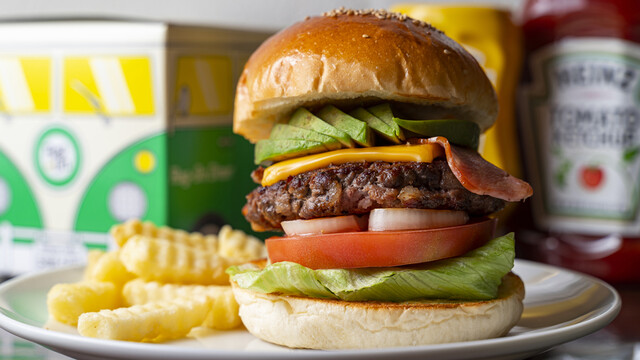
Higashi Shibuya changes the tempo: station-side glare gives way to quieter blocks between Shibuya and Ebisu, where small restaurants rely less on spectacle than repeat use. Here, the American diner reads differently from its U.S. source: tighter, edited, and folded into Tokyo’s habit of treating casual food with the seriousness often given to sushi counters and kappo rooms.
Tokyo’s burger culture has moved beyond novelty Americana into a defined craft-burger category, judged on patty sourcing, bun structure, service rhythm, and whether the room can carry both lunch traffic and destination diners. Reg-On Diner Shibuya hon ten belongs to that mature field. Its 2026 selection in Tabelog Hamburger “Tabelog 100” places it in a national conversation about Japanese burger shops, not just as a neighbourhood snack stop.
American diner grammar, translated into Shibuya scale
Read this not as a reproduction of an American roadside diner, but as Tokyo’s edited version of one. The format is familiar: hamburgers, cafe use, American references, a relaxed room, and take-out. The scale is local and compact, with 19 seats and terrace seating that also accounts for pets. In Tokyo, small capacity turns convenience into something closer to a counter-culture ritual, even when the category is casual.
The kitchen’s anchor is additive-free Australian beef, which explains why the restaurant sits in the craft-burger lane rather than fast food. Tokyo diners make distinctions inside categories outsiders often flatten. Ramen is not just ramen; tonkatsu is not just pork cutlet; a hamburger is not automatically a quick compromise between serious meals. Here, the point is a burger shop that can hold its ground in a city where casual specialism is heavily scrutinised.
Tabelog recognition is stronger than a generic popularity claim. “Tabelog 100” lists tend to reward consistency in crowded categories, and Japan’s hamburger field is now dense enough to make selection meaningful. This is not the same competitive set as high-spend Ginza sushi or a long kaiseki menu. It is Tokyo’s everyday-specialist circuit, where a restaurant can be inexpensive, narrow in focus, and still highly judged by diners who know the category.
Where the drinks question fits in a burger city
With an American diner, the easy temptation is to ask about the cellar, but the smarter read is broader: Tokyo’s casual Western-format restaurants rarely compete through wine depth alone. Their curation shows in proportion, pacing, and how the room handles different uses across the day. A burger shop in this bracket does not need a grand bottle list to be taken seriously; it needs clear food identity, dine-in and take-out flexibility, and a room that survives lunch demand.
That distinction helps travellers who build Tokyo itineraries around drinking as much as dining. A night might place sake, cocktails, or wine elsewhere, while a burger lunch asks another question: how does Tokyo absorb imported food forms and make them precise without making them stiff? For planning, Our full Tokyo bars guide and Our full Tokyo wineries guide are better for beverage-led stops; this address belongs to the food-specialist map.
In Shibuya, that map is fragmented. The area can mean station malls, late-night drinking, youth retail, backstreet cafes, or serious small restaurants, depending on exit and slope. Higashi has a softer register than scramble-crossing Shibuya. It suits a diner format because the American reference is filtered through a quieter Tokyo block, not staged as theme-park gesture.
Comparison clarifies the role. Kuhara sits in a Japanese ¥¥ lane, Jukuseizushi Yorozu in a high-spend sushi tier, and CHIKAMINE in a much more expensive bracket. Those answer different travel needs: cuisine depth, ceremony, or larger evening spend. Reg-On Diner Shibuya hon ten gives the city’s casual-specialist side equal respect, sitting between heavier bookings without feeling like a downgrade in intent.
How to place it in a Tokyo food itinerary
The strongest case is itinerary balance. Tokyo rewards diners who alternate formal meals with focused casual addresses. A day built around omakase, yakitori, or yakiniku can become monotonous if every booking demands full attention and a long seated arc. A burger specialist gives a different read on the city: imported format, Japanese precision, modest scale, and a neighbourhood central without being trapped in Shibuya’s main current.
For readers mapping the wider city, it pairs naturally with other category-specific stops rather than another burger. Tokyo’s range can stretch from 124. KAGURAZAKA (Yakitori) to 3 Chome no Curry Ya San, from 12/10 Shinjuku ten to. 鮪と炭火焼き うお炭 秋葉原店. That spread is the point: the city’s dining intelligence is distributed across narrow formats, not concentrated only in high-price rooms.
Visitors beyond Tokyo can use the same logic across Japan. A compact cafe such as 2D Cafe speaks to visual concept dining, while.cafe in Osaka.know in Kumamoto, (Shoku) Vietnam in Kawasaki, [Curry Senmon Ten] Maruyama Kyoju. in Sapporo, and [ki:] in Kyoto show how tightly focused restaurants can carry a city’s personality. Outside Japan, Jōdo Saké Bar in Los Angeles and Onigiri Time in Pasadena offer another angle on Japanese food culture abroad.
Practical judgement is simple: come for the burger category, not ceremony. The restaurant has been open since 2008, accepts reservations, maintains a non-smoking policy, supports take-out, and lists an English menu, making it easier for travellers than many small specialist rooms. Payment flexibility is broader than the old cash-only stereotype of Tokyo casual dining. For larger city planning, use Our full Tokyo restaurants guide alongside Our full Tokyo hotels guide and Our full Tokyo experiences guide.
The editorial value is not that a hamburger becomes luxury by association. It is that Tokyo gives low-cost specialism enough structure to matter. Reg-On Diner Shibuya hon ten occupies that lane cleanly: a small Higashi Shibuya room, American diner vocabulary, a serious burger signal through Tabelog Hamburger “Tabelog 100” 2026, and a price tier that makes it a sharp casual meal rather than a major-night commitment.
Where the Accolades Land
Comparable venues side-by-side for orientation.
| Venue | Cuisine | Price | Notes |
|---|---|---|---|
| Reg-On Diner Shibuya hon tenThis venue — the venue you are viewing | Gourmet American Burger Diner | $$ | Not listed |
| Brothers Nihonbashi takashimaya ten | Gourmet Hamburger Restaurant | $$ | Chūō |
| Chillmatic Hamburger & Bistro | Burger bistro | $$ | Shibuya |
| fummy's grill | California Cuisine with Asian-Western Fusion | $$ | Shibuya |
| ババ・ガンプ・シュリンプ 東京店 | American Seafood - Shrimp Specialists | $$ | Bunkyō |
| OLD NEW DINER | Gourmet American-style Burger Diner | $$ | Tachikawa |
Recognition history
Dated appearances from independent guides and award organizations, with the underlying list record or original source where available.
Tabelog 100 #21 · No. 21
Tabelog · Tabelog 100 - Hamburger - 2026













At a Glance
- Cozy
- Lively
- Trendy
- Casual Hangout
- Date Night
- Family
- Group Dining
- After Work
- Private Event
- Standalone
- Design Destination
- Private Dining
- Beer Program
- Street Scene
Casual neighborhood American-style burger diner with cozy seating, lively but relaxed energy, and a slightly retro feel that is popular for dates, families, and small celebrations.