
RAMAI Yokohama isezaki mo-ru ten puts Yokohama’s curry culture into a soup-curry frame, with Indonesian and Japanese curry signals in the same room. Its selection for Tabelog Curry EAST “Tabelog 100” in 2019, 2020, 2023, and 2024 gives it a clear credential in a category where local repeat custom matters as much as ceremony.
Pearl is the En Primeur Club membership app — saves, bookings, and concierge access live there. Same editors, same standards.
- Address
- Japan, 〒231-0045 Kanagawa, Yokohama, Naka Ward, Isezakichō, 1 Chome−6-5 Kiraku, 7F
- Phone
- +81 45-308-8338
- Website
- ramai.co.jp
 Saves & bookings on Pearl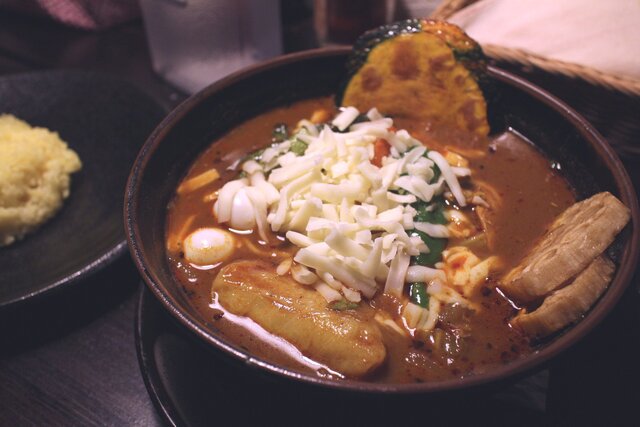
Isezaki Mall has the particular rhythm of central Yokohama commerce: station traffic, casual eating, and multi-floor addresses stacked above street-level convenience. In that setting, curry reads less as a special-occasion category than as urban fuel, but Yokohama’s better curry rooms have become more specific than the generic roux-and-rice template. Soup curry, spice-led Japanese curry, South Asian formats, and hybrid menus now sit close enough for serious comparison.
RAMAI Yokohama isezaki mo-ru ten belongs to the soup-curry side of that conversation, with Indonesian and curry categories attached rather than a narrow Japanese curry label. That matters because soup curry is built around broth, spice extraction, vegetables, and protein in a looser structure than the thick, sweet-leaning curry rice familiar across Japan. The pleasure is not only heat; it is how the bowl carries aromatics and texture without turning into a single uniform sauce.
Soup curry in Yokohama is a sourcing argument, not just a spice argument
Curry in Japan often gets discussed through regional style, but ingredient handling is the sharper lens here. Soup curry depends on components remaining legible: broth, spice base, rice, vegetables, and whatever protein or garnish completes the order. A kitchen in this genre has less cover than a heavy roux shop, because thinness exposes imbalance. When the format works, sourcing and prep show through in the way vegetables hold shape, rice keeps its role, and broth carries spice without swallowing the bowl.
That is why the Tabelog Curry EAST “Tabelog 100” selections in 2019, 2020, 2023, and 2024 are useful signals. They place the restaurant inside a regional curry cohort rather than a general dining popularity contest. A Tabelog score of 3.57 also sits in a zone that matters in Japan’s user-review culture, where high-scoring casual specialists often earn attention through repeat local use rather than luxury cues. The category is crowded, and recognition here points to consistency in a field where small variations in broth depth, rice quality, and spice balance separate everyday curry from a destination bowl.
The Indonesian tag adds a further clue. Yokohama’s dining culture has long absorbed outside influences through port-city exchange, but curry has its own route into Japanese daily eating, from naval and home-style versions to contemporary spice shops. A soup-curry room with Indonesian adjacency suggests a broader spice register than standard curry rice, while staying within a casual, accessible format. The result is a useful counterpoint to Yokohama’s higher-priced dining and bar circuits: serious category credibility without the theatre of a tasting-menu room.
Where it fits among Yokohama's casual specialists
The more interesting comparison is not luxury dining versus curry; it is how Yokohama’s casual specialists divide by purpose. A visitor moving through the city might use 1000 (Yakitori (Grilled chicken skewers)) for grilled-chicken skewers, Aichun for a different local register, or Ajowan and Alpenjiro Honten to keep the curry comparison tighter. That spread says something useful about Yokohama: the city rewards diners who treat modest formats with the same seriousness usually reserved for formal counters.
Within the comparison set, Marumasara sits in a similar everyday curry price band, while Toraya reaches higher at dinner and Spice Drunker yabuya moves into a much more expensive bracket. Bar Noble, by contrast, belongs to Yokohama’s cocktail economy rather than its curry circuit. Those contrasts help define the decision. RAMAI Yokohama isezaki mo-ru ten is not competing on rarity, chef mythology, or private-room polish. It competes on the reliability of a focused curry format, a seat count large enough for regular traffic, and recognition from a curry-specific list.
For travellers building a food map beyond one meal, the city’s range is better read by category than by prestige alone. Our full Yokohama restaurants guide gives the wider dining frame, while Our full Yokohama hotels guide, Our full Yokohama bars guide, Our full Yokohama wineries guide, and Our full Yokohama experiences guide show how the city works across a full itinerary. The same logic extends outside Yokohama: -Grilled beef Sukiyaki- KAMAKURA TANUKIAN 鎌倉 たぬき庵 in Kamakura. 鮪と炭火焼き うお炭 秋葉原店 in Tokyo.cafe in Osaka.know in Kumamoto, (Shoku) Vietnam in Kawasaki, [Curry Senmon Ten] Maruyama Kyoju. in Sapporo, Anzen Shokudo, Jōdo Saké Bar in Los Angeles, and Onigiri Time in Pasadena each make more sense when judged by format discipline rather than grand claims.
A practical curry choice with real category credentials
The case for this room is strongest for diners who want Yokohama curry with a clear point of view. The format is casual and family-friendly, with children welcome, counter and couple seating listed among the room options, and no private rooms. Reservations are not offered, which suits the genre: curry here belongs to the daily city rather than the advance-planned dining calendar. Non-smoking status and broad payment acceptance also make it easier to fold into a day around Kannai and Isezaki without turning the meal into an expedition.
The editorial read is simple: choose it when soup curry is the target, not when the night calls for ceremony. Yokohama has flashier categories and more expensive rooms, but this address occupies a useful lane, a curry specialist with repeated Tabelog Curry EAST “Tabelog 100” recognition and a format that makes ingredient clarity central to the experience. In a city where the strongest meals are often found by choosing a category with precision, that is enough reason to pay attention.
Quick Comparison
Comparable venues by category and price.
| Venue | Cuisine | Price | Notes |
|---|---|---|---|
| RAMAI Yokohama isezaki mo-ru tenThis venue — the venue you are viewing | Hokkaido-style soup curry & Indonesian-inspired curry | $$ | Not listed |
| ロックンスリー | Jidori Chicken Shoyu Ramen | $$ | Shin-Yokohama |
| TRICK (鶏喰) | Chicken Shoyu Ramen | $$ | Yoshinocho |
| hoshinochuukasoba | Ramen and Tsukemen | $$ | Kanazawa |
| Kuri Yama | Japanese Tsukemen / Ramen | $$ | Kanagawa |
| Tonkatsu Aoki Yokohama bashamichi ten | Japanese Tonkatsu | $ | Naka |
Recognition history
Dated appearances from independent guides and award organizations, with the underlying list record or original source where available.
Tabelog 100 #87 · No. 87
Tabelog · Tabelog 100 - Curry - EAST - 2024










At a Glance
- Cozy
- Lively
- Bohemian
- Solo
- Family
- Group Dining
- Casual Hangout
- After Work
- Late Night
- Standalone
- Design Destination
Current opening hours
- Monday
- 11:30 AM–10 PM
- Tuesday
- 11:30 AM–10 PM
- Wednesday
- 11:30 AM–10 PM
- Thursday
- 11:30 AM–10 PM
- Friday
- 11:30 AM–10 PM
- Saturday
- 11:30 AM–10 PM
- Sunday
- 11:30 AM–10 PM
Hours can change for holidays and private events. Last verified .
Interior is intentionally dim with many partitions, larger tables, and authentic Balinese furnishings and paintings sourced from Bali, creating a relaxed, exotic bar-like atmosphere that still feels casual and bustling during peak times.