Puffer-Imbiss sits on Hasenheide in Neukölln-Kreuzberg, one of Berlin's most food-dense street corridors, where the imbiss format has long served as the city's democratic dining institution. Against a backdrop of Michelin-chasing tasting menus at venues like Nobelhart & Schmutzig and CODA Dessert Dining, this counter-service spot represents a different register entirely: fast, direct, and rooted in the everyday.
Pearl is the En Primeur Club membership app — saves, bookings, and concierge access live there. Same editors, same standards.
- Address
- Hasenheide, 10967 Berlin, Germany
- Phone
- +491784639436
- Website
- puffer-imbiss.9gg.de
- Directions
- Get directions
 Saves & bookings on Pearl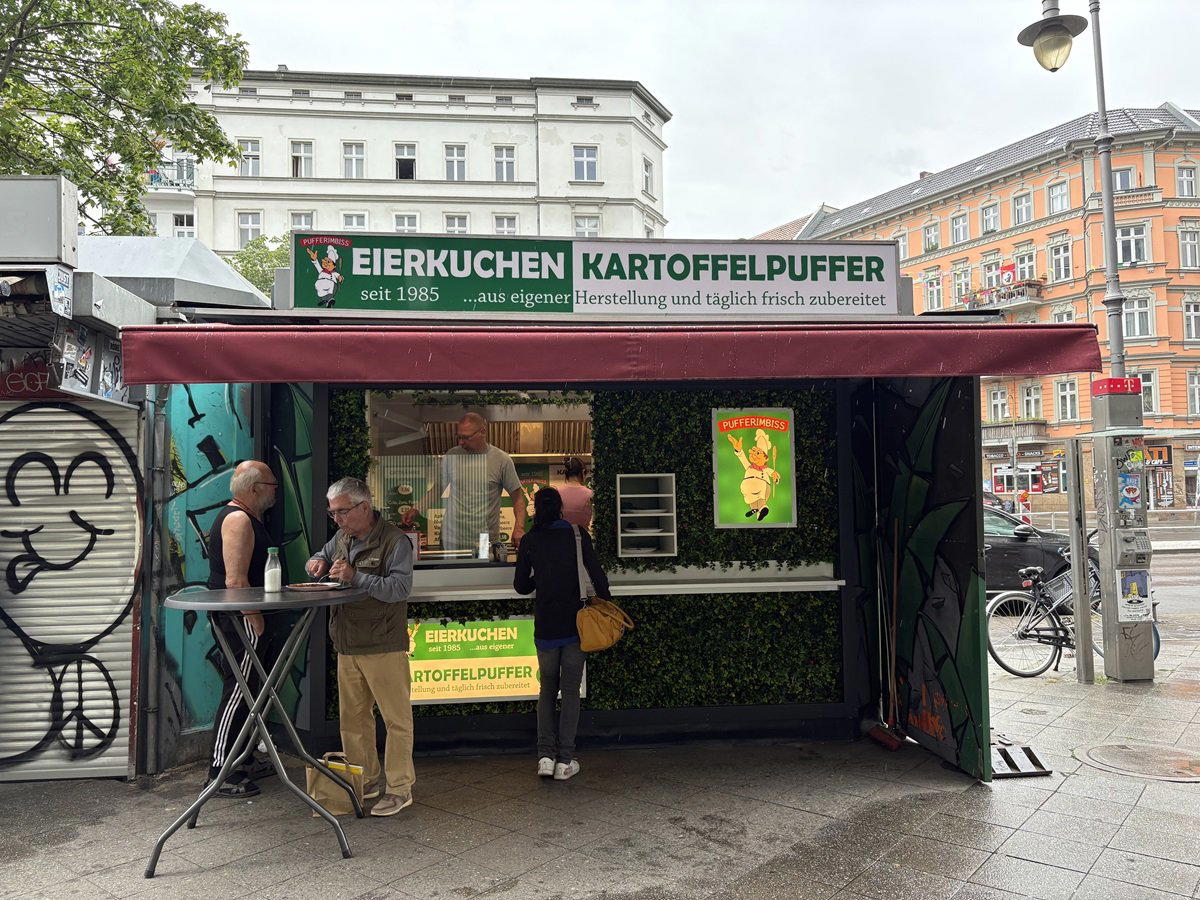
The Imbiss as Berlin Institution
Berlin's relationship with the imbiss is not incidental. The format, a counter-service stand dispensing hot food quickly and without ceremony, has shaped the city's street-level food culture for generations. It predates the wave of Nordic-influenced tasting menus and the dining rooms that now populate Mitte and Prenzlauer Berg. On Hasenheide, one of the commercial arteries cutting through the Kreuzberg-Neukölln border, the imbiss operates in its natural habitat: a dense, mixed-use neighbourhood where the population eats practically and often outdoors, regardless of season.
This is a neighbourhood where döner shops, Vietnamese canteens, and falafel counters coexist within a few blocks of each other, and where price pressure keeps formats honest. Puffer-Imbiss occupies that world. Its address on Hasenheide places it firmly in a corridor that has resisted the full-scale gentrification of nearby Bergmannkiez, maintaining the functional food character that defines working Kreuzberg rather than the curated café version of it.
What the Imbiss Format Actually Means
The imbiss is not simply a fast-food stall. In Berlin's cultural grammar, it carries social significance: it is where shift workers, students, and architects on lunch breaks eat the same thing from the same counter. The format enforces a kind of equality that restaurants with prix-fixe menus and dress codes structurally cannot. That democratic character is worth noting when positioning any imbiss against Berlin's broader dining spectrum.
At the upper end of that spectrum, venues like Nobelhart & Schmutzig and Rutz operate at €€€€ price points with multi-course formats and advance booking requirements measured in weeks. CODA Dessert Dining and FACIL occupy similar tiers, with creative menus and Michelin recognition underpinning their positioning. The imbiss exists at the opposite structural pole: no reservation, no tasting format, no extended service window. These two poles are not in competition. They answer different needs for different occasions, and both are essential to understanding how Berliners actually eat.
Sustainability and the Everyday Format
The conversation around sustainability in dining has largely been captured by fine-dining operators. Tasting-menu restaurants have become the venues most associated with sourcing transparency, waste reduction programmes, and direct producer relationships, partly because their margins and PR resources allow them to articulate those commitments publicly. But the imbiss format carries its own structural sustainability logic, one that rarely gets framed in those terms.
Counter-service formats produce less food waste per cover than tasting-menu restaurants by virtue of their operational model. Portion sizes are fixed, turnover is high, mise en place is leaner, and the absence of elaborate plating reduces trim waste. The energy footprint per meal served at a high-throughput counter is substantially lower than in a low-seat, multi-course kitchen running for several hours. None of this requires a certified sourcing programme or a chef with a column in a food magazine to achieve; it is baked into the format itself.
The neighbourhood context matters here too. Kreuzberg-Neukölln has one of the highest concentrations of independently owned food businesses in Berlin, and those independents collectively maintain shorter supply chains than hospitality groups operating across multiple cities. The Hasenheide corridor reflects that pattern: a street economy of small operators buying from regional wholesalers and, in some cases, from market suppliers at Markthalle Neun in nearby Eisenbahnstrasse, one of the city's most active hubs for producer-to-consumer food trade.
Broader comparisons across the German dining scene illustrate how sustainability thinking has filtered differently through price tiers. At Aqua in Wolfsburg or Schwarzwaldstube in Baiersbronn, sustainability appears as a deliberate curatorial choice communicated through menus and press. At Waldhotel Sonnora in Dreis or Schanz in Piesport, provenance is embedded in the regional identity of the cooking. The imbiss achieves something structurally similar through operational necessity rather than editorial intent, which makes it an interesting counterpoint to the virtue-signalling that can accompany fine-dining sustainability narratives.
Where Puffer-Imbiss Sits in Berlin's Dining Map
Berlin's food scene splits broadly into three registers. At the leading, Michelin-recognised rooms attract international visitors and domestic special-occasion diners. In the middle, a large casual-dining sector has grown considerably since 2015, absorbing natural wine bars, ramen counters, and nose-to-tail bistros. At the base, the imbiss format and its equivalents serve daily, habitual eating. Puffer-Imbiss operates in that third register, on a street with significant foot traffic and a neighbourhood population that treats the area's food options as part of daily life rather than destination dining.
For international visitors who have spent time at Restaurant Tim Raue or booked far ahead for a counter seat at one of the city's creative tasting formats, the imbiss offers a different kind of access to how the city eats. It is not a corrective to fine dining; it is simply a different entry point to the same city.
JAN in Munich, Vendôme in Bergisch Gladbach, ES:SENZ in Grassau, Victor's Fine Dining in Perl, Restaurant Haerlin in Hamburg, and Bagatelle in Trier. For international comparison with counter-format dining at the opposite end of the formality spectrum, Le Bernardin in New York and Atomix in New York represent how radically different a counter experience can read across contexts.
The Essentials
Comparable venues nearby, for context on price, style, and recognition.
| Venue | Cuisine | Price | Notes |
|---|---|---|---|
| Puffer-ImbissThis venue — the venue you are viewing | Not listed | $ | Not listed |
| Georgbraeu | Mitte, Traditional German Brewery | $$ | Not listed |
| Julchen Hoppe | Mitte, Traditional Berlin German | $$ | Not listed |
| Lebenswelten im Humboldt Forum | Not listed | $$ | Mitte, Sustainable German Bistro with Vegetarian Focus |
| Chipperfield Kantine | Mitte, Sustainable Vegetarian Canteen | $$ | Not listed |
| Stock & Stein | Not listed | $$ | Friedrichshain, German Stone Grill Steakhouse |


At a Glance
- Casual
- Rustic
- Casual Hangout
- Solo
- Standalone
Current opening hours
- Monday
- 11 AM–6:30 PM
- Tuesday
- 11 AM–6:30 PM
- Wednesday
- 11 AM–6:30 PM
- Thursday
- 11 AM–6:30 PM
- Friday
- 11 AM–6:30 PM
- Saturday
- Closed
- Sunday
- Closed
Hours can change for holidays and private events. Last verified .
Casual street food atmosphere with a charming, unpretentious vibe typical of a traditional German snack bar.