On a narrow street in Florence's medieval centro storico, Pizzeria o'Vesuvio brings Neapolitan pizza-making tradition into a city more associated with bistecca and ribollita. The address on Via dei Cimatori places it within walking distance of the Bargello and the Piazza della Signoria, making it a practical and honest option in a neighbourhood otherwise tilted toward high-end Tuscan dining.
Pearl is the En Primeur Club membership app — saves, bookings, and concierge access live there. Same editors, same standards.
- Address
- Via dei Cimatori, 21r, 50122 Firenze FI, Italy
- Phone
- +39 334 894 2233
- Website
- ovesuviofirenze.com
- Directions
- Get directions
 Saves & bookings on Pearl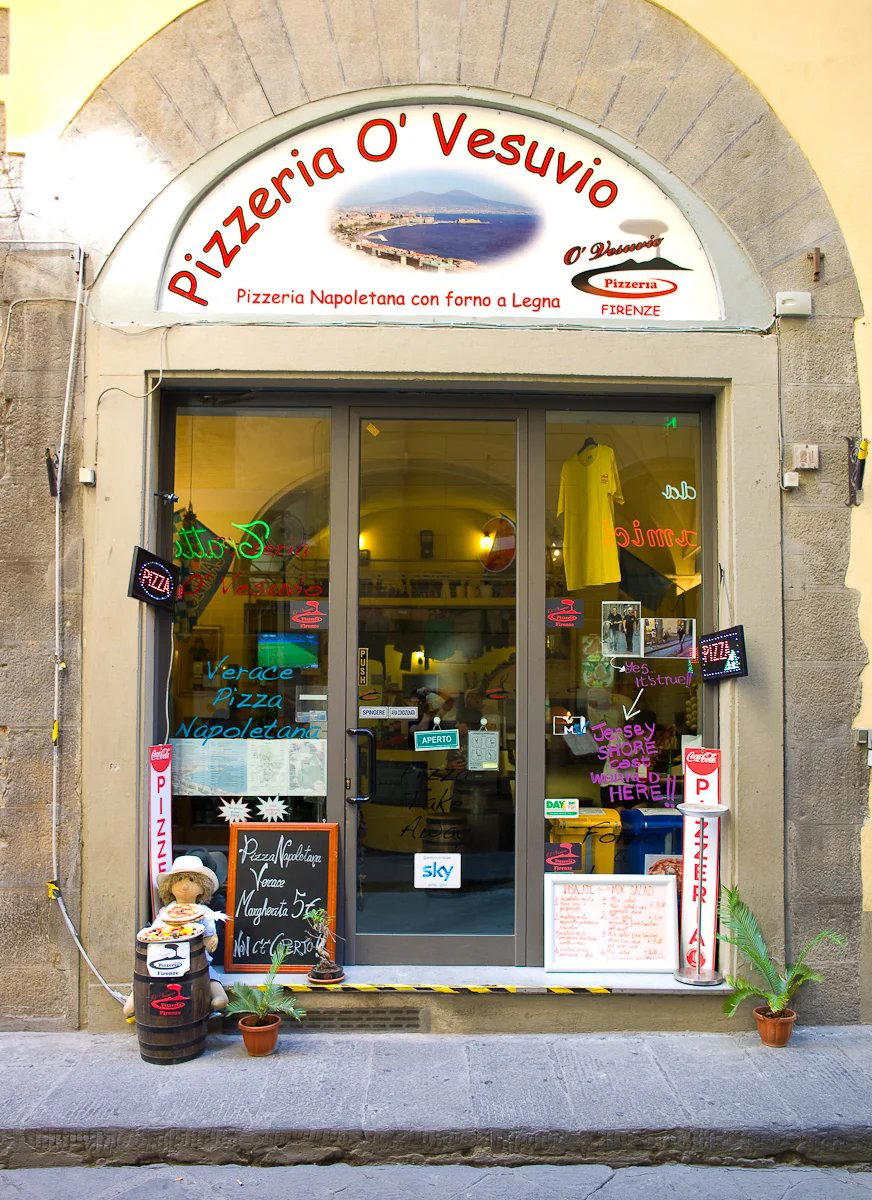
Pizza in the Shadow of the Duomo: What Neapolitan Tradition Looks Like in Florence
Florence's dining identity is built around Tuscan orthodoxy: the long-braised, the wood-fired, the deeply local. Ribollita, lampredotto, bistecca alla Fiorentina cooked over oak at precise weights. Against that backdrop, Neapolitan pizza occupies an interesting position in the city, one that has grown in seriousness over the past decade as Florentine diners have become more attentive to the craft signals that distinguish a properly made Neapolitan from its lesser approximations. Pizzeria o'Vesuvio is a Neapolitan pizza restaurant in Florence at Via dei Cimatori, 21r, 50122 Firenze FI, Italy, with a casual dress code and a walk-in-friendly policy.
Via dei Cimatori is one of those narrow medieval streets that connects the commercial density around the Duomo to the civic gravity of Piazza della Signoria. It is not a restaurant-row address in the obvious sense; it is the kind of street that rewards visitors who are already moving through the city with some purpose. The immediate neighbourhood is dense with high-end Tuscan and Italian Contemporary dining: Enoteca Pinchiorri, Santa Elisabetta, and Atto di Vito Mollica all operate nearby at the €€€€ tier, which means the neighbourhood's ambient expectation skews formal and expensive. A pizzeria at this address signals something: it is either a tourist trap filling a gap, or something that has found a sustainable position in a market that can otherwise sustain only high-ticket operators.
The Neapolitan Tradition and Why It Travels Unevenly
Neapolitan pizza is governed by a set of technical requirements that are difficult to fake once you know what to look for. The dough, made with 00 flour and fermented for a minimum of 24 hours, should be supple and slightly charred at the cornicione. The tomato base, ideally made from San Marzano DOP tomatoes, carries a bright acidity that distinguishes it from generic tomato sauce. The fior di latte or buffalo mozzarella should hold moisture without making the base wet. The cook happens in a wood-fired dome oven at temperatures around 450-480°C for roughly 60-90 seconds. Every element is in conversation with the others, and the result is either in balance or it is not. There is limited room for partial credit.
When this tradition travels north out of Campania, quality tends to degrade in proportion to distance. The further from Naples, the more corners get cut on fermentation time, sourced ingredients, and oven temperature management. Florence has historically had few addresses that applied the full Neapolitan methodology with discipline. The growing interest in certified Neapolitan pizza, partly driven by the inclusion of the art of Neapolitan pizza-making on UNESCO's Intangible Cultural Heritage list in 2017, has raised consumer awareness enough that Florentine diners now ask better questions of the pizzerias they frequent.
Service as Part of the Offer: The Floor-to-Kitchen Relationship
In a well-run pizza operation, the collaboration between the kitchen and the floor matters more than it does in a formal restaurant, because the margin for error on a pizza is smaller. A 90-second cook cannot be paused; the pizza that leaves the oven is the pizza that arrives at the table. This places a premium on timing and communication between the pizzaiolo and the team running the floor. When that coordination works, the pace feels natural and the product arrives at its intended temperature and texture. When it breaks down, even a technically correct pizza suffers.
At a neighbourhood level, this kind of operational discipline is what separates addresses that survive on repeat local custom from those that cycle through tourist spend without building a real following. Florence's centro storico generates enormous tourist footfall from spring through autumn, but the addresses around Via dei Cimatori, close enough to the Uffizi to attract visitors moving between the museum and the Ponte Vecchio, also need to hold up for locals who know what a well-made pizza should taste like.
For a broader view of where Pizzeria o'Vesuvio sits relative to Florence's wider dining scene, including the high-end Italian Contemporary addresses that dominate the same neighbourhood, see our full Florence restaurants guide. For context on what the city's formal dining tier looks like, Borgo San Jacopo and Gucci Osteria da Massimo Bottura represent the modern Italian Contemporary register in the same city at a different price point and formality level.
Florence in the Context of Italian Dining More Broadly
Italy's most discussed restaurant addresses in 2024 and 2025 are concentrated in a handful of cities: Modena, where Osteria Francescana continues to define Italian Contemporary at the highest register; Milan, where Enrico Bartolini operates across formats; and coastal addresses like Uliassi in Senigallia and Quattro Passi in Marina del Cantone that have built international reputations on regional product. Florence sits within that conversation as a city with significant culinary credibility at the summit tier, but where the mid-range and casual segments have historically been underserved by serious operators. The rise of credible pizza in Florence is part of a broader normalisation: cities that had only two gears, tourist-casual and fine dining, are finding sustainable middle registers.
The scale is different, but the principle holds across formats.
When to Visit and How to Plan
Florence's tourist density peaks in June, July, and August, when the area around Via dei Cimatori can see significant foot traffic during lunch and dinner hours. The spring shoulder season, from late March through May, and the autumn window of September and October tend to offer more manageable conditions, both in terms of queues and in the ambient character of the city itself. For those visiting in summer, arriving at opening time for either lunch or dinner service is generally one reliable approach to avoiding a long wait at popular casual addresses in the centro storico.
Via dei Cimatori 21r is centrally located and reachable on foot from most of Florence's major landmarks. The nearest major reference points are the Bargello museum to the north and the Palazzo Vecchio to the west. For anyone structuring a full day in the city, the address works naturally as part of a circuit covering the Uffizi, the Piazza della Repubblica, or the streets around the Mercato Nuovo.
For Italian dining at the highest formal level in other parts of the country, Dal Pescatore in Runate and Atelier Moessmer Norbert Niederkofler in Brunico represent the kind of regional-rooted fine dining that anchors Italy's reputation internationally.
City Peers
Comparable venues nearby, for context on price, style, and recognition.
| Venue | Cuisine | Price | Notes |
|---|---|---|---|
| Pizzeria o'VesuvioThis venue — the venue you are viewing | Neapolitan Pizza | $$ | Not listed |
| Osteria Santo Spirito | Traditional Tuscan Trattoria | $$ | Santo Spirito |
| Ristorante Ricchi | Traditional Tuscan Italian | $$ | Santo Spirito |
| Trattoria 4 Leoni | Tuscan Trattoria | $$ | Santo Spirito |
| 'l Trippaio di San Frediano | Traditional Florentine Offal Street Food | $ | San Frediano |
| Trattoria Sabatino | Authentic Tuscan Trattoria | $ | San Frediano |
Continue exploring
More in Florence
Restaurants in Florence
Browse all →
Bars in Florence
Browse all →
Hotels in Florence
Browse all →
At a Glance
- Rustic
- Cozy
- Classic
- Casual Hangout
- Family
- Group Dining
- Open Kitchen
Current opening hours
- Monday
- 12–3:30 PM, 6:30–10:30 PM
- Tuesday
- 12–3:30 PM, 6:30–10:30 PM
- Wednesday
- 12–3:30 PM, 6:30–10:30 PM
- Thursday
- 12–3:30 PM, 6:30–10:30 PM
- Friday
- 12–3:30 PM, 6:30–11 PM
- Saturday
- 12–3:30 PM, 6:30–11:30 PM
- Sunday
- 12–3:30 PM, 6:30–10:30 PM
Hours can change for holidays and private events. Last verified .
Simple, spartan yet cozy interior evoking Naples streets, with open kitchen view; welcoming and pleasant but can be noisy when busy.