Paesano
On Mulberry Street in the heart of Little Italy, Paesano occupies one of Manhattan's most historically layered dining corridors, where Italian-American cooking traditions have accumulated for well over a century. The address positions it inside a neighbourhood that has long served as a proving ground for the intersection of Old World technique and New York pragmatism, a tension that continues to define the block's better tables today.
Pearl is the En Primeur Club membership app — saves, bookings, and concierge access live there. Same editors, same standards.
- Address
- 136 Mulberry St, New York, NY 10013
- Phone
- +12129651188
- Website
- paesanosofmulberrystreet.com
- Directions
- Get directions
 Saves & bookings on Pearl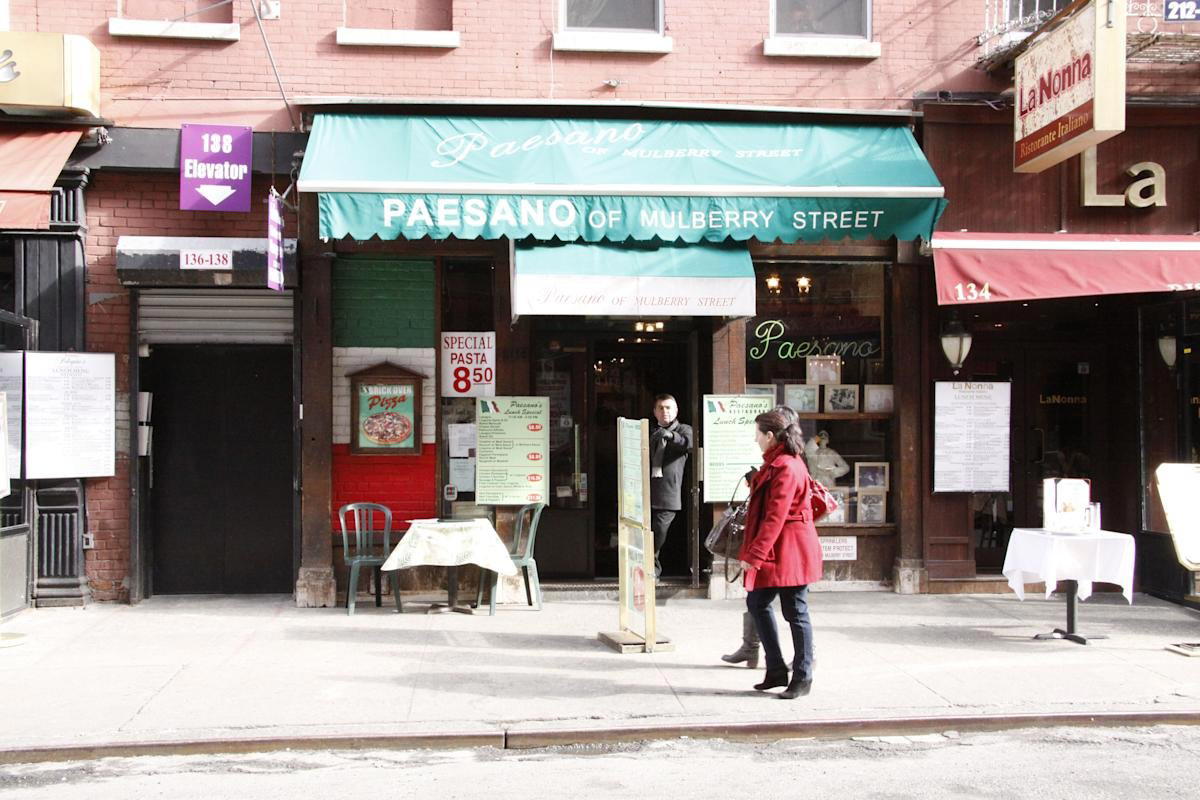
Little Italy's Long Memory
Mulberry Street did not become shorthand for Italian-American dining by accident. The corridor between Canal and Houston attracted successive waves of Neapolitan and Sicilian immigrants through the late nineteenth and early twentieth centuries, each depositing culinary habits that gradually calcified into neighbourhood tradition. What that history produced is a specific kind of restaurant culture: one that prizes recognisability over novelty, where a familiar red-sauce grammar functions as a trust signal rather than a limitation. Paesano sits at 136 Mulberry St, deep inside that inheritance.
The broader context matters for any visitor deciding where to spend a meal in this part of lower Manhattan. Little Italy has contracted significantly since its mid-century peak, squeezed from the north by SoHo's commercial expansion and absorbed from the south by the growth of Chinatown. What remains along Mulberry is a compressed, tourist-aware strip that coexists somewhat uneasily with a smaller population of neighbourhood regulars. The tables that retain local credibility in this environment tend to do so through consistency rather than reinvention.
Technique Imported, Ingredients Rooted
Italian cooking in New York has always been a story of translated methods meeting whatever the local market could supply. The early immigrant kitchens on Mulberry worked with what they found: East Coast seafood instead of Adriatic, domestic wheat instead of Sicilian durum, New York dairy where Campanian buffalo milk was unavailable. What emerged over generations was not a diluted version of Southern Italian cooking but something functionally distinct, a cuisine that kept the structural logic of the original while substituting and adapting ingredients according to what was available and economical. That adaptive tradition is the editorial lens through which a place like Paesano makes most sense.
Across the wider Italian-American dining category in New York, this tension between imported technique and domestically sourced product has become more deliberate in the last two decades. Restaurants in this space now make explicit decisions about flour provenance, cured-meat sourcing, and the degree to which they acknowledge the American inflection in dishes that were originally European. The more considered operations treat the local-ingredient question as a point of differentiation rather than a supply-chain default. This is the frame that separates a Mulberry Street table from one that is simply coasting on neighbourhood nostalgia. Comparative examples from further afield, Blue Hill at Stone Barns in Tarrytown, or Single Thread Farm in Healdsburg, represent the opposite end of the same spectrum, where ingredient provenance is the explicit programme. Italian-American neighbourhood cooking rarely makes that declaration so formally, but the underlying question of what is local, what is imported, and what is a creative hybrid applies equally.
Positioning Within Lower Manhattan's Dining Tiers
Lower Manhattan's restaurant hierarchy runs from the tourist-facing Mulberry strip through to the more considered tables of Tribeca and the Financial District, with a mid-tier of neighbourhood-focused spots scattered through NoLIta and the edges of Chinatown. Paesano occupies the Mulberry Street tier, which means it competes primarily on accessibility, atmosphere, and value for money rather than on Michelin recognition or elaborate tasting formats. That is a different competitive conversation from the one happening at Le Bernardin, Per Se, or Masa, each of which operates in a tier where prix-fixe formats and multi-hundred-dollar per-head spends are the baseline expectation.
For visitors working through a broader New York dining itinerary, understanding where Italian-American neighbourhood restaurants sit in the overall map is useful. They serve a different function from the destination tables that require weeks of advance planning. A Mulberry Street dinner is typically a walk-in or same-day proposition, neighbourhood tempo, not event dining. That logic applies across comparable American dining cities: Emeril's in New Orleans, Bacchanalia in Atlanta, and Addison in San Diego all operate in formal tiers where the advance-booking requirement is part of the experience design. Little Italy works differently: the genre expectation is ease of access, and the better restaurants in the strip lean into that rather than fighting it.
For context on how American fine dining has moved in the same period that Little Italy has been consolidating, it is worth tracking the trajectory of places like Alinea in Chicago, Lazy Bear in San Francisco, Providence in Los Angeles, and The French Laundry in Napa. Each of these represents American fine dining's move toward highly choreographed, chef-driven formats where the ingredient provenance and technique narrative are front and centre. The Italian-American neighbourhood restaurant operates in deliberate contrast to that trajectory, which is part of what gives Mulberry Street its continued relevance for a particular kind of diner. Similarly, the long-running prestige of 8½ Otto e Mezzo Bombana in Hong Kong and Alain Ducasse at Louis XV in Monte Carlo demonstrates how Italian and French fine-dining formats have globalised at the leading end, a trajectory that has little to do with what Mulberry Street's neighbourhood tables are attempting.
What the Address Signals
136 Mulberry Street is a specific coordinate within a neighbourhood whose culinary density has made it a default shorthand for Italian-American eating in New York. The address itself carries the weight of that association, the street is one of the few in Manhattan where the category identity of the block precedes any individual restaurant's reputation. That is an asset for operators who can align with the expectation it creates, and a constraint for those who want to diverge from it. Paesano's position on this block places it firmly within the former group, where the neighbourhood context does a significant portion of the scene-setting before a diner walks through the door.
Know Before You Go
- Address: 136 Mulberry St, New York, NY 10013
- Neighbourhood: Little Italy, Lower Manhattan
- Getting There: The 6 train to Spring Street is one direct subway option; Canal Street (6, J, Z, N, Q, R, W) is also walkable. The block is pedestrian-accessible and surrounded by Chinatown and NoLIta.
- Walk-in Policy: Reservations are recommended.
- Price Tier: Moderate, around $30 per person.
At a Glance
Comparable venues nearby, for context on price, style, and recognition.
| Venue | Cuisine | Price | Notes |
|---|---|---|---|
| PaesanoThis venue — the venue you are viewing | Not listed | $$ | Not listed |
| Casa Bella | Not listed | $$ | SoHo-Little Italy-Hudson Square, Classic Italian |
| Pepolino | Not listed | $$ | SoHo-Little Italy-Hudson Square, Authentic Tuscan Italian |
| Trattoria Bianca | Not listed | $$ | Chelsea-Hudson Yards, Casual Italian Trattoria |
| Evelina | Not listed | $$ | Fort Greene, Modern Italian Mediterranean |
| Il Forno | Hell's Kitchen, Modern Italian Trattoria | $$ | Not listed |
Continue exploring
More in New York City
Restaurants in New York City
Browse all →
Bars in New York City
Browse all →
Hotels in New York City
Browse all →





At a Glance
- Classic
- Cozy
- Rustic
- Family
- Group Dining
- Casual Hangout
- Historic Building
Current opening hours
- Monday
- 11 AM–10 PM
- Tuesday
- 11 AM–10 PM
- Wednesday
- 11 AM–10 PM
- Thursday
- 11 AM–10 PM
- Friday
- 11 AM–10:30 PM
- Saturday
- 11 AM–10:30 PM
- Sunday
- 11 AM–10 PM
Hours can change for holidays and private events. Last verified .
Rustic wood-beamed interior with a cozy, welcoming traditional atmosphere.