
Kawasaki’s ramen scene rewards precision at small counters rather than ceremony. noodles kitchen GUNNERS belongs to that compact, value-driven tier: a Shin-Maruko ramen shop selected for Tabelog Ramen KANAGAWA “Tabelog 100” in 2024 and 2025, with a counter format that makes the menu architecture the point rather than a long-form dining occasion.
Pearl is the En Primeur Club membership app — saves, bookings, and concierge access live there. Same editors, same standards.
- Address
- 神奈川県川崎市中原区新丸子町754
- Website
- tabelog.com
 Saves & bookings on Pearl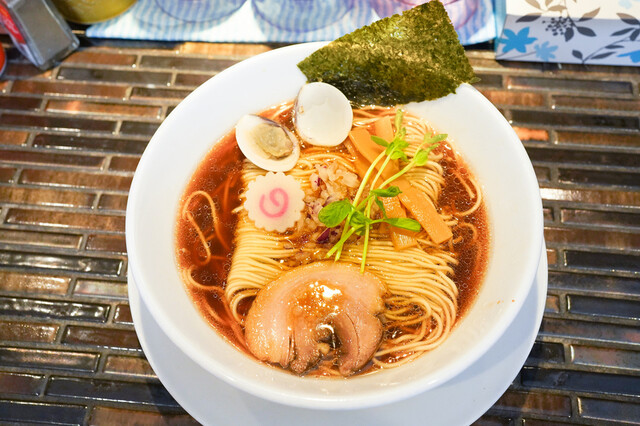
Approaching a serious ramen counter in Shin-Maruko is a different proposition from crossing Tokyo for a tasting menu. The room is built for turnover, concentration, and solo decision-making: counter seating, a compact footprint, and a menu that has to communicate its hierarchy quickly. In that setting, noodles kitchen GUNNERS reads as part of Kawasaki’s sharper ramen circuit, where the value ceiling stays low but the expectations are not casual. Its 2024 and 2025 selection for Tabelog Ramen KANAGAWA “Tabelog 100” places it inside a regional conversation that rewards consistency more than spectacle.
A compact ramen counter shaped by menu discipline
Ramen shops at this level are often judged by how clearly the menu is structured. A sprawling list can signal ambition, but it can also blur the house’s point of view. A compact ramen counter works differently: the customer reads the options, chooses a lane, and the kitchen repeats that lane with enough precision to hold regulars and destination diners at the same time. That is the useful frame for noodles kitchen GUNNERS. The format is counter-led, the category is ramen, and the dining occasion skews toward solo eating, which means the menu has to carry the argument without the cushioning of wine pairings, long service choreography, or room drama.
Kawasaki’s restaurant map is often treated as secondary to Tokyo’s, but the stretch around Shin-Maruko and Musashi-Kosugi has its own logic. Commuter density supports short-format meals, and serious low-price restaurants can build an audience without behaving like luxury destinations. In the same city, Menya Deko sits in a comparable ramen price band, while Belmatine and Belmatine show how Kawasaki’s under-¥1,000 bracket extends beyond a single genre. At the other end, UCHIDA‐TEI operates in a far higher spend category, which makes the contrast useful: Kawasaki is not a one-note budget city, but its ramen culture remains one of the clearest ways to understand how local demand rewards focus.
The Tabelog recognition matters here because it is regional and category-specific. A “Tabelog 100” ramen selection for Kanagawa does not place a shop into the same conversation as Michelin fine dining, and it should not be read that way. It does, however, identify a ramen address that has cleared a meaningful local threshold in a crowded prefectural field. For diners comparing Kawasaki choices, that is a stronger signal than generic popularity. It says the shop has been noticed within the exact format it is trying to serve.
Why Shin-Maruko suits this kind of ramen
Shin-Maruko’s appeal is practical rather than theatrical. The neighborhood sits close to Musashi-Kosugi’s transit gravity but keeps a smaller-street restaurant rhythm, which suits ramen houses that rely on repeat local traffic and compact service. In this part of Kawasaki, a meal does not need to become an event to be worth a detour. The draw is the density of competent, specialized places within a manageable radius, from ramen and curry to bakeries and casual counters.
That broader pattern is visible across the local list. Buta Boshi and KOSUGI CURRY point to the city’s appetite for focused comfort formats, while Boulangerie Metier Pa-ku shiti musashi kosugi za ga-den shows how bakery culture has become part of the same daily-use dining grid. C'EST UNE BONNE IDEE! and (Shoku) Vietnam widen the frame without changing the underlying point: Kawasaki rewards places with a clear proposition and restrained pricing more than places built around grand occasion dining.
For ramen, that context is especially important. The bowl is often read through broth, noodle, tare, and toppings, but the deeper question is architecture: how many choices the shop offers, how sharply those choices are separated, and whether the format keeps attention on the bowl rather than the room. noodles kitchen GUNNERS belongs to the school where scale is part of the message. A small counter compresses the experience. It also exposes inconsistency quickly, which is why repeat recognition in 2024 and 2025 carries weight.
How to place it in a Kawasaki eating day
This is not the restaurant to frame as a long lunch or a dressed-up dinner. It is better understood as a precise ramen stop within a wider Kawasaki itinerary, especially for travelers who already know Tokyo’s ramen density and want to see how Kanagawa’s scene expresses itself outside the capital’s louder neighborhoods. The useful comparison is not with luxury dining; it is with other focused, low-spend specialists where the room, pace, and menu all point toward a single decision.
Readers building a day around the area can treat the restaurant as the ramen anchor and then expand outward through the city’s other formats. The broader edit sits in Our full Kawasaki restaurants guide, with parallel planning in Our full Kawasaki hotels guide, Our full Kawasaki bars guide, Our full Kawasaki wineries guide, and Our full Kawasaki experiences guide. For wider Japan and overseas context, the same short-format discipline appears in different forms at -Grilled beef Sukiyaki- KAMAKURA TANUKIAN 鎌倉 たぬき庵 in Kamakura. 鮪と炭火焼き うお炭 秋葉原店 in Tokyo.cafe in Osaka.know in Kumamoto, [Curry Senmon Ten] Maruyama Kyoju. in Sapporo, [ki:] in Kyoto, Jōdo Saké Bar in Los Angeles, and Onigiri Time in Pasadena.
The editorial case is simple: Kawasaki ramen is at its strongest when it does not imitate destination fine dining. It compresses craft into a counter meal, keeps the transaction clear, and lets recognition come from repetition rather than ceremony. The restaurant fits that pattern cleanly. Its appeal is not excess; it is a small-format ramen shop with enough category credibility to justify making Shin-Maruko part of the plan.
Comparable Options
Comparable venues for orientation by cuisine and category.
| Venue | Cuisine | Price | Notes |
|---|---|---|---|
| noodles kitchen GUNNERSThis venue — the venue you are viewing | Ramen shop (clam-broth focus) | $ | Not listed |
| Hikage | Ramen shop in Shin-Kawasaki | $ | Saiwai-ku |
| Sumiyoshiya Sohonten | Traditional Japanese sweets café (kuzumochi, soba & udon) | $ | Kawasakidaishi |
| Niboshi Ramen Tanaka Niboru | Niboshi-focused ramen & tsukemen | $ | Takatsu Ward |
| Ramen Kan 2 Ya Kawasaki ten | Yokohama Iekei pork-soy sauce ramen | $ | .null |
| Ramen Jiro Keikyu kawasaki ten | Jiro-style Ramen Shop | $ | Kawasaki Ward, Kawasaki City |
Recognition history
Dated appearances from independent guides and award organizations, with the underlying list record or original source where available.
Tabelog 100 #26 · No. 26
Tabelog · Tabelog 100 - Ramen - KANAGAWA - 2025












At a Glance
- Cozy
- Trendy
- Solo
- Casual Hangout
- After Work
- Standalone
A small, non-smoking counter-only ramen shop with just six seats, creating a cozy, intimate feel and a casual, solo-diner-friendly atmosphere rather than a bustling group venue.