
An eight-seat counter in Kawasaki’s Musashi-Shinjo area, Niboshi Ramen Tanaka Niboru sits in the city’s serious ramen tier through a dried-sardine ramen and tsukemen focus. Its Tabelog Ramen KANAGAWA 100 selections in 2024 and 2025 place it among Kanagawa shops worth planning around, especially for solo diners tracking compact counter formats.
Pearl is the En Primeur Club membership app — saves, bookings, and concierge access live there. Same editors, same standards.
- Address
- 神奈川県川崎市高津区末長4-25-3
- Website
- tabelog.com
 Saves & bookings on Pearl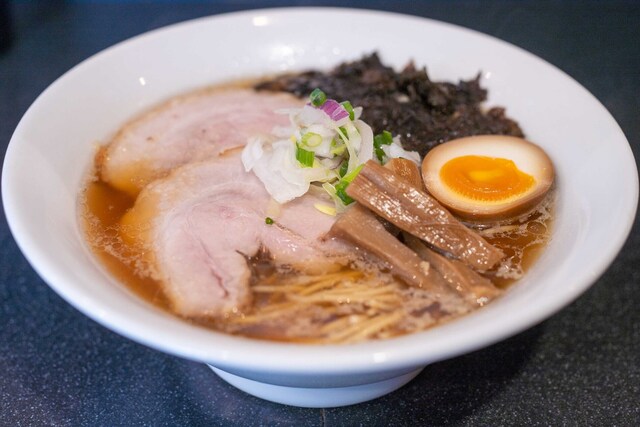
Musashi-Shinjo’s ramen culture is built for close quarters: narrow frontage, quick turnover, counter seats, and a room where the work happens in full view rather than behind dining-room choreography. In that setting, dried-sardine ramen has a particular authority. Niboshi broth is not a neutral comfort style; it asks for a cook willing to control bitterness, salinity, oil, and depth without burying the fish character under heavy pork or broad seasoning. Kawasaki’s position between central Tokyo and Yokohama gives these smaller specialist shops room to build local followings without behaving like destination tasting counters.
Niboshi Ramen Tanaka Niboru belongs to that compact, specialist lane. The format is ramen and tsukemen, with the logic of a counter rather than a restaurant built around lingering. The room’s eight seats matter because they define the experience as much as the bowl: a tight cadence, minimal ceremony, and a direct view of how a shop handles a broth style that can turn harsh when treated casually. Its selection for Tabelog Ramen KANAGAWA 100 in both 2024 and 2025 gives the shop a credible public marker in a prefecture where ramen strength is dispersed across commuter towns rather than concentrated in a single nightlife district.
Dried-sardine ramen in a commuter-city register
Niboshi ramen has older roots than the current wave of specialist shops suggests. Dried small fish have long been used in Japanese stock-making, and ramen shops that foreground them tend to divide diners: some look for rounded umami, others want a sharper marine edge. The cultural point is that ramen in Japan is not one cuisine but a series of regional and technical subcultures. Tonkotsu, miso, shoyu, shio, chicken paitan, tsukemen, and niboshi all carry different expectations about aroma, weight, noodle behavior, and finish.
Kawasaki rewards that kind of specialization. The city’s dining map is less theatrical than Tokyo’s central wards, but it is strong on daily-use formats: counters, neighborhood bakeries, curry rooms, yakiniku, and small international restaurants. A diner comparing ramen with the broader local field will find useful contrasts in (Shoku) Vietnam, Belmatine, Boulangerie Metier Pa-ku shiti musashi kosugi za ga-den, Buta Boshi, and C'EST UNE BONNE IDEE!. Those addresses point to Kawasaki’s real dining identity: not grand dining rooms, but precise neighborhood formats with strong regular traffic.
The comparison set also explains why a ramen shop can carry serious editorial weight without luxury signals. Men Goya Techi, Curry House Delhi, Match Bo Mizonokuchi ten, and 炭火焼肉ホルモンさわいし occupy different everyday categories in Kawasaki, from noodles to curry to grilled meat. Against that background, an eight-seat niboshi counter is not competing with fine dining. It competes on focus, repetition, and how clearly a single style is expressed within a short meal.
What the recognition says, and what it does not
Tabelog’s Hyakumeiten lists are useful in Japan because they map specialist depth by category and area rather than treating all restaurants as one hierarchy. A Kanagawa ramen selection narrows the field to noodle shops within the prefecture, which is the right frame for Kawasaki: local enough to matter, broad enough to include serious competition. Niboshi Ramen Tanaka Niboru’s 2024 and 2025 selections show continuity rather than a single spike of attention.
The shop’s Tabelog score of 3.73 also needs Japanese context. On Tabelog, scores above the mid-threes can signal substantial traction, especially for casual categories where volume, regulars, and specialist preferences shape the rating. That number should not be read like a Western five-star review scale. It is more useful as a comparative signal inside Japan’s restaurant-review culture, where a high-three score for a ramen counter can indicate a place already filtered by demanding noodle obsessives.
The appeal, then, is not breadth. There is no need to turn this into a general Japanese dining stop when Kawasaki has other options for that. The appeal is the compressed encounter between a narrow ramen tradition and a counter built for quick, concentrated eating. Diners who want a long evening should look elsewhere. Diners who understand that a serious bowl can be the entire point will understand why the shop sits in the conversation.
How to place it in a Kawasaki food day
For travelers treating Kawasaki as more than a rail connection, the smart move is to think by neighborhood and format. Musashi-Shinjo is not Ginza, Naka-Meguro, or Minato Mirai; its strength is practical density. A ramen counter here fits naturally into a day that also considers bakeries, casual restaurants, bars, and nearby cultural stops rather than a single destination meal. The broader planning frame starts with Our full Kawasaki restaurants guide, then branches into Our full Kawasaki hotels guide, Our full Kawasaki bars guide, Our full Kawasaki wineries guide, and Our full Kawasaki experiences guide for a fuller read on the city.
Ramen travelers often build Japan itineraries by famous stations and social-media queues. That approach misses how much of the country’s noodle culture lives in smaller commuter zones, where the audience is less transient and a shop must keep regulars returning. This is the level at which technique becomes habit rather than spectacle. The same principle applies across Japan’s casual dining map, from -Grilled beef Sukiyaki- KAMAKURA TANUKIAN 鎌倉 たぬき庵 in Kamakura to. 鮪と炭火焼き うお炭 秋葉原店 in Tokyo.cafe in Osaka.know in Kumamoto, [Curry Senmon Ten] Maruyama Kyoju. in Sapporo, and [ki:] in Kyoto. Outside Japan, related interest in Japanese everyday formats shows up at Jōdo Saké Bar in Los Angeles and Onigiri Time in Pasadena, though the cultural rhythm is different when the format leaves its home market.
The editorial case for Niboshi Ramen Tanaka Niboru is clear: a small Kawasaki counter, a defined dried-sardine noodle style, and consecutive recognition on a Kanagawa ramen list. That combination is enough. The point is not luxury, rarity language, or chef mythology. The point is a ramen subculture doing what it does well in the kind of neighborhood where the format belongs.
Price Lens
Nearby venues at a similar price tier for orientation.
| Venue | Cuisine | Price | Notes |
|---|---|---|---|
| Niboshi Ramen Tanaka NiboruThis venue — the venue you are viewing | Not listed | $ | Not listed |
| Match Bo Mizonokuchi ten | Takatsu-ku, Wakayama-style ramen | $ | Not listed |
| Teuchi Chuka Soba Sakata | Kawasaki-ku, Handmade Chuka Soba Ramen | $ | Not listed |
| San San Nana | Not listed | $ | Kawasaki Station area, Tsukemen & ramen shop |
| Buta Boshi | Not listed | $ | Nakahara-ku (Motosumiyoshi Area), Ramen & Tsukemen Shop |
| Ramen Jiro Ikuta ekimae ten | Tama-ku, Jiro-style Ramen Shop | $ | Not listed |
Recognition history
Dated appearances from independent guides and award organizations, with the underlying list record or original source where available.
Tabelog 100 #81 · No. 81
Tabelog · Tabelog 100 - Ramen - KANAGAWA - 2025











At a Glance
- Cozy
- Lively
- Solo
- Family
- Casual Hangout
- After Work
- Chefs Counter
- Standalone
A compact, 8-seat counter-only ramen shop with a casual, non-smoking atmosphere; it feels like a local hideout, often busy at lunch and dinner, with direct minimalist decor that keeps the focus on the ramen.