
Tabelog Silver #91
Our verdict
Nishizaki brings Tokyo sushi into a quieter Setagaya register: small counter, reservation-only service, and recognition from Tabelog rather than international trophy-chasing. Its appeal is less about spectacle than concentration, with a 12-seat format, a private four-seat counter, and a price band that places it in the serious sushi tier without the Ginza address premium.

Pearl is the En Primeur Club membership app, where members save venues, book tables and use the concierge.
The menu
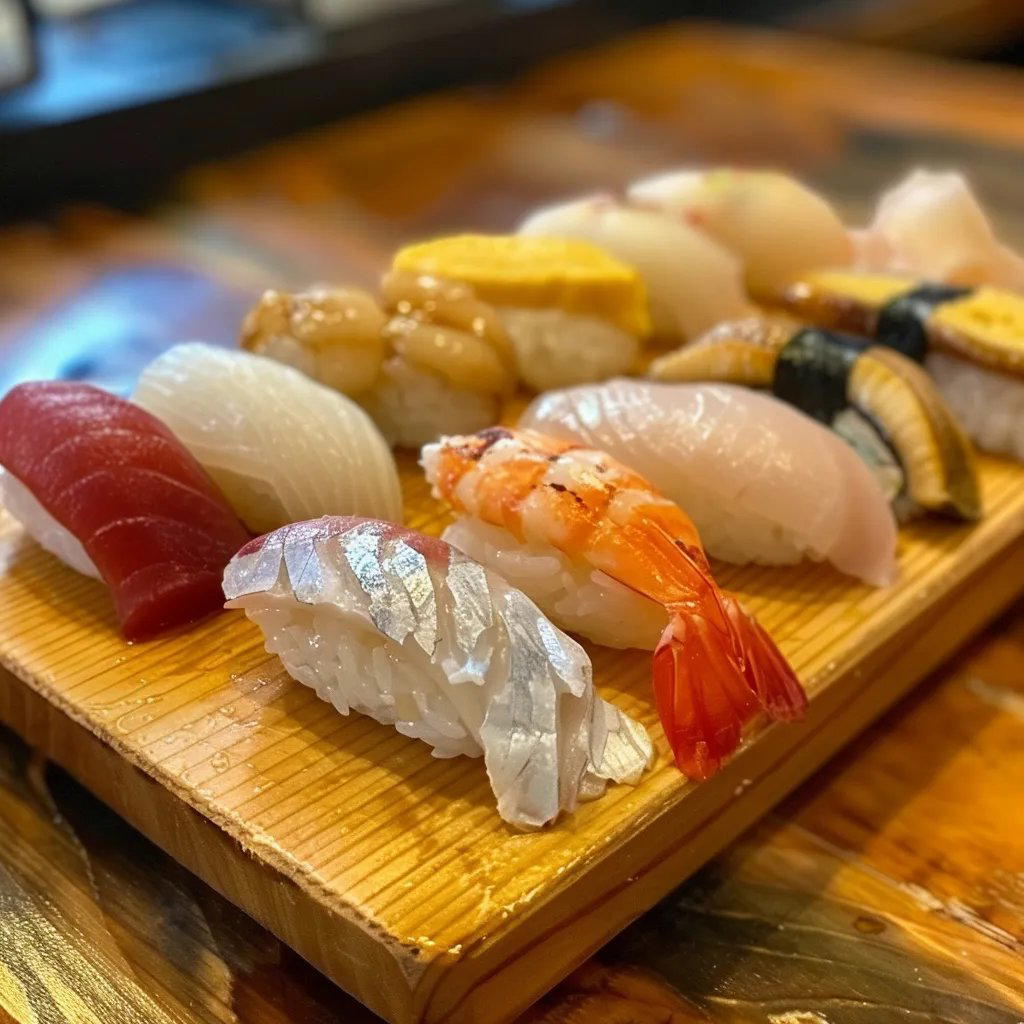
What to order
- Shiro ika
- Kinmedai zuke with oba
- Shime saba
- Aged kanpachi
- Hotate warayaki
Serious Tokyo sushi often begins before the first piece: a quiet street, a basement address, a room built around counter distance rather than dining-room drama. In Setagaya’s Kitazawa area, Nishizaki belongs to the smaller Tokyo category where atmosphere compresses, conversation drops, and the meal’s rhythm is set by the counter rather than a printed menu. The cues matter. A 12-seat room changes the contract: guests are not spectators in a grand restaurant, but participants in a format where timing, temperature, and attention sit close to the hand.
Tokyo’s sushi hierarchy is often flattened for visitors into one idea of omakase, but the city’s counter culture is more varied. Ginza carries the international shorthand; residential and west-side addresses often draw diners already comfortable reading Japanese reservation systems, award lists, and price bands. Nishizaki’s Tabelog Award 2026 Silver recognition, 2025 Bronze recognition, and inclusion in Tabelog Sushi TOKYO 100 in 2025 place it in a serious domestic conversation. Tabelog influence in Japan is not a travel magazine ranking; it is a granular local signal, especially meaningful in dense categories such as sushi.
A Setagaya counter in Tokyo's serious sushi tier
The Setagaya setting changes the expectation. This is not a hotel sushi counter or the polished theatre of a central luxury district. The appeal is closer to Tokyo’s neighborhood high-end dining pattern: low capacity, controlled pacing, and a room where silence can feel like service language. Compared with a casual ramen stop such as 12/10 Shinjuku ten or an everyday curry address such as 3 Chome no Curry Ya San, this sits in a different economic and behavioral category. The price band changes the evening’s planning, and so does the etiquette: guests enter a compact counter environment where pace and restraint carry weight.
The configuration reinforces this. A main eight-seat counter and a private four-seat counter create two kinds of intimacy: shared concentration at the main counter, and a quieter enclosure for a small party. That format is common at the serious end of Tokyo sushi because it protects service cadence. Sushi here is not only cuisine; it is timing discipline, with rice, fish, hand movement, and guest attention working inside a narrow window. Awards and scores help, but counter architecture tells the diner just as much about the evening being offered.
There is also a useful distinction between recognition and celebrity. Nishizaki has a Tabelog score in the low 4s and recent award momentum, but its public story is not built around a famous chef biography or global media persona. For many Tokyo diners, that is no drawback. It returns focus to craft and room: sushi as measured repetition, not personality branding. For readers comparing across Tokyo, Our full Tokyo restaurants guide is more useful than a single trophy list, because the city’s appeal lies in the spread from counter sushi to yakitori, curry, French, ramen, and cafés.
Texture, restraint, and the sound of a small room
The strongest clue is the stated emphasis on texture between fish and sushi rice. That is a precise lens for Tokyo sushi, where a meal often turns less on novelty than calibration: how warm the rice feels against the neta, how firmly a piece holds, and how quickly it should be eaten after being placed down. Without reliable dish-level details, the responsible reading is broader: this restaurant works inside traditional sushi counter grammar, where repetition and adjustment matter more than menu spectacle.
That sensory register separates it from louder Tokyo dining modes. Charcoal-focused casual meals such as . 鮪と炭火焼き うお炭 秋葉原店, graphic café interiors such as 2D Cafe, and precise skewer formats such as 124. KAGURAZAKA (Yakitori) apply different sensory pressure. Sushi at this tier reduces the room’s noise rather than amplifying it. The counter becomes the visual field; the drama is in sequence and proportion.
Drink positioning also signals range. Sake and wine are both offered, placing the restaurant in contemporary Tokyo sushi rather than a narrow old-school mode. The city has become increasingly comfortable with wine at counters once dominated by sake and beer, especially where international diners and Japanese regulars overlap. That does not Westernize the meal. It widens the pairing conversation, with acidity, texture, and temperature considered across more than one drinking tradition.
How to read it against the wider Tokyo dining map
For travelers building a Tokyo itinerary, Nishizaki is a precision choice rather than a general recommendation. It suits diners who understand that a small sushi counter asks for attention, punctuality, and a willingness to let the format lead. It is less suited to anyone seeking a flexible drop-in meal, broad menu browsing, or theatrical energy. Tokyo offers those abundantly, from French dining such as 124. KAGURAZAKA (Yakitori) alternatives in the wider guide to casual regional cooking and specialist bars.
The wider comparison set clarifies the decision. DIALOGUE occupies Tokyo’s French category, while Chukasoba KOTETSU sits in ramen’s lower-price daily-dining lane and Oishii Curry in an inexpensive curry bracket. Those venues solve different travel problems: speed, breadth, or variety. Nishizaki solves the counter-sushi problem: a compact, award-recognized room for diners who want concentration over range. For travelers pairing the meal with broader planning, Our full Tokyo hotels guide, Our full Tokyo bars guide, Our full Tokyo wineries guide, and Our full Tokyo experiences guide help place the evening inside a larger Tokyo stay.
Outside Tokyo, the contrast sharpens. The atmosphere has little in common with destination-specific meals such as -Grilled beef Sukiyaki- KAMAKURA TANUKIAN 鎌倉 たぬき庵 in Kamakura, café-led stops such as.cafe in Osaka, or regional addresses including.know in Kumamoto, (Shoku) Vietnam in Kawasaki, [Curry Senmon Ten] Maruyama Kyoju. in Sapporo, and [ki:] in Kyoto. Even Japanese dining abroad, from Jōdo Saké Bar in Los Angeles to Onigiri Time in Pasadena, operates under different expectations. This is Tokyo counter culture in a tight frame: small room, serious recognition, and a meal whose value depends on attention rather than abundance.
Frequently asked questions
Is Nishizaki okay with children?
Those details are not published. What is clear is the format: a 12-seat sushi room in Setagaya, with reservation-only service and a 4-seat private room, which makes it better suited to adults who can keep to counter etiquette. Check the venue's official channels for the latest details.
How would you describe the vibe at Nishizaki?
Expect a small, tightly run sushi counter rather than a broad dining room. Nishizaki has 12 seats in total, non-smoking service, and Tabelog recognition in 2025 and 2026, which puts the room in Tokyo’s serious sushi tier.
What are the opening hours for Nishizaki?
Hours at Nishizaki: Mon, Tue, Wed, Thu, Fri, Sat 18:00 - 23:00.
What's the address for Nishizaki?
Nishizaki is located in Tokyo.
Peers Worth Knowing
Comparable venues for orientation by cuisine and category.
| Venue | Cuisine | Price | Awards | Notes |
|---|---|---|---|---|
| NishizakiThis venue (the venue you are viewing) | Omakase Sushi | $150–200 | Tabelog Silver #91 | Not listed |
| ルミエルネ | French Bistro & Natural Wine Bar | $50–100 | Not listed | Not listed |
| DIALOGUE | French Bistro | $50–100 | Michelin Bib Gourmand | French |
| Chukasoba KOTETSU | Classic Shoyu Chukasoba | $10–20 | Michelin Bib Gourmand | Ramen |
| Oishii Curry | Japanese Curry House | $10–20 | Tabelog 100 #43 | JPY 1,000 - JPY 1,999 JPY 1,000 - JPY 1,999 |
Recognition history
Dated appearances from independent guides and award organizations, with the underlying list record or original source where available.
Tabelog Silver #91
Tabelog
Full recognition history (2 entries)
Tabelog 100 #26 · No. 26
Tabelog · Tabelog 100 - Sushi - TOKYO - 2025
Continue exploring
More in Tokyo
Restaurants in Tokyo
All restaurants in Tokyo →



Bars in Tokyo
All bars in Tokyo →





Details
- Quiet
- Intimate
- Elegant
- Sophisticated
- Special Occasion
- Date Night
- Chefs Counter
- Open Kitchen
- Private Dining
- Sake Program
- Sustainable Seafood
- Local Sourcing
- Omakase
- Counter Dining
- Sake
- Wine
- Allergy Accommodating
Current opening hours
- Monday
- 6–11:30 PM
- Tuesday
- 6–11:30 PM
- Wednesday
- Closed
- Thursday
- 6–11:30 PM
- Friday
- 6–11:30 PM
- Saturday
- 6–11:30 PM
- Sunday
- 6–11:30 PM
Hours can change for holidays and private events. Hours as of .
Serene, minimalist basement counter with only 12 seats total, creating an intimate and quiet atmosphere where diners can focus on the chef's meticulous work.