
Tabelog 100 #69
Our verdict
Kyoto’s station dining often gets dismissed as transit food, but the sweet-cafe category is different: it rewards speed, clarity, and recognizable craft. Nakamura Tokichi Honten Kyoto eki ten brings Uji tea culture into that format, with Tabelog 100 recognition for Japanese sweets cafe in WEST 2023 and a setting suited to travelers who want a serious matcha stop without building a day around it.

Pearl is the En Primeur Club membership app, where members save venues, book tables and use the concierge.
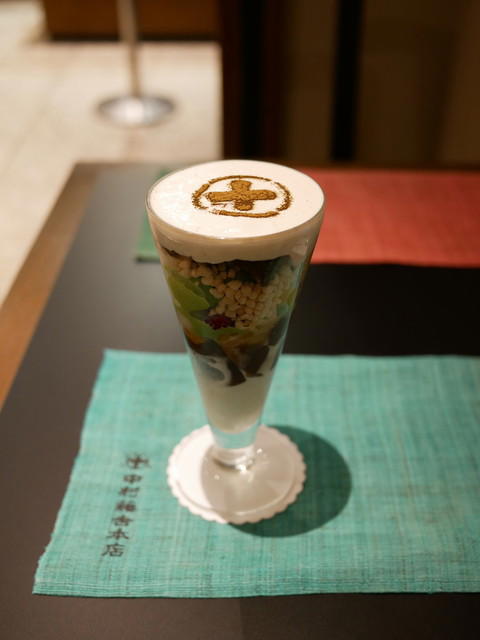
The menu
What to order
- Matcha parfait
- Matcha soba
- Matcha jelly dessert
Kyoto is not always a soft landing: escalators, concourses, department-store floors, luggage wheels, and train announcements can compress the city into a few vertical blocks. Here, a Japanese sweets cafe must read fast: tea, Japanese sweets, noodles, family tables, and a rhythm for travelers outside temple-district speed. Nakamura Tokichi Honten Kyoto eki ten belongs to modern Kyoto, where tea and sweets culture is translated into a practical cafe format, not preserved only as hushed ceremony.
That matters. Kyoto’s tea and confectionery traditions often reach visitors through two poles: formal tea rooms that demand time, and casual dessert counters that reduce matcha to a color. This branch sits between them. Its recognition in Tabelog Hyakumeiten 2023 places it in a competitive sweets-cafe context, not merely among convenient options. The public listing also gives it a Tabelog score of 3.54, a useful signal without turning the stop into a grand-occasion meal.
Tea culture, edited for a Kyoto crowd
The defining idea is not a chef-led tasting menu or personality-driven kitchen. It is format discipline: a tea-focused cafe serving Japanese sweets, cafe items, and noodles without losing identity. In Kyoto, where matcha is both serious ingredient and tourist shorthand, stronger addresses keep tea tradition visible through structure, not slogans.
Japanese sweets cafes in Kyoto move differently from kaiseki counters or high-end sushi rooms. Decisions are often made between plans, after hotel check-out, or before another city errand. A cafe room gives this branch useful middle ground: more settled than a kiosk, less ceremonious than a destination tea salon. It also explains the pull for families and friends as well as solitary sweet-seekers. The category is social by design; tea and sweets allow a shorter sitting without feeling compromised.
The menu categories signal a broader Kyoto habit: sweets cafes often refuse to behave as dessert-only rooms. Noodles sit beside Japanese sweets, and the cafe format serves travelers on a compressed schedule. When coherent, that mix is not dilution. It shows how casual dining in Japan becomes a practical extension of regional food culture, especially where visitors arrive with limited time and strong expectations.
For a street-level reading of Kyoto’s casual dining spectrum, compare it with other Kyoto dining rooms, quick-service counters, cafe addresses, and compact neighborhood restaurants. Those addresses point to different meals, but define the same city problem: Kyoto rewards planning, yet not every worthwhile stop needs a formal reservation.
The booking question is a timing question
Kyoto dining strategy often means securing counters months ahead, but sweets cafes run on a more fluid logic. The smarter question is not only whether a table can be secured in advance; it is whether the format fits the hour. A Kyoto cafe with Japanese sweets and noodles suits in-between moments formal restaurants rarely solve: post-arrival, pre-departure, or the gap between a museum plan and dinner.
That makes this branch more useful than its category suggests. In Kyoto, comparison venues cover wide price and occasion ranges: FUKUNAGA901 sits in a casual dessert bracket, Morita Ya JR kyoto isetan ten moves toward a meal-centered department-store experience, Mangetsu JR kyoto isetan ten occupies another sweets lane, Saikyo Yaki Kyoto Yamaroku answers a meal brief, and Gozan Nozomi belongs to a more expensive tier. Nakamura Tokichi Honten Kyoto eki ten is not competing with all directly; it competes for the traveler’s limited Kyoto-window attention.
That logic matters in Kyoto, where appeal is spread across the city with uneven transit times. A visitor may pass through central corridors only once or twice. A sweets cafe in that circulation pattern must justify itself quickly. Tabelog Hyakumeiten recognition does that better than ambience claims, because the category signal is specific to cafe and Japanese sweets culture, not general dining.
Kyoto’s older sweet traditions are better understood through long-running specialists and unnamed confectionery rooms, where one old-style sweet can carry the visit. The cafe format represents another Kyoto: compressed, modern, and designed for people moving through the city rather than lingering over one formal meal. Both belong in a serious itinerary, but solve different problems.
Where it fits in a Kyoto itinerary
The strongest use case is a targeted tea-and-sweets pause built around the day’s movement, not a destination meal that pulls the itinerary off course. It suits travelers who care about Kyoto’s tea identity but have allocated main meals to other Kyoto dining. It is also clean for mixed groups, because the cafe format is broad enough for different appetites without requiring a full restaurant commitment.
The room’s practical character is not lack of editorial weight. In Japan, city-center and transit-oriented dining can carry serious food culture, especially in regional sweets, bento, ramen, or specialist tea. Kyoto’s food floors and cafe counters feed travelers, office workers, domestic tourists, and locals buying gifts. The better places make speed and access part of the craft, not enemies of it.
Readers building a fuller Kyoto plan should use Our full Kyoto restaurants guide for dining, then cross-check stays through Our full Kyoto hotels guide, drinks through Our full Kyoto bars guide, wine context through Our full Kyoto wineries guide, and cultural planning through Our full Kyoto experiences guide. For a broader Japan and diaspora food map, look to other dining rooms in major Japanese cities and overseas communities, from casual counters and specialist cafes to sake bars and compact neighborhood stops.
The editorial verdict is simple: this is a precision stop, not a grand meal. Use it when Kyoto is already in the day and the brief is tea-led sweets with enough recognition to separate it from generic casual dining. In a city where reservations can dominate the itinerary, that flexible, category-specific address has real value.
Frequently asked questions
Is Nakamura Tokichi Honten Kyoto eki ten suitable for children?
It is listed as a cafe featuring Japanese sweets, cafe items, and noodles, with a JPY 1,000–1,999 budget for lunch and dinner. Check the venue's official channels for the latest details.
What's the overall feel of Nakamura Tokichi Honten Kyoto eki ten?
It reads as a Kyoto tea-and-sweets cafe rather than a formal dining room, with Japanese sweets, cafe service, and noodles all part of the listed category mix. The Tabelog Hyakumeiten 2023 recognition gives it clear editorial weight.
What's the pricing like at Nakamura Tokichi Honten Kyoto eki ten?
Pricing at Nakamura Tokichi Honten Kyoto eki ten is listed as JPY 1,000 - JPY 1,999 JPY 1,000 - JPY 1,999.
Is Nakamura Tokichi Honten Kyoto eki ten open every day?
Check Nakamura Tokichi Honten Kyoto eki ten's official channels for current opening days and hours before visiting.
How do I find Nakamura Tokichi Honten Kyoto eki ten?
Kyoto.
What's the defining dish or idea at Nakamura Tokichi Honten Kyoto eki ten?
The defining idea is tea handled through Japanese sweets and cafe service, with noodles also listed in the category mix. That places it squarely in the Kyoto sweets-cafe lane, not the kaiseki or counter-dining scene.
Cuisine and Credentials
Comparable venues by cuisine and category.
| Venue | Cuisine | Price | Awards | Notes |
|---|---|---|---|---|
| Nakamura Tokichi Honten Kyoto eki tenThis venue (the venue you are viewing) | Matcha sweets & soba café | $10–20 | Tabelog 100 #69 | Not listed |
| Grill Kodakara (グリル小宝) | Retro Yoshoku (Japanese Western) | $10–20 | Tabelog 100 #49 | Okazaki |
| Kyoto Uji Kintoki Ya | Kyoto kakigori, soft‑serve & udon shop | $10–20 | Tabelog 100 #60 | Higashiyama |
| 真白 | Modern Japanese Fine Dining | $200–300 | 1 Michelin Star · Tabelog Bronze #259 | Nakagyō |
| Cafe Don Bai Sfera | Japanese Café | $10–20 | Tabelog 100 #68 | Higashiyama |
| é«å°å¯º åä¹ å³ | Shojin Ryori (Buddhist Temple Cuisine) | Not listed | Not listed | Higashiyama |
Recognition history
Dated appearances from independent guides and award organizations, with the underlying list record or original source where available.
Tabelog 100 #69 · No. 69
Tabelog · Tabelog 100 - Japanese traditional sweets / Japanese sweets cafe - WEST - 2023
Continue exploring
More in Kyoto
Restaurants in Kyoto
All restaurants in Kyoto →
Bars in Kyoto
All bars in Kyoto →
Hotels in Kyoto
All hotels in Kyoto →
Wineries in Kyoto
Browse all →
Details
- Classic
- Cozy
- Well Known
- Solo
- Family
- Casual Hangout
- After Work
- Standalone
- Zero Proof
- Local Sourcing
- A La Carte
- Tea
- Non Alcoholic
Current opening hours
- Monday
- 11 AM–10 PM
- Tuesday
- 11 AM–10 PM
- Wednesday
- 11 AM–10 PM
- Thursday
- 11 AM–10 PM
- Friday
- 11 AM–10 PM
- Saturday
- 11 AM–10 PM
- Sunday
- 11 AM–10 PM
Hours can change for holidays and private events. Last verified .
Casual, bright station-front café with a warm, relaxed feel; simple modern interiors centered on tea-focused desserts and light meals, often with a lively but orderly atmosphere due to constant foot traffic and queuing.