
Musashino Udon Sawamura belongs to Saitama’s wheat-noodle tradition rather than Tokyo’s polished tasting-menu culture. Its Tabelog Udon EAST 100 selection in 2024 gives a clear signal: this is a low-price, specialist udon address where regional noodle craft, not luxury staging, sets the terms.
Pearl is the En Primeur Club membership app — saves, bookings, and concierge access live there. Same editors, same standards.
- Address
- 1-chome-2-25 Bijogikita, Toda, Saitama 335-0038, Japan
- Phone
- +81 48-424-7676
- Website
- instagram.com
 Saves & bookings on Pearl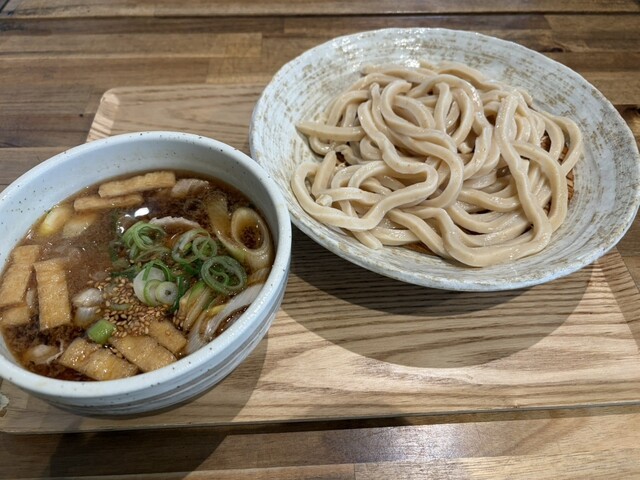
The approach is suburban Saitama rather than metropolitan theatre: a house-style restaurant in Toda, away from the dense Tokyo restaurant corridors. That matters. Musashino udon is rooted in the old wheat belt around western Tokyo and Saitama, where thicker noodles, firm bite and dipping formats carry the meal more than elaborate toppings or chefly ornament. The appeal is agricultural first: wheat, water, kneading, resting and cut. Musashino Udon Sawamura therefore reads less like a luxury destination restaurant than a serious regional noodle shop that has entered a national conversation.
Toda’s dining scene is practical, residential and price-sensitive, giving udon a different role from capital counter formats. A bowl or dipping set is not a prelude to an evening out; it is the meal. Selection for Tabelog Udon EAST 100 in 2024 places the restaurant among a curated group of eastern Japan udon specialists, a useful credential because the category rewards consistency where small variations in dough handling are easy to taste and hard to disguise. Its Tabelog score of 3.67 reinforces the point: not prestige dining, but a focused noodle address with public traction beyond its immediate neighbourhood.
Musashino udon puts wheat texture ahead of luxury signals
Regional udon in Japan is not one idea. Sanuki udon is associated with bounce and speed; Inaniwa with thin, refined strands; Kishimen with flat ribbons. Musashino udon sits in a sturdier register, linked to wheat cultivation around the Kanto plain and traditionally served with dipping broth rather than submerged as a delicate soup noodle. The format leaves the noodle’s structure exposed. Thickness, chew and surface texture become the main event; broth and condiments act as counterweight, not decoration.
That ingredient logic explains why a low-ticket restaurant can carry editorial weight. The listed price band sits below JPY 999, with review-based spending commonly JPY 1,000 to JPY 1,999, putting the experience closer to everyday regional food than special-occasion dining. In Japan, that distinction matters: some of the sharpest eating happens in narrow, repetitive categories judged by locals who return often. Udon belongs to that tradition. A shop needs no elaborate menu architecture when the wheat noodle itself is the test.
For travelers building a Toda food itinerary, the restaurant serves a different function from broader comfort-food or Western-leaning addresses such as Curry House Chirichiri or Pizzeria Oosaki Honten. The comparison is not hierarchy, but category. Curry, pizza and udon answer different appetites; udon speaks directly to Saitama’s relationship with wheat and Kanto’s everyday noodle culture. For a wider scan, Our full Toda restaurants guide is the cleaner starting point, while non-dining planning sits separately in Our full Toda hotels guide, Our full Toda bars guide, Our full Toda wineries guide and Our full Toda experiences guide.
A specialist shop in a city built for regulars
The logistics underline the local character. Reservations, private rooms and private use are unavailable; the setting is family friendly, with children welcome. The meal is governed by timing and turnover rather than ceremony. Credit cards and electronic money are not accepted, while PayPay is accepted, a reminder that everyday Japanese dining can be technologically mixed rather than uniformly card-friendly. Parking is listed at 25 units, another suburban signal separating the experience from station-front Tokyo noodle counters.
There is a temporal rhythm, too. Service runs during the daytime, and the business opened on 5 February 2019. Musashino Udon Sawamura belongs to a newer generation of regional specialists, not an inherited century-old house. The Tabelog 100 selection arrived in 2024, five years after opening: long enough to establish a following, short enough to feel contemporary rather than museum-like.
The absence of a named chef in the public-facing details is not a weakness. In udon culture, authorship often sits in repetition rather than biography. Craft is measured in daily dough and broth handling, not a personality-led tasting menu. The restaurant is useful for visitors who want to see how Japanese regional food earns recognition without luxury cues. Awards here carry a different message from Michelin stars: they identify specialists performing a familiar form with enough clarity to stand out in a crowded field.
How to place it within a wider Japan itinerary
Toda will not replace Tokyo, Kyoto or Osaka for breadth, but it can sharpen a traveler’s sense of what everyday regional dining does better than capital-city spectacle. Pairing an udon stop here with restaurants elsewhere in Japan clarifies the contrast: beef-led regional dining at -Grilled beef Sukiyaki- KAMAKURA TANUKIAN 鎌倉 たぬき庵 in Kamakura, seafood-and-grill formats at . 鮪と炭火焼き うお炭 秋葉原店 in Tokyo, café culture at.cafe in Osaka, contemporary regional dining at.know in Kumamoto, Vietnamese-Japanese casual dining at (Shoku) Vietnam in Kawasaki, curry specialization at [Curry Senmon Ten] Maruyama Kyoju. in Sapporo, Kyoto’s smaller-format dining at [ki:] in Kyoto, meat-focused Nara dining at #肉といえば松田 奈良本店 in Kashihara and burger culture at 1/3 HAMBURGER FACTORY in Kanazawa. Against that spread, udon in Toda becomes a study in restraint by category rather than design.
International comparisons help only if they do not flatten the food. Japanese drinking-and-small-plate culture in Los Angeles at Jōdo Saké Bar in Los Angeles or rice-ball specialization at Onigiri Time in Pasadena show how Japanese forms travel, adapt and become legible abroad. Musashino udon is harder to export because its identity depends on local wheat-noodle expectations and the everyday rhythm of a suburban shop. That is why it rewards the detour for travelers already moving through Saitama: it offers a clear, affordable reading of place through texture.
Quick Comparison
Nearby venues at a similar price tier for orientation.
| Venue | Cuisine | Price | Notes |
|---|---|---|---|
| Musashino Udon SawamuraThis venue — the venue you are viewing | Musashino Udon | $ | Not listed |
| Pizzeria Oosaki Honten | Neapolitan Pizza | $$ | Toda |
| Curry House Chirichiri | Curry House | $ | Toda Koen |
| Asahi Chonai Kai | Sapporo-style miso ramen | $ | Itabashi |
| Sanuki Udon Jobe | Traditional Sanuki Udon Shop | $ | Kami-Fukuoka |
| Chuka Soba Kaoru | Ramen | $ | Sakaecho |
Recognition history
Dated appearances from independent guides and award organizations, with the underlying list record or original source where available.
Tabelog 100 #56 · No. 56
Tabelog · Tabelog 100 - Udon - EAST - 2024
Continue exploring
More in Toda


Bars in Toda
Browse all →








At a Glance
- Cozy
- Classic
- Family
- Casual Hangout
- Group Dining
- Solo
- Standalone
Current opening hours
- Monday
- 11 AM–4 PM
- Tuesday
- 11 AM–4 PM
- Wednesday
- 11 AM–4 PM
- Thursday
- 11 AM–4 PM
- Friday
- 11 AM–4 PM
- Saturday
- 10 AM–4 PM
- Sunday
- 10 AM–4 PM
Hours can change for holidays and private events. Last verified .
A large, casual udon shop with an everyday neighborhood feel and a practical, no-frills atmosphere.