
A compact Itabashi ramen counter brings Sapporo ramen into Tokyo’s northern ward rhythm, with Tabelog Ramen TOKYO 100 selections from 2022 through 2025 and a 3.79 score. Asahi Chonai Kai is useful for travellers who want Tokyo ramen culture beyond station-mall convenience and Ginza-level ceremony: small room, no reservations, cash-only payment, and a format built for decisive eating rather than lingering.
Pearl is the En Primeur Club membership app — saves, bookings, and concierge access live there. Same editors, same standards.
- Address
- 3 Chome-5-1 Itabashi, Itabashi City, Tokyo 173-0004, Japan
- Phone
- +81 3-6915-5569
- Website
- twitter.com
 Saves & bookings on Pearl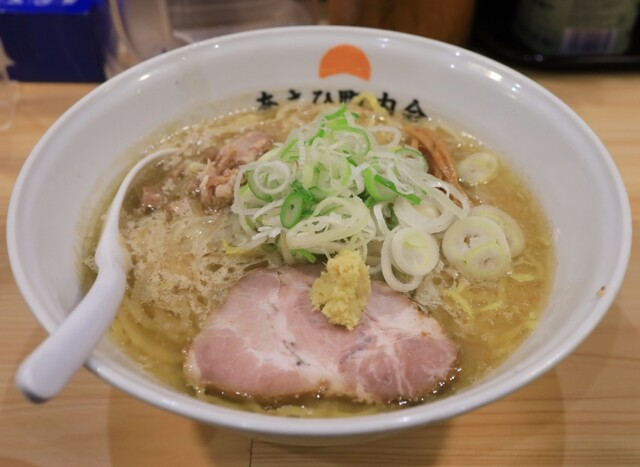
Itabashi’s ramen rooms tend to announce themselves without theatre: a low storefront, a short queue if timing is poor, steam on the glass, the sound of tickets, trays, and bowls moving faster than conversation. That physical modesty matters. Tokyo ramen is often discussed through destination shops in central wards, but much of the city’s serious noodle culture lives in neighbourhoods where lunch is functional, dinner is local, and reputation travels through repeat visits rather than staging.
Asahi Chonai Kai belongs to that second Tokyo. Its address in Itabashi places it away from the hotel corridors and department-store dining floors, yet its recognition puts it inside the city’s more competitive ramen conversation: selected for Tabelog Ramen TOKYO 100 in 2022, 2023, 2024, and 2025, with a Tabelog score of 3.79. Those signals do not turn a ramen shop into luxury dining. They tell a more useful story: a modest-format counter can earn sustained attention in a city where noodle specialists are judged bowl by bowl, not by room design.
Sapporo ramen, translated through an Itabashi counter
The defining point here is regional identity. Tokyo ramen has its own broad vocabulary, often associated with soy-led broths, clear stock profiles, and a lighter urban tempo. Sapporo ramen comes from a colder city and a different appetite: richer miso traditions, heavier aromatic impact, and a bowl designed to hold heat. Asahi Chonai Kai is explicit about that lineage. The owner trained at Sumire in Sapporo, and the house identity is framed as authentic Sapporo ramen rather than Tokyo ramen.
That distinction is not pedantry. Ramen in Japan is intensely regional, but Tokyo’s scale has made it a national showroom, where styles from Hokkaido, Kyushu, Kitakata, Tsubame-Sanjo, and other local traditions compete within the same transit map. The stronger shops do not merely import a label; they preserve enough of the regional grammar to make the bowl legible. In this case, the Sapporo reference gives the meal its context before any discussion of queue management or price category.
The room reinforces the point. Six counter seats, two four-person tables, and one two-person table make the format compact but not austere. Counter seating keeps the meal close to the kitchen rhythm, while the small number of tables explains why families can use the shop without turning it into a long, leisurely sitting. Ramen at this tier is about compression: a defined regional style, a short eating window, and a price band that keeps the experience in everyday Tokyo rather than special-occasion dining.
Why the recognition matters in Tokyo's ramen hierarchy
Tabelog’s ramen lists have become a practical shorthand for serious eaters in Japan, especially in categories where Michelin-style formality tells only part of the story. A Tokyo ramen selection across four consecutive years is a useful trust signal because it points to consistency in a category with high turnover, intense customer scrutiny, and little margin for service ornament. The score sits in a range that Japanese diners read with more seriousness than many visitors expect; Tabelog ratings tend to be conservative, and anything approaching the high threes in a crowded casual category deserves attention.
The competitive set also clarifies the value proposition. Among the comparison venues supplied for Tokyo, Pinocchio, China Soba Osada, and JUICY ALL STARZ occupy the same JPY 1,000 to JPY 1,999 bracket, while Stand Totonoi moves slightly higher and Shinkirow sits far above it. Asahi Chonai Kai’s position is therefore not about rarity by price. It is about a specific ramen tradition delivered within an accessible band, which is exactly where Tokyo’s noodle culture is often at its sharpest.
For travellers building a broader Tokyo eating map, this is the counterweight to reservation-led sushi, tasting-menu French, and cocktail bars with lengthy drink architecture. Itabashi rewards a different kind of planning: arrive with flexibility, eat directly, and let the neighbourhood do the framing. For more central restaurant planning, use Our full Tokyo restaurants guide; for the city’s hotel base decisions, see Our full Tokyo hotels guide. Drinking itineraries belong in Our full Tokyo bars guide, while broader specialist listings sit in Our full Tokyo experiences guide and Our full Tokyo wineries guide.
Know Before You Go
- Format: Ramen shop with counter seating and a small table section.
- Recognition: Tabelog Ramen TOKYO 100 selection in 2022, 2023, 2024, and 2025; Tabelog score 3.79.
- Regional frame: Sapporo ramen, with owner training linked to Sumire in Sapporo.
- Reservations: Not taken, so timing matters more than booking strategy.
- Payment: Credit cards, electronic money, and QR code payments are not accepted.
- Family use: Children are welcome, including babies, preschoolers, and school-age children; strollers are welcome.
- Smoke policy: Non-smoking.
- Parking: No dedicated parking; coin parking is available nearby.
Itabashi is not the only way to read Tokyo’s casual dining culture. Akihabara has its own after-work appetite at. 鮪と炭火焼き うお炭 秋葉原店, Shinjuku’s dense eating grid includes 12/10 Shinjuku ten, and Kagurazaka’s smaller rooms give yakitori a different cadence at 124. KAGURAZAKA (Yakitori). For lighter or more visual stops, 2D Cafe and 3 Chome no Curry Ya San show how Tokyo’s casual formats split by neighbourhood and mood.
Outside Tokyo, the same logic applies: category matters more than prestige shorthand. Kamakura’s beef-sukiyaki lane appears at -Grilled beef Sukiyaki- KAMAKURA TANUKIAN 鎌倉 たぬき庵 in Kamakura, Osaka’s cafe culture at.cafe in Osaka, Kumamoto’s contemporary dining at.know in Kumamoto, Kawasaki’s Vietnamese cooking at (Shoku) Vietnam in Kawasaki, Sapporo’s curry specialists at [Curry Senmon Ten] Maruyama Kyoju. in Sapporo, and Kyoto’s quieter modern tables at [ki:] in Kyoto. Across the Pacific, Japanese drinking and rice formats take different shapes at Jōdo Saké Bar in Los Angeles and Onigiri Time in Pasadena. Seen in that wider frame, the restaurant is not a detour from Tokyo dining; it is a clean example of how regional Japanese food culture survives inside the capital’s everyday infrastructure.
Accolades, Compared
Comparable venues side-by-side for orientation.
| Venue | Cuisine | Price | Notes |
|---|---|---|---|
| Asahi Chonai KaiThis venue — the venue you are viewing | Sapporo-style miso ramen | $ | Not listed |
| Ayu Ramen Plus (鮎ラーメンプラス) | Traditional Ayu Ramen | $ | Toranomon |
| Chuka Sobaya Ito | Classic Tokyo niboshi ramen | $ | Kita |
| Zehn Coffee | Japanese Kissaten / Coffee Shop | $ | Taitō |
| 青山浅田 | japanese | $ | Minato |
| Motenashi Kuroki | Modern Japanese Ramen | $ | Taitō |
Recognition history
Dated appearances from independent guides and award organizations, with the underlying list record or original source where available.
Tabelog 100 #89 · No. 89
Tabelog · Tabelog 100 - Ramen - TOKYO - 2025



At a Glance
- Cozy
- Lively
- Solo
- Casual Hangout
- Family
- Late Night
- Standalone
- Beer Program
Current opening hours
- Monday
- Closed
- Tuesday
- 11 AM–2:50 PM, 5–8:30 PM
- Wednesday
- 11 AM–2:50 PM, 5–8:30 PM
- Thursday
- 11 AM–2:50 PM, 5–8:30 PM
- Friday
- 11 AM–2:50 PM, 5–8:30 PM
- Saturday
- 11 AM–3 PM, 5–8:30 PM
- Sunday
- 11 AM–3 PM, 5–8:30 PM
Hours can change for holidays and private events. Last verified .
Simple, compact neighborhood ramen shop with counter-focused seating and a casual, bustling atmosphere suited to solo diners and families dropping in for a quick bowl.