Mezcalli Bratislava
Mezcalli sits on Námestie SNP, Bratislava's central square, where the Slovak capital's appetite for international formats meets the particular logic of mezcal and Mexican spirits culture. The address places it within easy reach of the Old Town's bar and restaurant circuit, and the concept occupies a niche that remains genuinely sparse in Central Europe's capital cities.
Pearl is the En Primeur Club membership app — saves, bookings, and concierge access live there. Same editors, same standards.
- Address
- Námestie SNP 1, 811 06 Bratislava, Slovakia
- Phone
- +421949548725
- Website
- mezcalli.sk
- Directions
- Get directions
 Saves & bookings on Pearl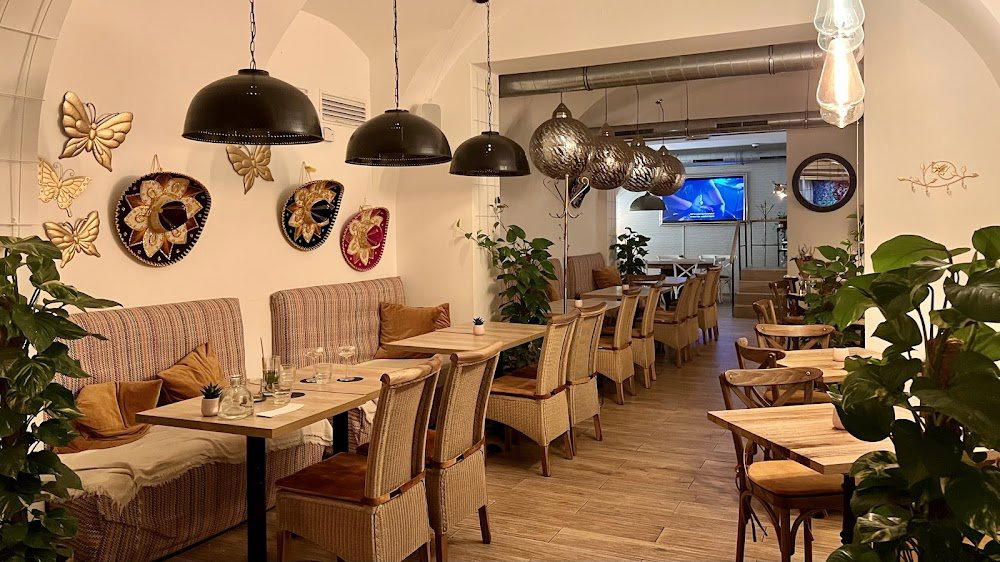
Námestie SNP is Bratislava's civic anchor: the square where protests were held, where the city exhales after work, and where the dining and bar strip runs close enough to the Danube embankment that the two scenes blur after dark. It is not where you would expect to find a serious agave spirits program. Central European bar culture has historically organised itself around wine, beer, and the regional spirits traditions of Hungary, Austria, and Czechia. Mezcal, with its slow-production logic, its regional denominations, and its dependency on wild or semi-wild agave stocks, represents a different kind of import entirely, one that requires both sourcing infrastructure and a clientele willing to engage with it on its own terms.
That Mezcalli has positioned itself on this square, rather than in side streets where specialist bars more often appear, says something about where Bratislava's drinking culture is heading. The city's bar scene has moved steadily toward formats that treat spirits as primary subjects rather than cocktail ingredients, and the SNP address reflects an ambition to capture foot traffic from a broader public, not just those already initiated into agave categories.
Agave Culture in a Central European Context
The intersection of imported technique and local context is particularly legible in how mezcal bars operate outside their home region. In Mexico, the denomination of origin for mezcal covers nine states, with Oaxaca producing the largest volume and commanding international recognition. Each producing region has its own agave species, roasting methods, and fermentation traditions, distinctions that matter enormously to serious collectors but which require active translation for audiences encountering the spirit for the first time.
Bratislava sits at a crossroads of Central European capital cities where this translation work is still in early stages. Budapest, Vienna, and Prague have each developed small but committed agave bar scenes, and Bratislava's position in that geography makes it a natural next point on the circuit. A bar operating here inherits both the challenge of educating a market and the advantage of relative scarcity: there is no crowded competitive field to distinguish itself from, which gives a focused program more room to define the category for local drinkers.
The address at Námestie SNP 1 puts Mezcalli within walking distance of the Old Town's established restaurant and bar strip, where venues like Ako doma, Al Faro, and Albrecht Restaurant represent the broader range of what serious eating and drinking looks like in this city. Mezcalli occupies a different register from all of them, neither Slovak-rooted nor European in its frame of reference, but building a case for why a spirit produced in Oaxacan highlands belongs on a square in the Slovak capital.
The Logic of the Format
Specialist spirits bars in cities outside the producing region tend to split into two models. The first is the broad selection warehouse approach: long back-bar, encyclopaedic menu, service that prioritises choice over guidance. The second is the curated-counter model: a shorter, more considered list where the host's selection criteria are themselves part of the proposition, and where conversation about provenance is built into the experience rather than optional.
The Central European cities that have developed credible agave programs, including a small number of bars in Vienna and Prague, have generally found more traction with the second model. Drinkers who are encountering mezcal seriously for the first time respond to curation and context; those already committed to the category come for the depth of a considered list rather than sheer volume. The format of positioning it on a high-footfall civic square suggests a venue aiming at accessibility as an entry point, with depth for those who want to pursue it further.
For context on what sophisticated imported-format restaurants are doing elsewhere in the Slovak dining scene, Antica Toscana and APOLKA Restaurant represent different inflection points in how Bratislava absorbs non-Slovak culinary traditions. The agave bar category sits in a comparable position to what Italian regional cooking occupied a decade ago: present, growing, and still in the process of building a literate local audience.
Bratislava in the Regional Dining Picture
Slovakia's restaurant scene operates across a wider geography than its capital alone. Venues like Koliba Patria in Strbske Pleso and Fatrabeef in Lubochna anchor the country's strong tradition of regional, ingredient-led cooking in rural and mountain contexts. The contrast with what Mezcalli represents, an internationally-sourced spirits concept on the capital's central square, illustrates how the Slovak dining picture has diversified across formats and geographies simultaneously.
For those moving through Slovakia more broadly, Focus Restaurant in Zilina, Hotel & Restaurant Gino Park Palace in Povazska Bystrica, and Bulli Kebab in Kosice each reflect how the country's secondary cities are building their own distinct dining identities. KOLIBA na Vršku in Bytca, Holotéch víška in Kosariska, Kaštieľ Čičmany in Cicmany, Afrodita in Cerenany, and Klára v GOYA vitality hotel in Voderady round out a picture of a country whose culinary identity extends well beyond its capital. Mezcalli's Bratislava placement makes sense in this context: the capital is where imported concepts find their first audience before, in some cases, influencing what follows in smaller cities.
For the sharpest global comparisons in the imported-technique, specialist-format category, Le Bernardin in New York City and Atomix in New York City each demonstrate what happens when a foreign culinary tradition is absorbed, refined, and recontextualised for a new market with complete authority. That end-state is the ambition implicit in any serious imported-format venue, wherever it operates.
Planning a Visit
Mezcalli is located at Námestie SNP 1, at the edge of Bratislava's Old Town and within direct reach of the central tram and bus network. The address is walkable from the main train station in under fifteen minutes and sits on one of the city's most accessible public squares. Bratislava's bar scene operates on the early side relative to Western European capitals, with peak service typically running from early evening.
Where the Accolades Land
Comparable venues nearby, for context on price, style, and recognition.
| Venue | Cuisine | Price | Notes |
|---|---|---|---|
| Mezcalli BratislavaThis venue — the venue you are viewing | Traditional yet Innovative Mexican Taqueria | $$$ | Not listed |
| Massimo Ristorante | Authentic Italian with Neapolitan Pizza | $$$ | Staré Mesto |
| MOOZI | Creative Asian Fusion | $$$ | Staré Mesto |
| Dolnozemská | Modern Dolnozemski Slovak | $$ | Staré Mesto |
| Wabi Sabi | Authentic Japanese Sushi | $$$ | Staré Mesto |
| Koykan Eurovea | Global Street Food | $$ | Staré Mesto |
Continue exploring
More in Bratislava
Restaurants in Bratislava
Browse all →
Bars in Bratislava
Browse all →
Hotels in Bratislava
Browse all →
At a Glance
- Lively
- Sophisticated
- Date Night
- Casual Hangout
- Open Kitchen
- Craft Cocktails
Current opening hours
- Monday
- Closed
- Tuesday
- 11:30 AM–10 PM
- Wednesday
- 11:30 AM–10 PM
- Thursday
- 11:30 AM–10 PM
- Friday
- 11:30 AM–11 PM
- Saturday
- 11:30 AM–11 PM
- Sunday
- 11:30 AM–4 PM
Hours can change for holidays and private events. Last verified .
Attractive, colorful, and sophisticated interior evoking the warmth of Mexican culture.