
Masaru belongs to Hiroshima’s counter-led okonomiyaki culture, where the griddle is not backstage but the center of the room. Its Tabelog 100 Okonomiyaki 2025 selection, 20 counter seats around the iron plate, and station-side Hikarimachi location place it in the city’s serious everyday-dining tier rather than the formal special-occasion bracket.
Pearl is the En Primeur Club membership app — saves, bookings, and concierge access live there. Same editors, same standards.
- Address
- 2 Chome-14-24 Hikarimachi, Higashi Ward, Hiroshima, 732-0052, Japan
- Phone
- +81 82-263-0234
- Website
- japoncompany.business
 Saves & bookings on Pearl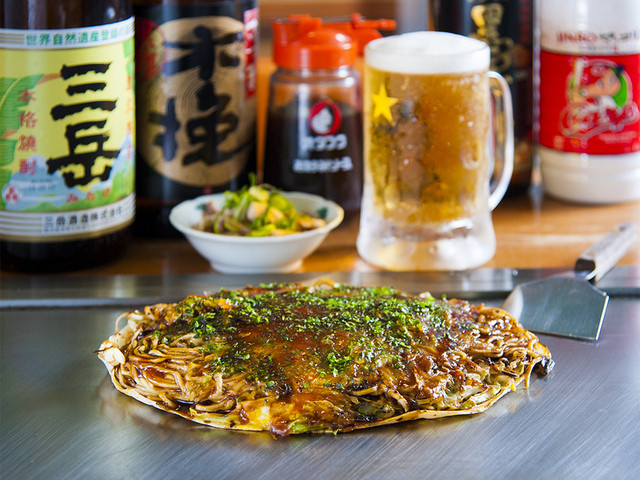
The first cue is the counter. Hiroshima okonomiyaki is a griddle ritual as much as a dish, and rooms built around the iron plate change the pace of the meal: orders move from batter to cabbage to noodles to sauce in public view, with diners watching timing and heat do the work. Masaru sits inside that tradition with a compact counter-only format, the kind of arrangement that makes the teppan the room’s common language rather than a kitchen appliance hidden behind a wall.
Hiroshima’s version of okonomiyaki has always carried a different grammar from Osaka’s mixed-batter style. The ingredients are layered rather than stirred together, and noodles are central, which makes sequence matter. That structure gives the city’s okonomiyaki counters their particular cadence: the meal is casual, but the cooking is not loose. A good counter keeps its rhythm under pressure, especially when the room is full and every seat faces the same heat source.
Counter okonomiyaki as Hiroshima dining etiquette
Masaru’s place in the city makes sense because Hiroshima treats okonomiyaki as daily food with serious local hierarchy. The category spans station-adjacent shops, neighborhood counters, and destination rooms where the same basic vocabulary is judged by texture, timing, and consistency. Tabelog’s 2025 Okonomiyaki 100 selection puts Masaru in a recognized national shortlist for the genre, but the more useful signal for travelers is format: a 20-seat counter surrounding the iron plate leaves little room for distance between cook, griddle, and diner.
That intimacy shapes etiquette. This is not the setting for a drawn-out tasting-menu performance or a table spread designed for lingering over multiple courses. The pleasure is in the sequence: watching the build, eating while heat is still part of the experience, then giving the counter back to the next wave. Hiroshima okonomiyaki rewards attention, but it does not ask for ceremony. It is democratic food with a sharp sense of order.
Compared with Icchan Honten, which sits at a leaner everyday budget, and Denkou Sekka Ekie hiroshima ten, which suits station-linked convenience, Masaru reads as a slightly more deliberate counter choice within the same civic food language. Tatsu occupies a comparable casual bracket, while Chinese Sai Kichijitsu belongs to a different spending category altogether. Those comparisons matter because Hiroshima dining can look deceptively narrow from a distance: okonomiyaki may be the city’s shorthand, but the decision is about pace, setting, and how much of the meal should happen in front of the iron plate.
What the Hikarimachi setting says about the meal
Hikarimachi, near Hiroshima Station’s north side, is not the postcard version of the city’s dining life. That works in its favor. Around the station, restaurants often serve residents, office workers, rail passengers, and returning locals in the same service window, which keeps the cooking practical. In that context, a counter okonomiyaki restaurant does not need theatrical design. The room’s authority comes from the visible work of the griddle and the discipline of a limited number of seats.
The restaurant’s categories, okonomiyaki, Japanese cuisine, and teppanyaki, also signal how Hiroshima’s everyday dining refuses tidy foreign-language boxes. Teppanyaki outside Japan often suggests a staged premium format; here, the iron plate is closer to civic infrastructure. Sake, shochu, wine, and cocktails broaden the meal without turning it into a bar program. The result is a flexible local format: suitable for a quick lunch, a casual dinner, or a small group that wants the shared focus of the counter rather than a private-room meal.
For travelers building a Hiroshima food map, Masaru belongs beside rather than beneath the city’s more polished dining addresses. Creative-cuisine rooms such as Akai (Creative Cuisine) speak to Hiroshima’s contemporary restaurant ambitions; ANDERSEN, Bishu Bikou Hamai, Butter Cake no Nagasaki Do, and CHILAN show how varied the city’s eating can be beyond the griddle. The better itinerary does not treat okonomiyaki as a tourist checkbox. It uses the counter as a calibration point for how Hiroshima eats when it is not performing luxury.
How to place it in a Hiroshima itinerary
Masaru is strongest as a meal built around rhythm, proximity, and a clear local form. The case for going is not scarcity or spectacle; it is the chance to read Hiroshima okonomiyaki from a serious counter where the format is the experience. The Tabelog 100 recognition provides the external credential, while the counter-only layout provides the more revealing clue about how the meal unfolds.
It also suits travelers who want one grounded, genre-specific meal between broader city stops. Use Our full Hiroshima restaurants guide for a wider dining route, then pair it with Our full Hiroshima hotels guide, Our full Hiroshima bars guide, Our full Hiroshima wineries guide, and Our full Hiroshima experiences guide if the trip extends beyond one meal. Readers comparing casual Japanese formats across the country can also look at -Grilled beef Sukiyaki- KAMAKURA TANUKIAN 鎌倉 たぬき庵 in Kamakura. 鮪と炭火焼き うお炭 秋葉原店 in Tokyo.cafe in Osaka.know in Kumamoto, (Shoku) Vietnam in Kawasaki, [Curry Senmon Ten] Maruyama Kyoju. in Sapporo, Jōdo Saké Bar in Los Angeles, and Onigiri Time in Pasadena for other ways simple formats become serious dining decisions.
Cuisine-First Comparison
Side-by-side context: comparable cuisine and price.
| Venue | Cuisine | Price | Notes |
|---|---|---|---|
| MasaruThis venue — the venue you are viewing | Hiroshima Okonomiyaki | $$ | Not listed |
| Hatsu Chan | Izakaya, Steak & Ramen | $$ | Naka |
| Hiroshima Marukajiri Naka-chan | Hiroshima okonomiyaki & teppanyaki izakaya | $$ | Naka |
| LOPEZ | Hiroshima okonomiyaki & teppanyaki | $$ | Nishi |
| Nukazuke Kobo nipote Misasa honten | Nukazuke-focused Yoshoku (Japanese-style Western) | $$ | Nishi |
| Tyra Restaurant | Cafe with Japanese fusion | $$ | Naka |
Recognition history
Dated appearances from independent guides and award organizations, with the underlying list record or original source where available.
Tabelog 100 #30 · No. 30
Tabelog · Tabelog 100 - Okonomiyaki - 2025
Continue exploring
More in Hiroshima
Restaurants in Hiroshima
Browse all →
Bars in Hiroshima
Browse all →
At a Glance
- Cozy
- Lively
- Classic
- Casual Hangout
- Solo
- Family
- Group Dining
- Standalone
- Beer Program
Current opening hours
- Monday
- 11:30 AM–2 PM, 5:30–11 PM
- Tuesday
- Closed
- Wednesday
- 11:30 AM–2 PM, 5:30–11 PM
- Thursday
- 11:30 AM–2 PM, 5:30–11 PM
- Friday
- 11:30 AM–2 PM, 5:30–11 PM
- Saturday
- 11:30 AM–2 PM, 5:30–11 PM
- Sunday
- 11:30 AM–2 PM, 5:30–11 PM
Hours can change for holidays and private events. Last verified .
Small, casual, and lively, with a cozy house-restaurant feel centered around the teppan.