
Tabelog Bronze #60
Our verdict
Eizan is a small Hiroshima Japanese-cuisine counter built around ritual, restraint, and a narrow service rhythm rather than spectacle. Recognition includes The Tabelog Award 2026 Bronze and selection for Tabelog Japanese cuisine WEST 100 in 2025, placing it in the serious regional conversation for formal Japanese dining.

Pearl is the En Primeur Club membership app, where members save venues, book tables and use the concierge.
The menu
What to order
- Wild Red Sea Bream
- Sakakiyama Wagyu Beef
- Sashimi from Seto Inland Sea
- Charcoal-grilled Local Fish
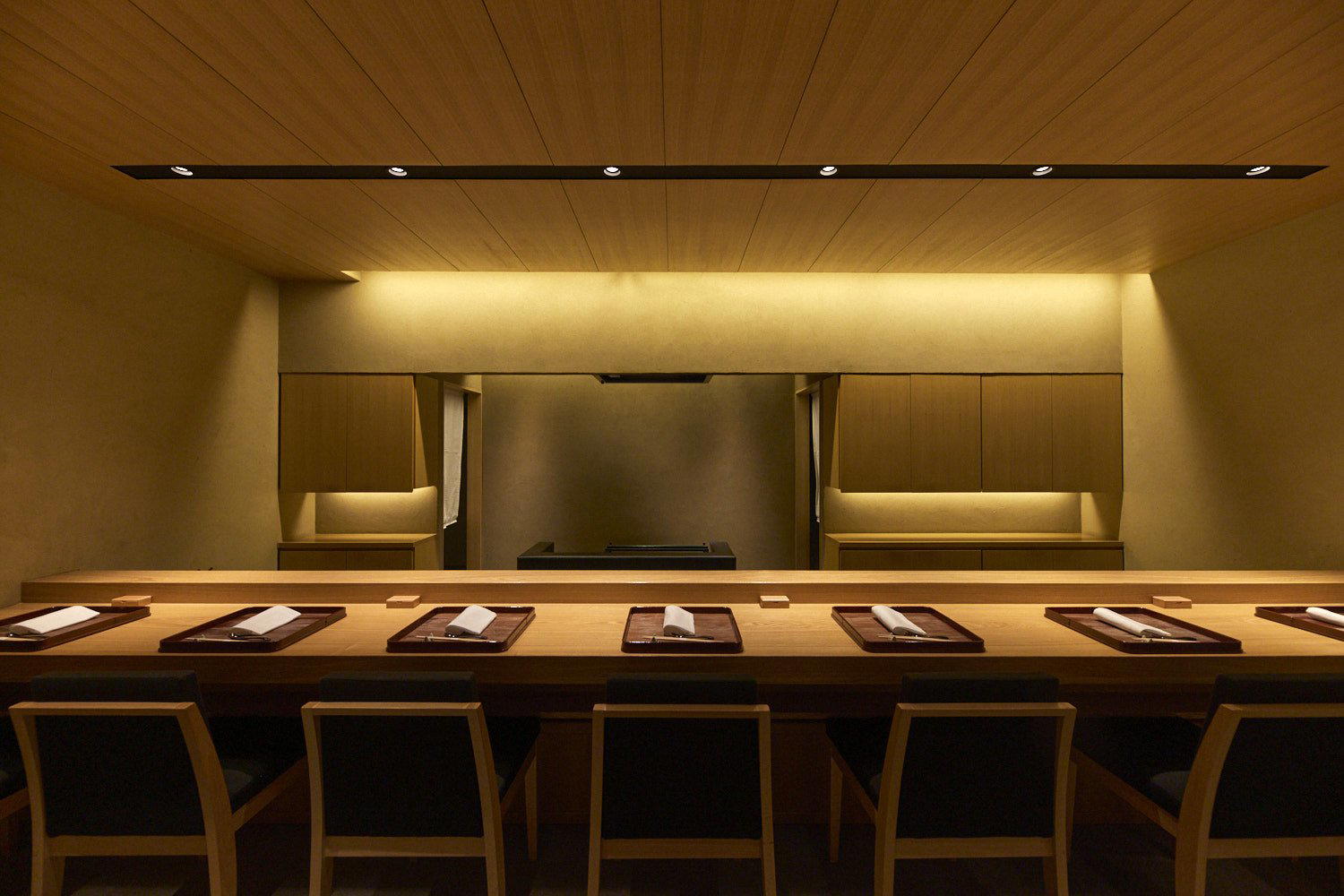
In Noboricho, the dining mood shifts quickly from city movement to ceremony. The room is small, arranged around counter seats with a separate table setting, and that scale matters: Japanese cuisine at this level depends on pacing, silence, and the accumulated attention of a few guests rather than the energy of a large dining room. Eizan belongs to Hiroshima’s quieter high-end register, where the meal is less about theatrical presentation than the sequence of service, the handling of fish, and the etiquette of arriving ready for a set rhythm.
A compact Japanese counter where the ritual carries the meal
Hiroshima is often reduced by visitors to okonomiyaki, oysters, and casual drinking, but the city’s serious Japanese-cuisine rooms operate on a different frequency. They ask for time, advance planning, and an acceptance that the chef-led meal is not a flexible à la carte negotiation. Eizan’s 12-seat format, with 8 counter seats and 4 table seats, places it firmly in that category. The counter is not just a viewing position; it is the social contract of the meal, where timing, temperature, and sequence carry as much weight as the ingredients themselves.
The useful comparison is not with casual Hiroshima institutions such as Okonomiyaki Hasshou, where value and immediacy define the appeal, but with the city’s smaller reservation-led rooms. Tori Yamamoto, in the comparison set, sits in a different lane, yakitori and izakaya culture at a lower spend level. Eizan is closer to formal Japanese cuisine: fish-led, drink-aware, and structured for guests who understand that the pace is part of the point. The Tabelog Award 2026 Bronze recognition and 2025 Japanese cuisine WEST 100 selection give that positioning objective weight without turning the meal into a trophy exercise.
This is also where Hiroshima’s geography becomes relevant. The city has direct access to the Seto Inland Sea and a long habit of valuing seafood in both casual and formal settings. A restaurant described around fish, sake, shochu, and wine sits inside that local grammar rather than outside it. The important distinction is discipline: in a small Japanese-cuisine room, regional ingredients are not enough on their own. The meal depends on how the room controls tempo, how drinks are matched to the sequence, and how guests read the cues of service.
The serious Hiroshima dinner sits between local habit and national ranking culture
Japan’s ranking culture can distort how travellers choose restaurants. A Bronze award or a place on a regional 100 list should not be read as a promise of grandness; in many cases, it signals a restaurant whose appeal is narrower and more demanding. That is the case here. The meal is built for diners who want a formal Japanese progression in Hiroshima, not a checklist of local specialities. It rewards attention to sequence, portion, and restraint, the elements that rarely translate well into a quick dining-card description.
Private rooms for small parties add another layer to the format. In Japanese dining, privacy can change the tone of the meal, especially for business dinners or groups who want conversation without losing the structure of the kitchen’s pacing. The counter, however, remains the sharper expression of the genre. It keeps the meal in dialogue with the craft rather than turning it into a private banquet. For travellers deciding between counter and room, the editorial call is simple: choose the counter if the point of the evening is the cooking; choose privacy if the company matters more than the choreography.
The drink program also signals a broader Japanese-cuisine stance. Sake and shochu anchor the tradition, while wine acknowledges how contemporary kaiseki-adjacent and fish-led meals have widened their pairing language. BYO is available, which changes the calculus for collectors, but the broader point is not bottle display. A serious Japanese meal works when drink supports the sequence rather than competes with it.
How to place it in a Hiroshima itinerary
This is not the restaurant to schedule as an afterthought between sightseeing and a late bar. It belongs on a day where dinner is the centre of gravity. Hiroshima can handle both registers in one trip: formal Japanese cuisine here, casual counter culture elsewhere, and patisserie or coffee during the day. For a broader city view, use Our full Hiroshima restaurants guide, then compare nearby food addresses such as Akai (Creative Cuisine), ANDERSEN, Bishu Bikou Hamai, Butter Cake no Nagasaki Do, and CHILAN.
The wider planning picture matters because Hiroshima is compact enough for a tightly edited trip, but not every category should be forced into one evening. Hotels shape the radius of a formal dinner, bars determine whether the night continues, and experiences can absorb the day before a structured meal. For that wider frame, see Our full Hiroshima hotels guide, Our full Hiroshima bars guide, Our full Hiroshima wineries guide, and Our full Hiroshima experiences guide.
For readers mapping Japanese dining beyond Hiroshima, the contrast is useful: regional specialisation changes the ritual as much as the ingredients do. Compare the formality here with -Grilled beef Sukiyaki- KAMAKURA TANUKIAN 鎌倉 たぬき庵 in Kamakura, casual Tokyo drinking-room cooking at. 鮪と炭火焼き うお炭 秋葉原店 in Tokyo, café culture at.cafe in Osaka, Kyushu dining at.know in Kumamoto, Vietnamese cooking in Japan at (Shoku) Vietnam in Kawasaki, Sapporo curry culture at [Curry Senmon Ten] Maruyama Kyoju. in Sapporo, and the Japanese-diaspora drinking and rice culture seen at Jōdo Saké Bar in Los Angeles and Onigiri Time in Pasadena. Eizan’s value is clearest in that context: a small Hiroshima room where ritual, not abundance, defines the evening.
Frequently asked questions
Is Eizan suitable for children?
Eizan admits guests aged 12 and above, so junior high school students are allowed. That policy fits its 12-seat format in Noboricho, Hiroshima, rather than a casual family dining room.
What's the vibe at Eizan?
The room is described as stylish and relaxing, with 8 counter seats and 4 table seats. Combined with reservation-only service and a Tabelog Bronze award in 2025 and 2026, it reads as a focused Japanese-cuisine dinner room rather than a loose drop-in spot.
What days is Eizan closed?
Hours at Eizan: Tue, Thu, Sat 18:00 - 22:00.
How do I find Eizan?
Eizan is located in Hiroshima.
Cuisine Lens
Nearby venues at a similar price tier for orientation.
| Venue | Cuisine | Price | Awards | Notes |
|---|---|---|---|---|
| EizanThis venue (the venue you are viewing) | Seasonal Kaiseki Omakase | $150–200 | Tabelog Bronze #60 | Not listed |
| Wagyu lab K | Sakakiyama Beef Yakiniku | $50–100 | Tabelog Bronze #509 | Nishi |
| Teppanyaki Atago | Modern Japanese Teppanyaki & Wagyu | $100–150 | Tabelog 100 #36 | Naka |
| 馳走啐啄一十 | Modern Japanese Omakase | $200–300 | Tabelog Silver #15 | Naka |
| Tomisuke | Kappo specializing in small fish | $50–100 | Tabelog Bronze #467 | Naka |
| Takanobashi Kiyotan | Traditional Japanese Izakaya with Omakase | $50–100 | Tabelog Bronze #186 | Naka |
Recognition history
Dated appearances from independent guides and award organizations, with the underlying list record or original source where available.
Tabelog Bronze #60
Tabelog
Full recognition history (3 entries)
Tabelog Bronze
Tabelog
Tabelog 100 #96 · No. 96
Tabelog · Tabelog 100 - Japanese cuisine - WEST - 2025
Continue exploring
More in Hiroshima
Restaurants in Hiroshima
All restaurants in Hiroshima →
Bars in Hiroshima
All bars in Hiroshima →
Details
- Intimate
- Elegant
- Quiet
- Minimalist
- Special Occasion
- Celebration
- Date Night
- Chefs Counter
- Open Kitchen
- Private Dining
- Sake Program
- Local Sourcing
- Omakase
- Counter Dining
- Sake
- Pescatarian Friendly
Current opening hours
- Monday
- Closed
- Tuesday
- 6–10 PM
- Wednesday
- 12–2:30 PM, 6–10 PM
- Thursday
- 6–10 PM
- Friday
- 12–2:30 PM, 6–10 PM
- Saturday
- 6–10 PM
- Sunday
- 12–2:30 PM, 6–10 PM
Hours can change for holidays and private events. Hours as of .
Low warm lighting reveals wood grain and ceramic details; open charcoal grill provides gentle hiss and aromatic smoke; service is quiet and precise without theatrical flourish.