Mama Ayesha's
One of Washington D.C.'s oldest continuously operating Middle Eastern restaurants, Mama Ayesha's on Calvert Street NW has fed the city's diplomatic and neighborhood crowds since 1960. Where trendier competitors price at fine-dining levels, this Adams Morgan institution holds a different register: generous portions, unadorned dining rooms, and a menu rooted in Lebanese and Palestinian cooking that predates the capital's current Middle Eastern dining boom by decades.
Pearl is the En Primeur Club membership app — saves, bookings, and concierge access live there. Same editors, same standards.
- Address
- 1967 Calvert St NW, Washington, DC 20009
- Phone
- +12022325431
- Website
- mamaayeshasdc.com
- Directions
- Get directions
 Saves & bookings on Pearl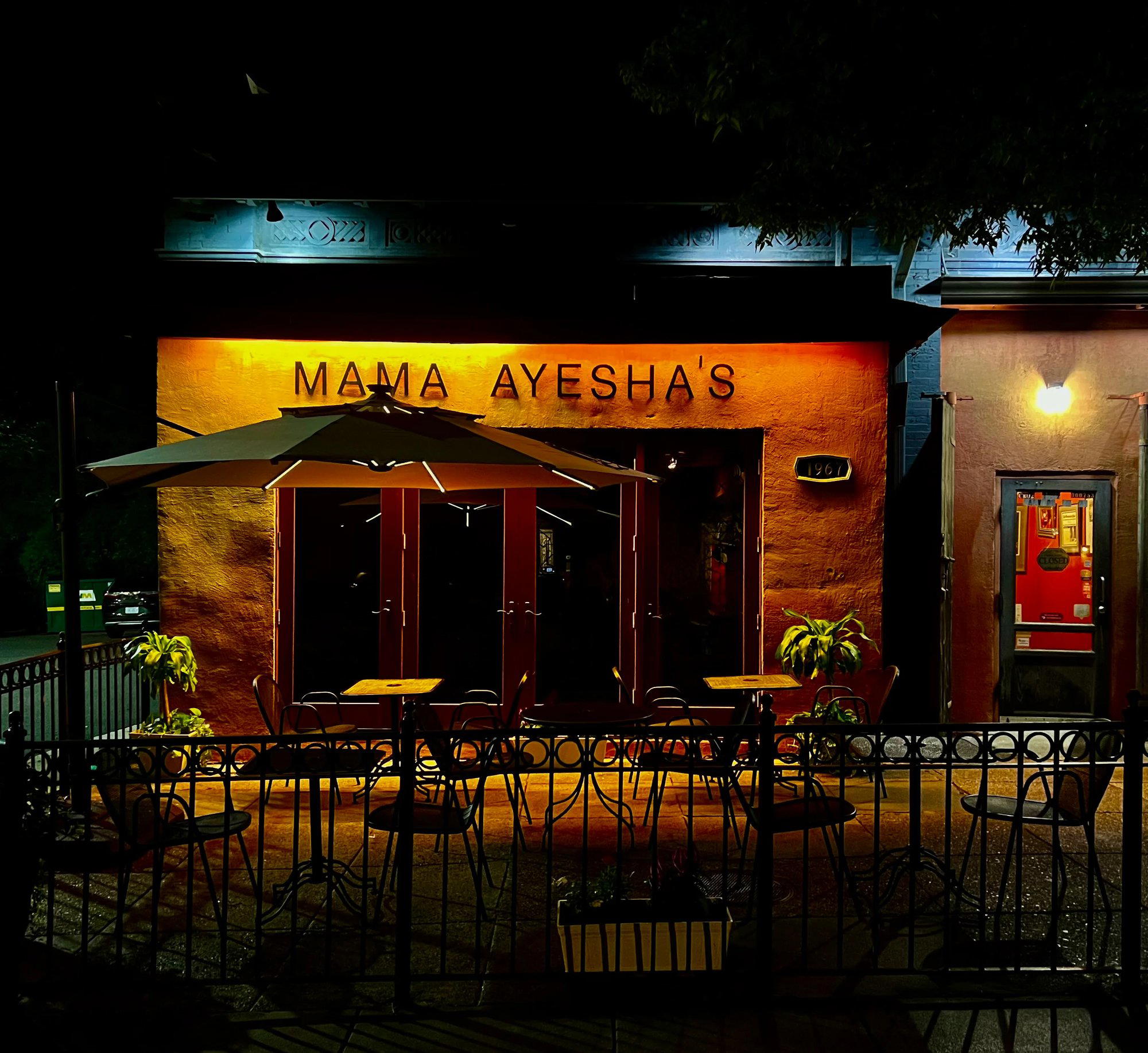
Adams Morgan Before the Boom
Washington D.C.'s appetite for Middle Eastern food has never been more pronounced. Tasting-menu restaurants like Albi have reframed the region's cooking through a fine-dining lens, drawing national attention and award recognition in the process. That shift is real and worth tracking. But it also makes the longer history easier to overlook: Middle Eastern kitchens were feeding this city's diplomats, students, and neighborhood regulars long before the current wave arrived. Mama Ayesha's, at 1967 Calvert St NW in Adams Morgan, is especially legible monument to that earlier chapter.
The restaurant opened in 1960, making it one of the oldest continuously operating Middle Eastern restaurants in the United States. That span covers the construction of the Kennedy Center, multiple rounds of Adams Morgan's gentrification, and the entire arc of D.C.'s restaurant industry from expense-account steakhouses to the current era of chef-driven tasting menus. few kitchens of any cuisine survive that kind of timeline in a major American city. Fewer still survive it without reinvention, without rebranding, and without abandoning the original address.
What the Room Tells You
The physical environment at Mama Ayesha's communicates something that newer entrants to the D.C. Middle Eastern scene cannot manufacture: accumulated time. The dining room carries the weight of decades in its walls, its photographs, and its lack of studied design. There is no ambient playlist calibrated for demographic targeting. The chairs do not match in the way a designer chose for them to mismatch. This is not a criticism. It is a description of a place that has never needed to perform authenticity because authenticity was never a marketing decision here, it was simply what happened when a kitchen stayed in one place for sixty-plus years.
Adams Morgan itself has cycled through multiple identities across that period. The neighborhood's dining strip now includes spots that price at levels comparable to Causa and Oyster Oyster, both of which occupy the city's more ambitious contemporary tier. Mama Ayesha's has never competed at that price point or in that register. Its value to the neighborhood has always been different: a kitchen that feeds people rather than presenting to them.
Lebanese and Palestinian Cooking at This Scale
The editorial angle that matters here is not simply that restaurant is old. Longevity alone is not culinary authority. What gives the restaurant weight is that it represents a strand of Lebanese and Palestinian cooking that arrived in the United States through community networks rather than through the restaurant industry's usual channels of culinary school and media exposure. The techniques and recipes that define the menu are ones passed through households, through family memory, through the kind of repetition that produces consistency rather than spectacle.
That approach stands in instructive contrast to how the broader American restaurant industry has absorbed Middle Eastern cuisine in recent years. The more visible version of that process runs through fine-dining frameworks: imported technique overlaid onto regional ingredients, tasting menus that deconstruct flatbreads and dips into composed courses, wine pairings with natural producers from Georgia or Lebanon. That format has produced genuinely interesting restaurants, and Albi is the clearest local example. But it is also a specific kind of translation, one that requires the cuisine to pass through a fine-dining filter before it reaches the plate.
The restaurant represents the older, less mediated version: techniques that came directly from the source, not through a culinary intermediary. The two approaches are not in opposition. They serve different purposes and different moments in how a diner wants to engage with a cuisine. Understanding both is part of reading D.C.'s Middle Eastern dining scene with any precision.
Where It Sits in the D.C. Dining Picture
Washington's restaurant scene in 2024 is more technically sophisticated than at almost any point in its history. Restaurants like Jônt and minibar operate at the technical extreme of American fine dining, with reservation windows, tasting formats, and price points that align them with the country's most ambitious tables, places like Alinea in Chicago, The French Laundry in Napa, or Le Bernardin in New York City. That bracket represents one end of what D.C. dining can do.
The restaurant occupies a different coordinate entirely, and that is precisely what makes it relevant to anyone mapping the city's full range. A dining city's depth is not measured only by its most technically accomplished kitchens. It is also measured by what survives across decades, what feeds the city at a non-ceremonial register, and what carries the histories of communities that built neighborhoods before those neighborhoods became restaurant destinations. Adams Morgan's current dining identity owes something to the groundwork laid by establishments like this one, even when the newer arrivals do not acknowledge that lineage directly.
Planning Your Visit
The restaurant is located at 1967 Calvert St NW, in the core of Adams Morgan, in Adams Morgan. Reservations are recommended, and weekend evenings tend to draw larger crowds from the neighborhood and beyond. Arriving earlier in the evening helps avoid the busiest service periods. This is a restaurant that rewards the visitor who is not in a hurry, who wants a full meal rather than a single composed course, and who reads the dining room as context rather than backdrop.
The Essentials
Comparable venues nearby, for context on price, style, and recognition.
| Venue | Cuisine | Price | Notes |
|---|---|---|---|
| Mama Ayesha'sThis venue — the venue you are viewing | Not listed | $$ | Not listed |
| Darvish Kitchen | Dupont Circle, Authentic Persian | $$ | Not listed |
| Busboys and Poets | Not listed | $$ | Cardozo, American Comfort with Vegan Options |
| Chef Geoff's West End | West End, Contemporary American | $$ | Not listed |
| Green Almond Pantry | Not listed | $$ | Georgetown, Turkish-Mediterranean cafe counter & market |
| Umaya | East End, Authentic Japanese Izakaya | $$ | Not listed |
Continue exploring
More in Washington DC
Restaurants in Washington DC
Browse all →
Bars in Washington DC
Browse all →
Hotels in Washington DC
Browse all →
At a Glance
- Classic
- Cozy
- Well Known
- Business Dinner
- Special Occasion
- Historic Building
Current opening hours
- Monday
- Closed
- Tuesday
- 4–10 PM
- Wednesday
- 4–10 PM
- Thursday
- 4–10 PM
- Friday
- 4–11 PM
- Saturday
- 4–10 PM
- Sunday
- 4–10 PM
Hours can change for holidays and private events. Last verified .
Dangling punched-tin lanterns, jewel-toned booths, and glowing candles create an authentic Middle Eastern atmosphere with a classic, homey feel.