
Michelin Bib Gourmand
Our verdict
A fourth-generation fish ball soup house on Daxi Street tracing its roots to a Qing Dynasty hawker stall over 150 years ago, Che Qiao Tou Wen A Shui Wan remains one of Quanzhou's most enduring street-food institutions. The kitchen still hand-beats and hand-squeezes fresh catch into broth-simmered globes, alongside a mock chicken roll that has become its own quiet point of local pride.

Pearl is the En Primeur Club membership app, where members save venues, book tables and use the concierge.
The menu
What to order
- Catch-of-the-Day Fish Balls
- Fish Ball Soup
- Mock Chicken Roll
A Street That Remembers
Xijie Street in Licheng District does not announce itself with tourist signage or curated heritage branding. The lane moves at the tempo of a working neighbourhood: scooters threading past ceramic shopfronts, incense drifting from a nearby temple, the ambient percussion of woks and ladles reaching the pavement long before any menu board comes into view. It is in this texture, the ordinary, functional hum of a Fujianese street, that a fish ball soup counter has operated, in one form or another, for more than 150 years. The lineage began during the Qing Dynasty, when a hawker sold from a portable setup, building a local following through consistency rather than novelty. That founding posture still governs the room today.
The Ritual of the Bowl
Fujianese fish ball culture has a grammar of its own, and understanding it reframes what might otherwise look like a simple soup. The process begins with fresh catch, deboned entirely by hand, then puréed and beaten, a labour-intensive technique that creates the elasticity distinguishing a quality fish ball from the compressed, flavourless varieties found in casual noodle shops across the region. The beating aerates the paste; the hand-squeezing shapes each globe with a density that allows it to absorb broth without disintegrating. What arrives at the table is not a garnish in a bowl of liquid but the point of the meal, delivered in a pork bone broth built for depth rather than drama.
The pace at which this kind of food is meant to be eaten matters. Fish ball soup in Quanzhou is not rushed. The broth is served hot, the balls release heat slowly through their dense centres, and the correct approach involves a deliberate alternation between the two, a spoonful of broth, a ball halved with chopsticks, another spoonful. Regulars eat at a rhythm that looks unhurried from the outside but is actually the result of long familiarity with the dish's structure. First-time visitors who race through the bowl miss most of what makes it worth the stop.
The mock chicken roll operates on a different register. Built from water chestnut, minced pork, and fish, it is a preparation that belongs to a wider Fujianese tradition of textural contrast, the crunch of the chestnut inside a yielding, savoury exterior. It has no pretension to being something other than what it is: a precise piece of street cookery, refined through repetition over generations. As a pairing with the soup it works particularly well, the firmer texture of the roll providing counterpoint to the broth's sustained warmth.
Four Generations and What That Actually Means
In Chinese food culture, generational continuity in a recipe-led operation carries specific weight. It is not simply a marketing story. Each generation passing a preparation to the next involves active renegotiation, decisions about sourcing, about what the broth base tolerates in a changed supply environment, about whether the hand-techniques can survive when volume increases. The fact that this operation is now in its fourth generation and has expanded into a small chain does not dilute the significance of the original method; it raises questions about how that method is maintained at scale. What can be verified here is that the Daxi Street location, as the founding address, retains the institutional memory that newer branches are measured against.
The parallel in Chinese culinary tradition is worth noting. Long-lived street food operations that anchor to a specific neighbourhood address, rather than migrating to higher-rent venues or franchising aggressively, tend to maintain craft consistency longer than those that chase expansion as the primary goal. At establishments like Chun Sheng elsewhere in Quanzhou, a comparable commitment to format discipline is observable. The same pattern plays out at Hall Thing (Licheng), where neighbourhood rootedness functions as both identity and quality signal.
Quanzhou's Broader Food Positioning
Quanzhou sits at a particular intersection in Chinese food history. As a major port city during the Tang and Song dynasties, it was a point of sustained cultural exchange, a fact that inflected its cuisine with techniques and ingredient combinations not found in landlocked Fujianese cooking. The fish ball tradition here is distinct from Chaozhou or Cantonese interpretations of the same preparation, leaning more heavily on pork bone as a broth base and favouring the hand-squeezed globe over the machine-formed variety that dominates commercial production elsewhere.
It sits closer to venues like De Wen Xia Zai Mian, where a specific preparation, executed consistently, is the entire proposition. That is a different mode of dining from the broader range visible at Antstory or A Qiu Niu Pai (Huxin Street), and requires a different kind of attention from the visitor. You are not there to graze or explore a menu, you are there to encounter a specific dish on its own terms.
For Chinese dining traditions operating at the opposite end of the formality scale, the contrast with venues like Xin Rong Ji (Xinyuan South Road) in Beijing, Chef Tam's Seasons in Macau, or Imperial Treasure Fine Chinese Cuisine in Guangzhou is instructive. Those venues translate Chinese culinary tradition into a high-investment, multi-course format; Daxi Street operates on the opposite logic, where the entire value proposition concentrates into a single preparation with a 150-year proof of concept behind it. Neither is a diminished version of the other, they represent genuinely different modes of engaging with the same culinary culture.
Planning Your Visit
The address is 17 Xijie Street, Licheng District, a short distance from the historic centre of Quanzhou, accessible on foot from several of the old city's main cultural sites. Phone and booking information are not published, and given the operation's hawker-counter heritage, walk-in is the expected format. Arriving outside peak meal hours reduces wait time; mid-morning and mid-afternoon visits tend to move faster than the lunch and dinner rushes. No dress code applies. Pricing sits at the accessible end of Quanzhou's eating spectrum, consistent with the street-food positioning the operation has maintained across all four generations. For broader planning across the city, our full Quanzhou restaurants guide, hotels guide, bars guide, and experiences guide cover the wider picture.
Frequently asked questions
What kind of recognition has Che Qiao Tou Wen A Shui Wan (Daxi Street) received?
Che Qiao Tou Wen A Shui Wan (Daxi Street) has received recognition including: The founder was a hawker who sold fish ball soup over 150 years ago, during the Qing Dynasty. Now run by the fourth-generation owner, the brand has grown into a restaurant chain, but its speciality remains the same. Catch of the day is debo….
Where is Che Qiao Tou Wen A Shui Wan (Daxi Street) in Quanzhou?
Che Qiao Tou Wen A Shui Wan (Daxi Street) is located at 17 Xijie St, Licheng District, Quanzhou, Quanzhou, Fujian, China, 362000, Quanzhou.
What should I order at Che Qiao Tou Wen A Shui Wan (Daxi Street)?
Order the fish ball soup: fresh catch is deboned, puréed, hand-beaten, and hand-squeezed into spheres served in pork bone broth, the preparation that has defined this operation since its Qing Dynasty hawker origins. The mock chicken roll, made with water chestnut, minced pork, and fish, is the second item worth ordering and rounds out the menu's core identity.
Do I need a reservation for Che Qiao Tou Wen A Shui Wan (Daxi Street)?
No reservation system is published for the Xijie Street location. The operation descends from a hawker stall founded over 150 years ago, and walk-in remains the standard format. Arriving early, particularly at lunch, is the practical approach given the street's foot traffic.
What's Che Qiao Tou Wen A Shui Wan (Daxi Street) best at?
The hand-beaten fish ball method is what separates this address from generic fish ball vendors in Quanzhou. The technique, deboning, puréeing, and hand-squeezing each ball, produces a texture that machine-processed versions do not replicate. That consistency, maintained across four generations since the Qing Dynasty, is the operational credential worth noting.
Category Peers
Comparable venues nearby, for context on price, style, and recognition.
| Venue | Cuisine | Price | Awards | Notes |
|---|---|---|---|---|
| Che Qiao Tou Wen A Shui Wan (Daxi Street)This venue (the venue you are viewing) | Traditional Quanzhou Small Eats | Not listed | Michelin Bib Gourmand | Not listed |
| Zhuang Ji Quan Fu Lu Mian Guan | Fujianese Lor Mee | $1–10 | Michelin Bib Gourmand | Licheng |
| Hall Thing (Licheng) | Traditional Minnan Fujian | Not listed | Michelin Bib Gourmand | Licheng |
| Chun Sheng | Home-style Fujian | $20–30 | Michelin Bib Gourmand | Jinjiang |
| å¼ æå§æ¯é¸ | Chinese Restaurant | Not listed | Not listed | Quanzhou |
| Zhang Lin A Shan Jiang Mu Ya | Fujian Ginger Duck | Not listed | Michelin Bib Gourmand | Licheng |
Recognition history
Dated appearances from independent guides and award organizations, with the underlying list record or original source where available.
Michelin Bib Gourmand
Michelin
Continue exploring
More in Quanzhou
Restaurants in Quanzhou
All restaurants in Quanzhou →
Bars in Quanzhou
Browse all →




Details
- Classic
- Rustic
- Cozy
- Casual Hangout
- Historic Building
- Local Sourcing
- A La Carte
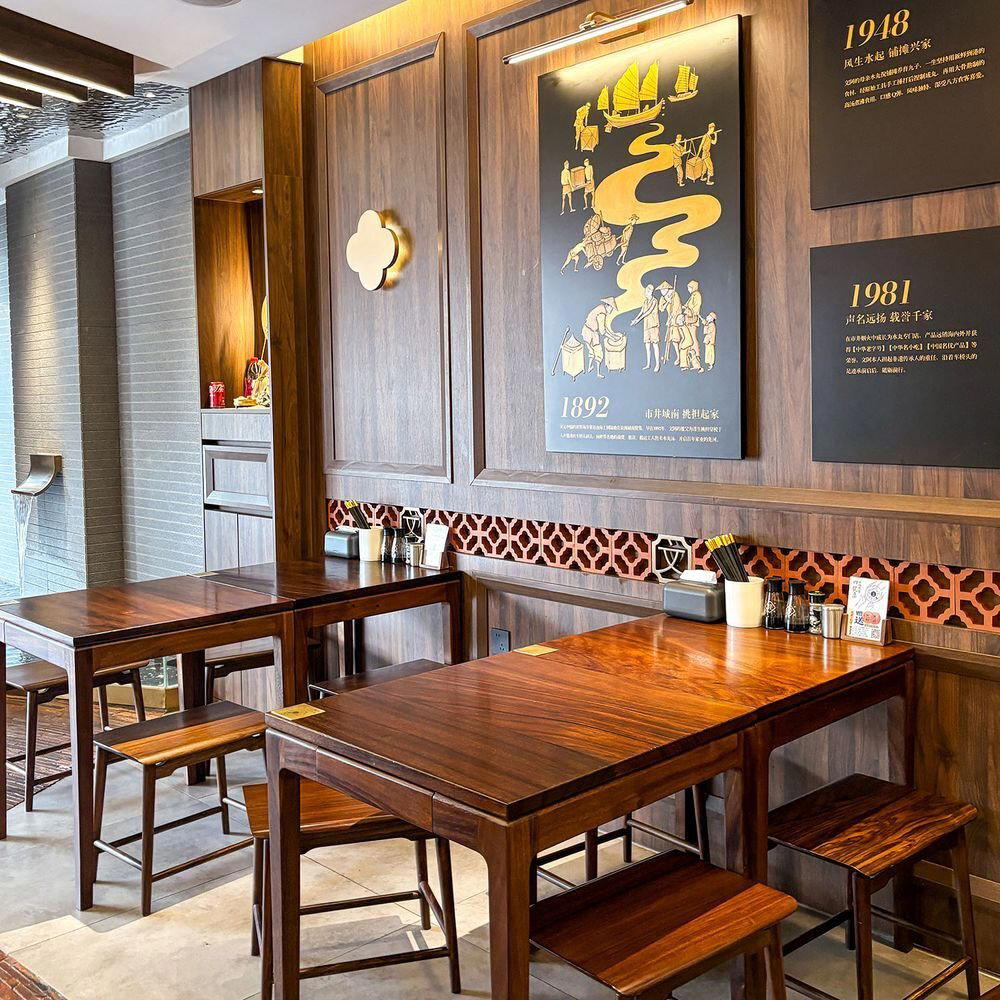
Direct functional aesthetic with white-tiled walls, visible prep counter, simple wooden benches, and a working kitchen atmosphere focused on speed and comfort.