

1 Michelin Star · Black Pearl 1 Diamond
Our verdict
Lei Garden's first Beijing outpost, inside Jinbao Tower in Dongcheng, carries Michelin one-star recognition (2024) and a Black Pearl Diamond (2025) into the capital's competitive Cantonese tier. The Hong Kong group sources ingredients from its own farm and anchors the menu around slow-cooked soups and roasted pork belly that reflect southern Chinese technique at a price point broadly in line with Beijing's premium casual category.

Pearl is the En Primeur Club membership app, where members save venues, book tables and use the concierge.
The menu
What to order
- Roasted Pork Belly
- Shrimp Dumplings
- Slow-Cooked Soups
- Pan-fried Turnip Cakes
- Lobster Dumpling
Cantonese in the Capital
Beijing's relationship with Cantonese cuisine has always been complicated. The capital's own culinary identity runs deep, from imperial-era roast duck to the thick, wheat-forward flavours of the north, and southern Chinese cooking has historically occupied a secondary lane here. What shifted that dynamic, gradually, was the southward flow of Hong Kong investment and the northward appetite for precision cooking that Guangdong kitchens had refined over generations. Cantonese food in Beijing is no longer a consolation for transplants; at the premium end, it draws diners who are making an affirmative choice. The question for any Hong Kong group opening in Dongcheng is whether the translation holds.
Lei Garden, which built its reputation in Hong Kong over decades of dim sum, whole-bird roasting, and slow-fire soups, opened its first Beijing outpost inside Jinbao Tower, positioning itself in the ¥¥¥ bracket alongside peers such as The Beijing Kitchen (Jianguo Road) and below the ¥¥¥¥ tier occupied by Zijin Mansion. That positioning is deliberate: accessible enough to attract a business-lunch crowd from the tower's commercial tenants, serious enough to draw food-focused diners making a special trip. By 2024, the restaurant had earned a Michelin star in the Beijing guide, and the 2025 Black Pearl Diamond followed, confirming that its performance was not a soft-opening anomaly.
What Hong Kong Cantonese Technique Looks Like in Practice
Cantonese cooking is frequently described in terms of restraint, but that framing understates the technical demand. The cuisine asks for sourcing precision and timing control that most kitchens cannot sustain at volume. Slow-cooked soups, for instance, are a category where shortcuts are immediately obvious: an undersimmered broth reads thin and sweet, not round and layered. At Lei Garden, the soups that require more than six hours of cooking need to be pre-ordered in advance, which is itself a signal. A restaurant willing to ask a diner to plan ahead rather than simplify its method is making a statement about process priority.
Roasted pork belly occupies a similar position on the menu. The cut demands strict attention to the fat-to-meat ratio and the heat management required to achieve skin that blisters without burning the flesh beneath. The restaurant's records note alternating layers of fat and meat with crispy skin alongside juicy flesh, a combination that only holds if the timing and temperature are calibrated correctly. This is the kind of benchmark dish that regulars use to assess a kitchen's consistency across visits. For comparison across the southern Chinese restaurant category in mainland China, see how similar technique registers at Dai Yuet Heen in Nanjing and Imperial Treasure Fine Chinese Cuisine in Guangzhou.
The Farm Sourcing Model and What It Signals
The supply chain behind Chinese fine dining has become a meaningful differentiator as diners grow more attentive to ingredient provenance. Lei Garden's approach of sourcing a significant portion of its ingredients from its own farm is not standard in the Cantonese restaurant category in mainland China, and it carries operational implications that affect what arrives at the table. Farm-controlled supply chains allow for harvest-to-kitchen timing that commercial wholesale cannot match, particularly for vegetables and poultry where texture degrades quickly after picking or slaughter. The claim of freshness here is structural, not rhetorical.
Within Beijing, venues that have invested comparably in supply chain control tend to cluster at the top of their respective category ratings, and the Michelin and Black Pearl recognitions at Lei Garden are consistent with that pattern. It is worth reading those awards not just as quality endorsements but as confirmation that the sourcing investment is producing measurable results at the plate.
Reading the Room: Jinbao Tower and Dongcheng Context
Jinbao Tower sits in Dongcheng, the district that houses both Wangfujing and the stretch toward Jianguomen, making it one of the more commercially concentrated addresses in central Beijing. The building's profile as a mixed commercial and luxury development shapes the restaurant's operating rhythm: lunch service here serves a different audience than dinner, and the kitchen's ability to maintain form across both services is part of what the Michelin evaluation assesses. Dongcheng's dining scene has deepened considerably in recent years, with a number of serious restaurants choosing the district for its density of corporate and hotel demand. For a broader picture of what the area now offers, see The House of Dynasties and Fu Chun Ju, both operating in the same general corridor.
Cantonese cooking in Beijing increasingly sits alongside, rather than below, regional northern Chinese traditions in terms of critical recognition. Café Zi represents a different southern inflection in the capital's dining mix, and the contrast is instructive: where some venues adapt Cantonese technique for northern palates, Lei Garden appears to hold its Hong Kong template close, relying on the quality of execution rather than local accommodation to build its audience.
A Note on the Noodle Category
The editorial angle of noodle mastery sits at some distance from Lei Garden's core identity, which is rooted in roasting, slow-cooking, and dim sum rather than hand-pulled or knife-cut noodle work. Cantonese cuisine does engage with noodles, particularly through wonton noodle soups and pan-fried egg noodle preparations, but these are secondary to the roasting and soup programs that define the restaurant's published signature. For noodle-focused Cantonese contexts, the broader regional comparisons are better drawn at venues where that technique is the primary category signal. At Lei Garden, the noodle is a supporting player, and misrepresenting it as a headline would distort what the kitchen has chosen to build its reputation on.
How Lei Garden Sits in the Wider Cantonese Network
For readers tracking the spread of premium Cantonese cooking across Greater China, Lei Garden's Beijing presence connects to a broader map of how southern Chinese culinary standards have migrated north and across the region. Peer reference points include Forum in Hong Kong, which operates at the deeper end of the Cantonese tradition, and Le Palais in Taipei, which demonstrates how the cuisine performs in a different cultural setting. On the mainland, Xin Rong Ji in Chengdu offers a Taizhou-adjacent comparison point, and 102 House in Shanghai and Ru Yuan in Hangzhou show how premium Chinese dining is developing in other major cities. Chef Tam's Seasons in Macau provides another Cantonese benchmark in a market that skews toward high-stakes performance dining.
Within Beijing specifically, Lei Garden's ¥¥¥ positioning makes it one of the more accessible entry points to Michelin-recognised Cantonese cooking in the city, sitting below the ¥¥¥¥ venues that dominate the upper tier. For readers planning across the city's full dining range, our full Beijing restaurants guide maps the category in more detail, and our Beijing hotels guide, bars guide, wineries guide, and experiences guide cover the surrounding city.
Planning a Visit
Lei Garden at Jinbao Tower is in Dongcheng, easily reached from Wangfujing station on Line 1. The ¥¥¥ price range positions it as a considered spend rather than a casual drop-in, and given the pre-order requirement on slow-cooked soups, planning ahead is advisable rather than optional. A table booking is the practical baseline; arriving without one at peak dinner times in a building like Jinbao Tower carries the usual risks of a well-occupied commercial address.
What Regulars Order
The two dishes that anchor the regular's order at Lei Garden are the slow-cooked soups and the roasted pork belly. The soups, which require more than six hours of preparation, must be pre-ordered, and the restaurant's own guidance is clear that skipping that step means missing the dishes that most define the kitchen's southern Chinese credentials. The roasted pork belly, with its alternating fat-meat layering and crispy skin, is available without advance arrangement and serves as the session's structural centrepiece. Both dishes reflect techniques that Cantonese kitchens have refined over generations: they are not modern departures or fusion experiments, but expressions of a cooking tradition that the Michelin and Black Pearl evaluations have confirmed the restaurant is executing at a high standard. For readers who come from a northern Chinese dining default, both dishes offer a clear and reliable introduction to what premium Cantonese cooking asks of its kitchen.
Credentials Lens
| Venue | Cuisine | Price | Awards | Notes |
|---|---|---|---|---|
| Lei Garden (Jinbao Tower)This venue (the venue you are viewing) | Authentic Cantonese Fine Dining | $50–100 | 1 Michelin Star · Black Pearl 1 Diamond | Not listed |
| Jing | Modern French with Asian Influences | $300–500 | 1 Michelin Star · Black Pearl 1 Diamond | French Contemporary |
| Xin Rong Ji (Xinyuan South Road) | Taizhou Chinese Fine Dining | $300–500 | 3 Michelin Stars · World's 50 Best #84 | Taizhou |
| Chao Shang Chao (Chaoyang) | Modern Teochew (Chaoshan) Fine Dining | $200–300 | Michelin Plate · La Liste Top Restaurants | Chao Zhou |
| Lamdre | Modern Plant-Based Chinese Vegetarian | Not listed | 2 Michelin Stars · World's 50 Best #17 | Vegetarian |
| Jingji | Imperial Beijing Royal Cuisine | $200–300 | 2 Michelin Stars · La Liste Top Restaurants | Beijing Cuisine |
Recognition history
Dated appearances from independent guides and award organizations, with the underlying list record or original source where available.
Michelin 1 Star
Michelin
Black Pearl 1 Diamond
Black Pearl
Full recognition history (3 entries)
Michelin 1 Star
Michelin
Continue exploring
More in Beijing
Restaurants in Beijing
All restaurants in Beijing →
Bars in Beijing
All bars in Beijing →

Details
- Elegant
- Sophisticated
- Classic
- Business Dinner
- Group Dining
- Special Occasion
- Celebration
- Private Dining
- Historic Building
- Sommelier Led
- Farm To Table
- Local Sourcing
- A La Carte
- Family Style
- Wine Pairings
- Allergy Accommodating
Current opening hours
- Monday
- 11 AM–2:30 PM, 5–10 PM
- Tuesday
- 11 AM–2:30 PM, 5–10 PM
- Wednesday
- 11 AM–2:30 PM, 5–10 PM
- Thursday
- 11 AM–2:30 PM, 5–10 PM
- Friday
- 11 AM–2:30 PM, 5–10 PM
- Saturday
- 11 AM–2:30 PM, 5–10 PM
- Sunday
- 11 AM–2:30 PM, 5–10 PM
Hours can change for holidays and private events. Hours as of .
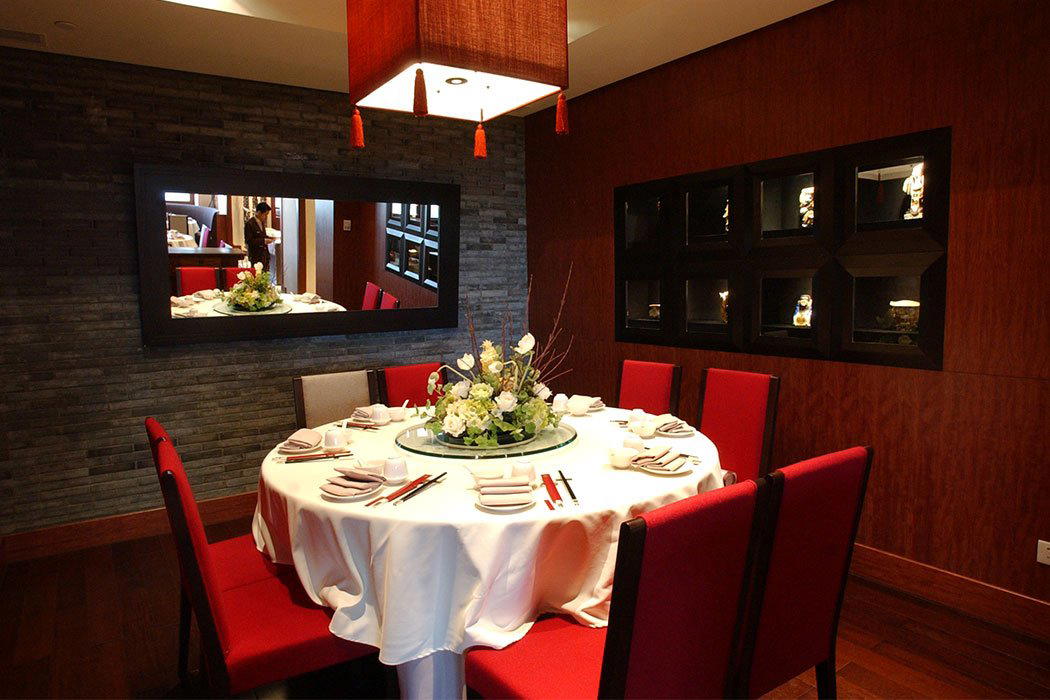
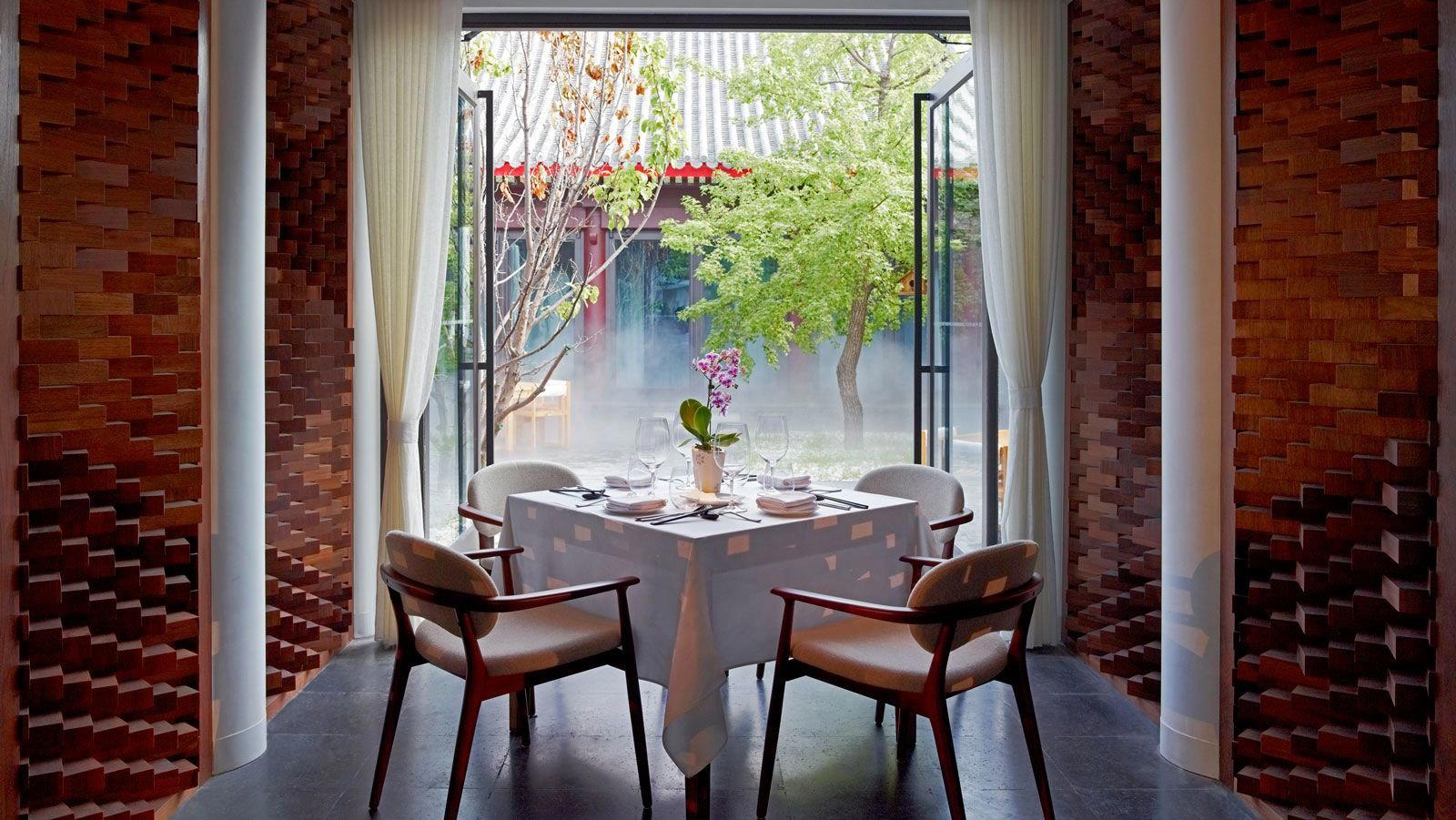
Warm, inviting atmosphere with red and gold tones, comfortable booth seating, panoramic windows providing natural light, and balanced acoustics that facilitate conversation.