Le Grand Cerf


A Michelin-starred inn on the Route Nationale between Reims and Épernay, Le Grand Cerf sits at the foot of the Montagne de Reims with a kitchen shaped by the Gérard Boyer school of classic French cooking. The dining room trades in seasonal luxury produce, John Dory, lobster, truffle, milk-fed veal, in a pale-wood interior that softens considerably after dark. Ranked #420 in Opinionated About Dining's 2025 Classical Europe list, this is Champagne country dining at its most deliberate.
Pearl is the En Primeur Club membership app — saves, bookings, and concierge access live there. Same editors, same standards.
- Address
- 50 Rte nationale, 51500 Villers-Allerand, France
- Phone
- +33 3 26 97 60 07
- Website
- le-grand-cerf.fr
 Saves & bookings on Pearl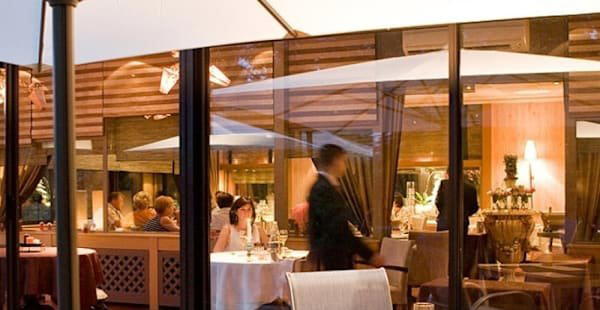
Where the Road to Épernay Slows Down
The Route Nationale that threads through the Marne valley between Reims and Épernay passes through some of the most storied vineyard land in France. For most drivers, Montchenot registers only as a blur of limestone walls and pruned vines. Le Grand Cerf is a one-Michelin-star restaurant in Villers-Allerand, France, serving Michelin-starred classic French gastronomic cuisine at about $99 per person. The building does not underplay its register: the exterior carries the weight of a place that has been receiving guests at some ceremony for decades, and the pale-wood dining room inside moves between formal and intimate depending on whether you arrive at midday or in the evening, when the light changes the room's character entirely.
The Boyer School and What It Produces
Classic French cuisine, as a category, contains multitudes. At one end sits the kind of cooking that merely references historical technique without embodying it. At the other sits kitchens that have absorbed classical method through direct lineage, training under chefs who themselves trained inside France's postwar grande cuisine tradition. Le Grand Cerf belongs firmly to the second category. Dominique Giraudeau spent formative years in the kitchens of Gérard Boyer at Les Crayères in Reims, one of the most significant fine dining addresses Champagne has produced. Boyer's approach to regional luxury, structured sauces, primary produce of the highest grade, a refusal to let modishness override technique, filtered through into the kitchen Giraudeau later built here alongside Pascal Champion.
That lineage matters because it explains the menu's logic. The Boyer school was never interested in provocation or novelty for its own sake. What it produced instead was food in which the quality of the raw material and the precision of the cooking were the whole argument. At Le Grand Cerf, the produce list reads accordingly: John Dory, free-range milk-fed veal, game in season, lobster, truffle. These are not ingredients deployed for prestige signalling, they are the vocabulary of a kitchen that knows exactly what it is doing with them. For comparison, the classic French kitchens that have accumulated the most sustained critical attention in France, from Auberge de l'Ill in Illhaeusern to Paul Bocuse's Auberge du Pont de Collonges, share a similar orientation: technique and produce in service of flavour, not concept.
One Star, One Region, One Style
Michelin awarded Le Grand Cerf a star in 2024, a recognition that positions it within the upper tier of Champagne's dining scene while also distinguishing it from the more creative addresses the guide has gathered elsewhere in France. In the same region, Assiette Champenoise in Reims occupies the multi-star, modernist end of the local hierarchy. Le Grand Cerf sits at a different coordinate: classical in method, auberge in format, and more concerned with the integrity of the season's leading produce than with the architecture of a tasting menu designed to announce ambition.
The restaurant holds a Google rating of 4.6 across 478 reviews.
Dining in Champagne Country: What the Region Demands
The Montagne de Reims sits between two of France's most-visited wine cities, and the dining culture of the zone reflects that geography. Visitors arrive with Champagne bottles they have tasted at houses in Reims or cellars along the Route du Champagne, and they expect the table to match the glass. Classic Cuisine, in this context, is not a nostalgic choice, it is a logical pairing with the wines of the region. Champagne's traditional accompaniments, from the region's freshwater fish to its game birds and veal, are exactly the ingredients that appear on menus shaped by Boyer-school thinking. Le Grand Cerf sits on a road that connects two of the most significant wine towns in France, and its kitchen uses that geography with clarity.
For those planning a broader Champagne and northern France itinerary, Le Grand Cerf sits usefully between the kind of creative high-end cooking found at Alléno Paris au Pavillon Ledoyen and the mountain-rooted classicism of Flocons de Sel in Megève. The wider French fine dining conversation also includes Mirazur in Menton, Troisgros in Ouches, Bras in Laguiole, AM par Alexandre Mazzia in Marseille, Au Crocodile in Strasbourg, and Auberge du Vieux Puits in Fontjoncouse, all operating in distinct French regional registers. For classic cuisine specifically, Maison Rostang in Paris and KOMU in Munich offer instructive comparisons in how the classical tradition translates across different city contexts.
Atmosphere and Format
The dining room at Le Grand Cerf is described in its Michelin entry as done out in pale wood with an opulent register that the evening light shades toward the romantic. This is a formal space that does not pretend otherwise, which places it in a specific category among French country inns: the kind of room where the physical environment makes an argument about how seriously the kitchen takes the meal. The lunch service, running from 12:15 to 1:30 PM, is a tight window that rewards punctuality. Evening service runs from 7:15 to 9:00 PM. The restaurant is closed Tuesday and Wednesday, and Sunday service is lunch only. The price bracket is €€€€, consistent with a one-star address at this produce level in provincial France.
For those building a full Montchenot visit around the meal, the wider area offers compelling reasons to extend the trip. Explore our full Montchenot restaurants guide, our Montchenot hotels guide, our Montchenot wineries guide, and our Montchenot experiences guide to place the restaurant within the full picture of what this stretch of the Marne valley offers. The Montchenot bars guide rounds out the evening options for those staying nearby.
Planning Your Visit
Le Grand Cerf is located at 50 Rte nationale, 51500 Villers-Allerand, France. Booking is essential, and the dress code is smart casual.
In Context: Similar Options
Comparable venues nearby, for context on price, style, and recognition.
| Venue | Cuisine | Price | Awards | Notes |
|---|---|---|---|---|
| Le Grand CerfThis venue — the venue you are viewing | Michelin-Starred French Gastronomic | $$$$ | Michelin 1 Star | |
| Château de Courban | Contemporary French Fine Dining | $$$$ | Michelin 1 Star | Courban |
| Le Restaurant du Cerisier | Modern French Fine Dining | $$$$ | Michelin 1 Star | Vieux Lille 3 |
| Omar Dhiab | Modern French with Egyptian Influences | $$$$ | Michelin 1 Star | Sentier |
| Le Lièvre Gourmand | Modern French-Asian Fusion Fine Dining | $$$$ | Michelin 1 Star | Quai du Châtelet |
| Château du Mont Joly | Modern French Fine Dining | $$$$ | Michelin 1 Star | Sampans |
At a Glance
- Elegant
- Sophisticated
- Classic
- Special Occasion
- Business Dinner
- Private Dining
- Extensive Wine List
Refined and unique setting with subtle gastronomic elegance in the heart of Champagne.