Kaigara Ya

Kaigara Ya is a compact counter ramen shop in Sagamihara’s Fuchinobe area, known for shellfish broth ramen and rich oyster tsukemen rather than the pork-heavy grammar many visitors associate with Kanagawa noodles. Its repeated Tabelog 100 ramen selections place it in a serious local category, but the appeal is more cultural than ceremonial: a small suburban room treating seafood stock with the concentration usually reserved for central-city ramen counters.
Pearl is the En Primeur Club membership app — saves, bookings, and concierge access live there. Same editors, same standards.
- Address
- 3 Chome-24-3 Fuchinobehoncho, Chuo Ward, Sagamihara, Kanagawa 252-0202, Japan
- Phone
- +81 42-707-8556
- Website
- twitter.com
- Directions
- Get directions
 Saves & bookings on Pearl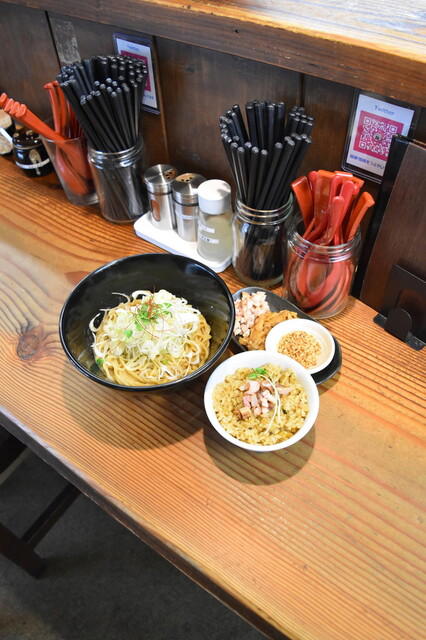
Fuchinobe is not the Kanagawa sold to first-time travelers. Streets around the station feel residential and practical, with ramen counters, curry rooms and bakeries folded into daily life rather than staged as destination dining. That matters. In Sagamihara, a serious bowl often arrives without ceremony: a short counter, tight menu identity, local queue, and a price band that keeps ramen everyday even when the cooking has specialist intent.
Kaigara Ya belongs to that tradition, though not its louder branches. Kanagawa ramen is often reduced to iekei, the Yokohama-born style built on pork-and-soy power, thick noodles and rice. Sagamihara has that language, as local peers such as Iekei Ramen Kukkura show, but Fuchinobe also rewards smaller, focused shops outside the obvious script. Here the signal is shellfish broth ramen and rich oyster tsukemen, a seafood-led lane that gives the city’s ramen map more range than one regional stereotype allows.
Shellfish broth puts Fuchinobe outside the usual Kanagawa ramen shorthand
Japanese ramen culture has long absorbed local appetites, port-city ingredients and postwar counter-service speed, while the recent specialist era has sharpened differences. One shop chases chicken clarity, another builds density through pork bones, a third uses dried fish, clams or oysters for impact without the same fatty weight. Shellfish broth sits in that last camp, relying less on brute force than salinity, concentration and balance, so it can feel more precise than casual ramen taxonomy suggests.
That makes Kaigara Ya useful for reading Sagamihara beyond a checklist. Its category is ramen and tsukemen, but the cultural point is narrower: seafood stock as a neighborhood specialty, not a coastal luxury cue. Rich oyster tsukemen changes the meal’s rhythm. Dipping noodles separate noodle texture from broth intensity, letting thicker soup work as condiment rather than full-volume soup. In a nine-seat counter setting, the format keeps attention on pacing, turnover and the bowl, not restaurant theatre.
The recognition is not decorative. Selection for Tabelog Ramen KANAGAWA “Tabelog 100” 2025, with prior Tabelog ramen selections stretching back through earlier East and Kanagawa lists, places the shop inside a vetted local ramen conversation. It does not turn a suburban counter into luxury; it identifies a place where a narrow specialty has earned sustained attention in a prefecture crowded with serious noodle shops.
A small counter economy, not a destination-dining performance
The counter-only format is central. Ramen at this level is a compact economy of seats, timing and repetition. Nine seats means the room absorbs few diners at once, shaping how visitors should approach the meal. This is not a long, multi-course booking with room to dawdle. It is a quick, concentrated sitting where the kitchen’s identity comes through broth, noodles and dipping format, then the seat turns over.
That scale also explains why suburban ramen can be more revealing than central Tokyo ramen for some travelers. Tokyo’s famous counters often carry international demand, advance planning or a performative pilgrimage mood. Sagamihara’s better shops sit inside ordinary movement: students, families, solo diners and locals treating a high-skill bowl as lunch or dinner, not an occasion. The venue’s family-friendly notes and solo-dining suitability fit that pattern. Serious ramen in Japan is not inherently formal; its rigor often lives inside a democratic format.
Local comparison clarifies the choice. Menya Ayumu and Taisho Ken Fuchinobe ten sit in a lower listed budget band, while Nakamura Menzaburo Shoten and Curry no Mise Maboroshi occupy similar everyday spending territory to Kaigara Ya. That spread is useful: Fuchinobe is not built around grand-price dining, but specialization within accessible formats. For another noodle angle in the city, Jikaseimen Nichome Ramen points toward the house-made noodle conversation, while Ganso Ichijoryu Ganko Sohonke Bunten suggests a different ramen lineage.
The practical reading is simple without being simplistic. A counter this size rewards off-peak timing, cash readiness and patience with local routines. The shop is near Fuchinobe Station rather than a major intercity hub, and works better as part of a Sagamihara day than as a Tokyo-standard detour. Parking exists in a designated contracted area, but the warning against neighboring lots or street space is etiquette. In Japan, good ramen travel often means not disrupting the neighborhood as much as finding the bowl.
How to place it within a Sagamihara food day
For readers mapping the city, the restaurant is a strong ramen-led anchor because it shows Sagamihara dining at street level: compact, specialized, and less dependent on spectacle than repeat local approval. Pair it with the broader listings in Our full Sagamihara restaurants guide rather than treating it as isolated. The city’s hospitality and nightlife layers are thinner than Tokyo’s, but planning improves when restaurants are read alongside Our full Sagamihara hotels guide, Our full Sagamihara bars guide, Our full Sagamihara wineries guide and Our full Sagamihara experiences guide.
Travelers building a wider Japan food route can use the same lens elsewhere: compare regional specialization instead of chasing generic prestige. A beef-focused stop such as -Grilled beef Sukiyaki- KAMAKURA TANUKIAN 鎌倉 たぬき庵 in Kamakura, a charcoal-and-tuna address like. 鮪と炭火焼き うお炭 秋葉原店 in Tokyo, or a compact urban cafe such as.cafe in Osaka each reveals a different everyday dining grammar. The same applies beyond the main circuit, from.know in Kumamoto and (Shoku) Vietnam in Kawasaki to [Curry Senmon Ten] Maruyama Kyoju. in Sapporo. Even overseas Japanese-leaning formats, such as Jōdo Saké Bar in Los Angeles and Onigiri Time in Pasadena, make more sense when judged by format discipline rather than decorative Japaneseness.
The editorial case for the restaurant is not that it turns ramen into fine dining. It is stronger: it shows how a suburban Kanagawa counter can take a specific broth tradition, keep the meal accessible, and still earn sustained recognition among ramen specialists. For travelers who understand Tokyo’s ramen spectacle, Fuchinobe offers a quieter lesson: regional depth often sits in small rooms where the category looks ordinary until the specialization comes into focus.
Budget Reality Check
Comparable venues by cuisine and price in the same metro.
| Venue | Cuisine | Price | Notes |
|---|---|---|---|
| Kaigara Ya | Fuchinobe, Shellfish-focused ramen shop | $ | Not listed |
| Nikuniboshi Chuka Soba Suzuki Ramen Ten | Not listed | $ | Minami Ward, Sagamihara City, Japanese Ramen |
| Nakamura Menzaburo Shoten | Chuo Ward, Sagamihara, Ramen shop | $ | Not listed |
| Menya Ayumu | Fuchinobe, Jiro-style ramen shop | $ | Not listed |
| Ramen Jiro Sagami oono ten | Sagami-Ono, Jiro-style Ramen | $ | Not listed |
| Sagamihara Keyaki | Not listed | $$ | Minami-ku, Sagamihara, Modern Japanese Ramen |
Recognition history
Dated appearances from independent guides and award organizations, with the underlying list record or original source where available.
Tabelog 100 #53 · No. 53
Tabelog · Tabelog 100 - Ramen - KANAGAWA - 2025
Continue exploring
More in Sagamihara
Restaurants in Sagamihara
Browse all →



Bars in Sagamihara
Browse all →


Hotels in Sagamihara
Browse all →


Wineries in Sagamihara
Browse all →
At a Glance
- Cozy
- Lively
- Intimate
- Solo
- Casual Hangout
- After Work
- Chefs Counter
- Standalone
Current opening hours
- Monday
- 11 AM–3 PM, 6–8 PM
- Tuesday
- 11 AM–3 PM, 6–8 PM
- Wednesday
- 11 AM–3 PM, 6–8 PM
- Thursday
- 11 AM–3 PM, 6–8 PM
- Friday
- 11 AM–3 PM, 6–8 PM
- Saturday
- 11 AM–3 PM, 6–8 PM
- Sunday
- 11 AM–3 PM, 6–8 PM
Hours can change for holidays and private events. Last verified .
A compact, counter-only neighborhood ramen joint with a simple noren, bright but no-frills interior, and a bustling, energetic feel as guests queue and quickly slurp down rich shellfish ramen.