
Tabelog 100 #5
Our verdict
Kaidashi Men Kitada puts Kyoto Station ramen into a tighter, more ingredient-led register: shellfish broth, Hokkaido-grown Yumechikara wheat noodles, and a compact counter format rather than tourist-district sprawl. Its selection for Tabelog 100 Ramen WEST in 2024 and 2025 gives it a useful benchmark in a city where casual bowls compete with sweets shops, department-store dining, and formal Kyoto cuisine.

Pearl is the En Primeur Club membership app, where members save venues, book tables and use the concierge.
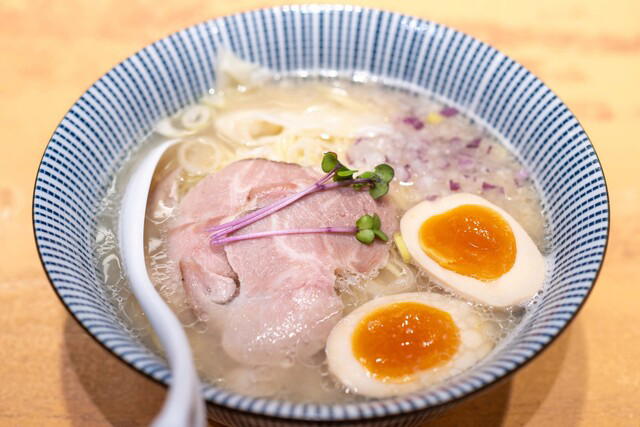
The menu
What to order
- Clam broth ramen
- Shellfish dashi noodle
- Kai dashi kara-miso ramen
In Kyoto, the food mood can shift fast: hotel lobbies, bus stops, department-store restaurants, commuters, luggage, and the practical appetite of people needing a serious bowl before the next part of the day. In that context, Kaidashi Men Kitada sits in a sharper Kyoto ramen category: focused, fast-moving, category-specific, and defined by the discipline of a ramen shop rather than a long menu for every passing crowd.
Kyoto is often framed through kaiseki, tofu, wagashi, and tea, but the city has its own everyday grammar too. It rewards restaurants that feed locals, business travelers, and visitors without blurring the kitchen’s point. This noodle shop is not competing with a slow formal lunch, a sweets tradition, or the tourist familiarity of other casual stops. It belongs to a separate Kyoto habit: precision eating, where the decision turns on ramen focus, pacing, and consistency.
Ramen gives the menu its organizing principle
The category signals the point: Kaidashi Men Kitada is listed for ramen, and that puts the bowl at the center. Kyoto ramen ranges widely in style, but a specialist shop changes the architecture of the meal. It asks the kitchen to build an identity around a narrow format, and makes execution more visible because the experience is not padded by a broad supporting menu.
The recorded recognition matters more than loose adjectives. In Japan’s ramen economy, public benchmarks help separate a focused shop from a merely convenient bowl. Kaidashi Men Kitada carries Tabelog Hyakumeiten recognition for 2025, with a listed score of 3.69, placing it among ramen addresses that have drawn measurable attention rather than relying only on word of mouth.
Kaidashi Men Kitada’s inclusion in the 2025 Tabelog Hyakumeiten field gives the format a public benchmark. Japan’s ramen field is crowded and stylistically mixed, with Kyoto adding its own technical specialists to the broader national conversation. Selection does not make a ramen shop fine dining; it places it among recognized specialists, the more relevant distinction here.
That also explains why the menu reads differently from Kyoto options such as Nakamura Tokichi Honten Kyoto eki ten, where tea and sweets anchor the appeal, or Morita Ya JR kyoto isetan ten, where beef and department-store dining define the occasion. A ramen shop at this level lives or dies on narrower questions: whether the bowl has a clear identity, the format suits it, and the shop keeps the experience disciplined.
A focused ramen format in Kyoto
The experience follows serious ramen logic in Japan: direct pacing, a focused category, and a rhythm shaped by diners who have come for a specific bowl rather than a broad restaurant menu. This is not a drawback but how the genre often protects consistency. Focused ramen shops can keep the meal sequence tight, reduce distraction, and avoid the broad-menu compromise common in high-traffic dining zones.
Practical signals define the experience without turning it ceremonial. At a ramen specialist, the value is usually in the directness of the visit: arrive, choose, eat, and move on with a clear sense of what the shop does well. In Kyoto, where diners often balance sightseeing, reservations, and transit, that kind of concise meal can matter as much as a longer restaurant plan.
The format should be read in the practical Japanese sense: focused, efficient, and built around ramen rather than lingering. Travelers moving between hotels, temples, and trains should understand it as a recognized ramen shop with a modest listed budget, not a broad Kyoto restaurant for an extended evening.
For a wider Kyoto map, the contrast helps. FUKUNAGA901, Kameya Mutsu, Kyōto Hyōto Kyōto Ekimae Honten, Morita Ya JR kyoto isetan ten, and Nakamura Tokichi Honten Kyoto eki ten belong to different dining rhythms, while Kaidashi Men Kitada answers a narrower ramen need. Across Japan, visitors can compare Kyoto’s ramen discipline with other casual formats in other cities. The useful comparison is not cuisine versus cuisine, but how each city expresses quick eating with seriousness.
Where it fits in a Kyoto dining day
The strongest use case is a targeted ramen meal in Kyoto, especially when the city’s formal dining calendar feels too rigid. Kyoto can be demanding for reservations and timing, and visitors often overload itineraries with temple visits by day and structured meals by night. A concise ramen stop solves another problem: it gives the day a defined local meal without the planning burden of a full restaurant appointment.
That makes Kaidashi Men Kitada a useful counterweight to polished hotel dining and Kyoto’s heritage-food circuit. It also belongs in the same trip-planning conversation as Our full Kyoto restaurants guide, Our full Kyoto hotels guide, Our full Kyoto bars guide, Our full Kyoto wineries guide, and Our full Kyoto experiences guide, because compact city eating often decides whether a Kyoto day feels fluent or overplanned.
For Japan-wide food itineraries, this shows casual price and critical recognition can share one bowl. The comparison extends beyond Kyoto in a general sense: modest-format places in many food cultures raise the same editorial question of when a focused, affordable stop says more about a city than a longer, costlier meal. In Kyoto’s case, a ramen shop with 2025 Tabelog Hyakumeiten recognition gives a clear answer.
Frequently asked questions
What's Kaidashi Men Kitada's location?
Kyoto.
What should I budget for a meal at Kaidashi Men Kitada?
Pricing at Kaidashi Men Kitada is listed as - JPY 999 - JPY 999.
What are Kaidashi Men Kitada's hours?
Hours for Kaidashi Men Kitada are not specified in the provided listing details.
What's Kaidashi Men Kitada best at?
Kaidashi Men Kitada is listed in the ramen category and has a clear credential: 2025 Tabelog Hyakumeiten recognition with a listed score of 3.69.
Nearby-ish Comparables
Comparable venues in the metro at similar price points.
| Venue | Cuisine | Price | Awards | Notes |
|---|---|---|---|---|
| Kaidashi Men KitadaThis venue (the venue you are viewing) | Shellfish Ramen | $10–20 | Tabelog 100 #5 | Not listed |
| Nakamura Tokichi Honten Kyoto eki ten | Matcha sweets & soba café | $10–20 | Tabelog 100 #69 | JPY 1,000 - JPY 1,999 JPY 1,000 - JPY 1,999 |
| Kyōto Hyōto Kyōto Ekimae Honten | Kyoto-Style Dashi Shabu-Shabu | $50–100 | Tabelog 100 #81 | Not listed |
| Kameya Mutsu | Traditional Kyoto wagashi (Japanese confectionery) | $10–20 | Tabelog 100 #45 | JPY 999 - JPY 999 View spending breakdown |
| Morita Ya JR kyoto isetan ten | Traditional Kyoto beef sukiyaki & shabu-shabu | $50–100 | Tabelog 100 #4 | JPY 5,000 - JPY 5,999 JPY 2,000 - JPY 2,999 |
| FUKUNAGA901 | Seasonal Fruit Parfait Cafe with Western-style Lunch | $10–20 | Tabelog 100 #89 | JPY 2,000 - JPY 2,999 JPY 2,000 - JPY 2,999 View spending breakdown |
Recognition history
Dated appearances from independent guides and award organizations, with the underlying list record or original source where available.
Tabelog 100 #5 · No. 5
Tabelog · Tabelog 100 - Ramen - WEST - 2025
Continue exploring
More in Kyoto
Restaurants in Kyoto
All restaurants in Kyoto →
Bars in Kyoto
All bars in Kyoto →

Hotels in Kyoto
All hotels in Kyoto →
Wineries in Kyoto
Browse all →
Details
- Cozy
- Modern
- Solo
- Casual Hangout
- Family
- Late Night
- Standalone
- A La Carte
- Counter Dining
Current opening hours
- Monday
- 7 AM–11:30 PM
- Tuesday
- 7 AM–11:30 PM
- Wednesday
- 7 AM–11:30 PM
- Thursday
- 7 AM–11:30 PM
- Friday
- 7 AM–11:30 PM
- Saturday
- 7 AM–11:30 PM
- Sunday
- 7 AM–11:30 PM
Hours can change for holidays and private events. Hours as of .