



At JULIA, omakase becomes a luminous dialogue between land, sea, and vine, crafted by a visionary chef and her sommelier husband. This intimate, couples-run address champions Japan as a terroir, spotlighting pristine produce and seafood from Ibaraki, the husband’s birthplace, in elegantly surprising pairings, often fruit-forward, designed to sharpen nuance over showmanship. Expect a feather-light progression that fuses color, clarity, and precision with rare Japanese wines, each pour amplifying texture, minerality, and a quiet sense of place. For the well-traveled gourmand, it’s a study in restraint and radiance, an experience that feels both self-taught and effortlessly assured.
Pearl is the En Primeur Club membership app — saves, bookings, and concierge access live there. Same editors, same standards.
- Address
- 3 Chome-1-25 Jingumae, Shibuya, Tokyo 150-0001, Japan
- Phone
- +81 3-5843-1982
- Website
- juliahospitalitygroup.com
- Directions
- Get directions
 Saves & bookings on Pearl
From Ibaraki to Jingumae: How a Regional Conviction Became a Tokyo Dining Proposition
Tokyo's contemporary restaurant tier has spent the better part of a decade sorting itself into two recognisable camps: the technically exacting French-inflected tasting menu, and the ingredient-forward Japanese counter that draws on kaiseki heritage. JULIA, operating from a ground-floor address in Jingumae, Shibuya, occupies neither camp cleanly. Its evolution from a regional restaurant rooted in Ibaraki Prefecture to a destination in one of Tokyo's most design-conscious neighbourhoods is the story of what happens when a couple's local conviction travels well.
The Architecture of a Pairing-Only Menu
Contemporary omakase in Tokyo generally presents a progression of courses where wine or sake pairings are offered as an optional supplement. JULIA inverts that structure entirely: the omakase set menu is pairings only. There is no option to eat without the drink programme running alongside.
The pairing programme is also where the restaurant's regional identity becomes most pointed. JULIA treats Japan as a wine-producing terroir rather than a beer-and-sake culture, advocating specifically for Japanese wines. This is a narrower position than most Tokyo contemporary restaurants take, and it places JULIA in a small peer group that includes producers and sommeliers working to build credibility for domestic viticulture. For diners arriving with expectations shaped by the broader Tokyo fine dining scene, it is a recalibration.
Vegetables, Fish, and Fruit: A Flavour Logic Worth Understanding
The cuisine at JULIA specialises in Japanese foodstuffs sourced predominantly from Ibaraki Prefecture, where co-owner and sommelier Kenichiro Motohashi was born. Most ingredients originate there, giving the kitchen a geographic anchor that shapes purchasing and seasonal rhythm. The flavour logic that emerges from this sourcing is specific: the restaurant favours pairings of vegetables and fish with fruit. This is not fusion in the intercultural sense but an internal flavour discipline, an approach to acidity, sweetness, and freshness that runs through the menu as an organising principle.
Chef Nao Motohashi's approach produces cuisine that is colourful and light in character. In the contemporary Tokyo tier, where kitchens often prioritise technical precision and restraint as aesthetic values, this lightness is itself a distinguishing quality. It also makes the restaurant's positioning legible in comparison to peers: where nôl and FUSOU operate inside more formally structured contemporary frameworks, JULIA's self-taught kitchen and pairing-forward format read as deliberately outside convention.
The Ibaraki Thread: Regional Identity as Editorial Position
The restaurant's evolution from an Ibaraki-based operation to a Shibuya address is worth examining as a model for how regional conviction can relocate without losing coherence. Many regional-ingredient restaurants that move to Tokyo become absorbed into the city's dominant dining grammar, using local provenance as a marketing footnote rather than a structural commitment. JULIA has maintained Ibaraki as its primary sourcing geography, which means the kitchen's range is constrained by what that region produces seasonally. That constraint is generative rather than limiting: it forces the menu to evolve with Ibaraki's agricultural calendar rather than with Tokyo's trend cycle.
This regional commitment also distinguishes JULIA from the broader contemporary tier in Tokyo, where sourcing narratives often span multiple prefectures or import international ingredients to fill gaps. The Ibaraki focus is a harder editorial line to maintain in a city where ingredient access is nearly unlimited, and the fact that it has held through the restaurant's relocation and Michelin recognition suggests it is structurally embedded rather than opportunistically stated.
Where JULIA Sits in Tokyo's Contemporary Tier
At the ¥¥¥¥ price point, JULIA prices against Tokyo's upper contemporary tier. Crony holds two Michelin stars; L'Effervescence and RyuGin hold three. Within that price bracket, the Michelin Plate positions JULIA as a recognised but not yet starred operation, which has practical implications for booking and accessibility. Reservations are essential, and the pairing-only format means the total experience cost is fixed rather than adjustable.
The Jingumae address in Shibuya places it in a neighbourhood more associated with fashion retail and lifestyle media than with serious dining, which is itself a positioning signal. Tokyo's upper-tier restaurants tend to cluster in Ginza, Nishi-Azabu, or Minami-Aoyama. Jingumae is adjacent to that corridor but carries a different ambient energy, younger and more eclectic. That context suits a restaurant whose approach is self-described as freewheeling and whose format breaks with convention.
For readers building a Tokyo itinerary around contemporary dining, the city offers considerable range across styles and price points. hakunei, HYÈNE, and KIBUN each represent distinct angles on what contemporary means in this city, and JULIA's pairing-first, regional-ingredient format adds a further dimension to that range. Beyond Tokyo, comparable commitments to regional identity and unconventional formats appear in places like HAJIME in Osaka, Gion Sasaki in Kyoto, akordu in Nara, Goh in Fukuoka, 1000 in Yokohama, and 6 in Okinawa. Internationally, the pairing-first omakase format has parallels at César in New York City and the contemporary Korean fine dining at Jungsik in Seoul, where beverage programmes carry comparable structural weight.
Planning Your Visit
JULIA is located at 3 Chome-1-25 Jingumae, Shibuya, Tokyo 150-0001, a short walk from Harajuku or Meiji-Jingumae stations. The ¥¥¥¥ price tier and pairing-only format mean the per-head cost is fixed at the higher end of the contemporary tier; guests should factor in that there is no à la carte fallback or pairing opt-out. Given the, advance reservations are advisable.
A Lean Comparison
Comparable venues nearby, for context on price, style, and recognition.
| Venue | Cuisine | Price |
|---|---|---|
| JULIAThis venue — the venue you are viewing | Shibuya, Modern Japanese Fine Dining | $$$$ |
| Sushisho Saito | Minato, Innovative Edomae Omakase | $$$$ |
| Makimura | Shinagawa, Kappo Kaiseki | $$$$ |
| Tanakada Nishiazabuten | Minato, High-end Hakata Izakaya | $$$$ |
| 麻布 幸村 - Yukimura | Minato, Modern Kyoto Kaiseki | $$$$ |
| Wagyumafia | Toshima, Modern Wagyu Steakhouse | $$$$ |
Recognition history
Dated appearances from independent guides and award organizations, with the underlying list record or original source where available.
Michelin Plate
Michelin
Opinionated About Dining Top Restaurants in Japan Recommended
Opinionated About Dining
Star Wine List
Star Wine List
Michelin Plate
Michelin
The Best Chef One Knife
The Best Chef
Michelin Plate
Michelin













At a Glance
- Intimate
- Elegant
- Sophisticated
- Cozy
- Date Night
- Special Occasion
- Chefs Counter
- Open Kitchen
- Sake Program
- Local Sourcing
Current opening hours
- Monday
- 12 PM–12 AM
- Tuesday
- Closed
- Wednesday
- 12 PM–12 AM
- Thursday
- 12 PM–12 AM
- Friday
- 12 PM–12 AM
- Saturday
- 12 PM–12 AM
- Sunday
- 12 PM–12 AM
Hours can change for holidays and private events. Last verified .
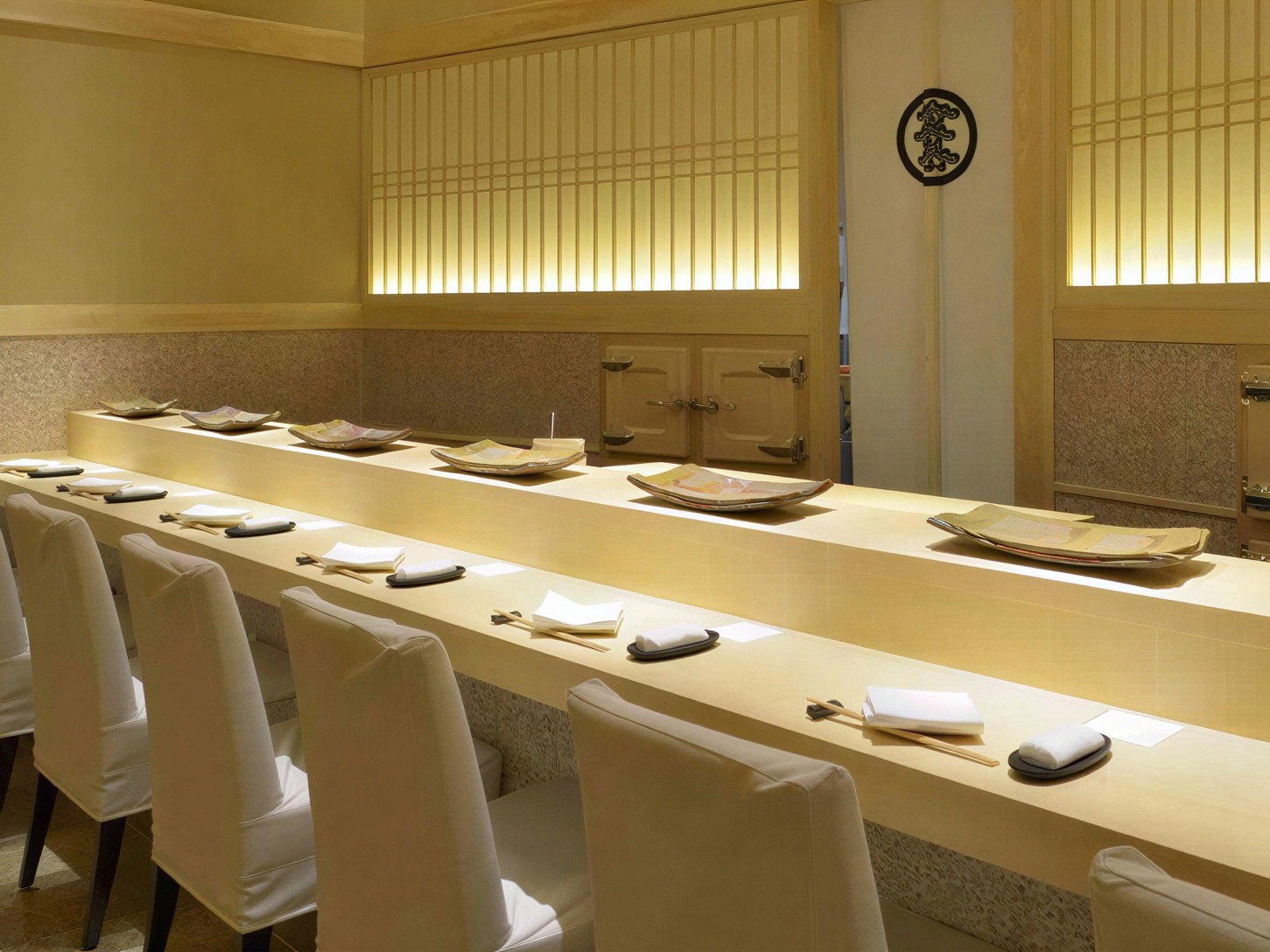
Intimate setting with open kitchen views, white-themed decor, relaxed yet refined atmosphere, welcoming lounge on first floor and upstairs dining.