

A Michelin-starred contemporary restaurant in Nishiazabu where French technique meets the discipline of Japanese foodways. Straw-smoked meats, bonito-accented sauces, and a dessert philosophy built on patience rather than spectacle define the kitchen's approach. The name itself, 'haku' for purity, 'nei' for meticulousness, functions as a working brief, not a marketing claim.
Pearl is the En Primeur Club membership app — saves, bookings, and concierge access live there. Same editors, same standards.
- Address
- 4 Chome-9-11 Nishiazabu, Minato City, Tokyo 106-0031, Japan
- Phone
- +81 90-8946-3919
- Website
- hakunei.com
- Directions
- Get directions
 Saves & bookings on Pearl
Where Nishiazabu Meets the Quiet Side of French-Japanese Cooking
Nishiazabu operates on a different register from the high-visibility dining corridors of Ginza or Roppongi. The streets here are quieter, the signage understated, and the restaurants that occupy its low-rise addresses tend to attract guests who already know where they are going. It is precisely the kind of neighbourhood where a kitchen built around restraint and precision can take root without the distraction of foot traffic or spectacle. Hakunei, at 4 Chome-9-11 Nishiazabu in Minato City, belongs to that setting in a way that feels deliberate rather than incidental.
The French-Japanese format is not new to Tokyo. The city has spent decades absorbing classical French technique and bending it against the logic of Japanese ingredients, seasonality, and craft values. What distinguishes the more serious practitioners in that tradition is a willingness to let the method serve the material rather than the other way around. Hakunei sits in that current, positioning itself alongside peers such as HYÈNE and nôl in a tier of Tokyo contemporary dining where the Michelin recognition reflects earned technical credibility rather than brand momentum.
The Kitchen's Logic: Fire, Stock, and the Ethics of the Whole Ingredient
The cooking at Hakunei is built around a set of choices that, taken together, read as a coherent philosophy of minimal waste and maximum extraction from each ingredient. Meat is oven-roasted and finished with straw smoke, a technique that draws on the deep Japanese tradition of wara-yaki, straw-firing, which has long been used in preparations such as katsuo no tataki in Kochi Prefecture. The approach is not decorative: straw burns at a high temperature for a short time, searing the surface rapidly and imparting a light, hay-like smoke without the heavier char of wood. The result is a cooking method that uses an agricultural byproduct, one that would otherwise be discarded after harvest, as a functional heat source.
Sauces are accented with bonito stock rather than the classical French fond built on reduced veal or chicken bones. Bonito dashi is among the more resource-efficient stocks in professional cooking: it requires no long simmering, uses the dried, fermented body of a single fish, and produces a clear, deeply savoury liquid with a fraction of the energy expenditure of its European equivalents. The choice is not simply about flavour bridging between two culinary traditions; it reflects a preference for extraction methods that are inherently less intensive. At a moment when the restaurant industry is reckoning seriously with the carbon cost of long-cooked meat stocks, this is a meaningful structural decision.
The substitution of unripe pepper for black pepper extends the same logic to the spice rack. Black pepper, dried and traded globally, carries a supply chain with it. Unripe pepper, green peppercorns harvested before they dry and darken, offers comparable heat with a fresher, more herbaceous character and, depending on sourcing, a shorter path from farm to kitchen. It is a small detail, but small details accumulate into a working system.
For further context on how Tokyo's contemporary kitchens are approaching French-Japanese crossover, FUSOU and JULIA offer useful comparison points in the same city tier.
Patience as Technique: The Millefeuille de Crêpes
Tokyo's Michelin-starred contemporary kitchens increasingly use a signature dessert as a statement of values rather than simply a sweet course. The millefeuille de crêpes at Hakunei, built by adding layer upon layer of individually made crêpes until the structure reaches its finished height, is the kitchen's most visible expression of the precision that the name promises. The word 'millefeuille' means a thousand leaves; in the French pastry tradition it refers to compressed layers of puff pastry. Hakunei transposes the format into crêpes, a preparation that demands consistent heat control, even batter distribution, and the patience to repeat the same action many times without shortcut.
This kind of process-intensive dessert does not scale easily, which is part of its point. It is the opposite of production-minded cooking. The labour investment per portion is high, the margin for error accumulates with each layer, and the finished result is entirely dependent on the care taken at every repetitive step. In a city where many ¥¥¥¥ tasting menus close with technically complex sugar work, a dessert built on repetition and craft patience reads as a deliberate choice about what the kitchen values.
Where Hakunei Sits in Tokyo's Contemporary Tier
The 2024 Michelin one-star recognition places Hakunei in a specific bracket of Tokyo's contemporary dining ecosystem. For reference, L'Effervescence and RyuGin operate at three stars in the French and kaiseki traditions respectively, while Crony holds two stars for its innovative French-leaning approach. Den, at two stars and a lower price tier, has made a different set of choices about accessibility. Hakunei's single star at ¥¥¥¥ pricing positions it as a kitchen that the Guide considers to be operating at a high technical level while remaining in what is, relative to its comparable set, an earlier phase of its recognition arc. That is not a caveat; it is context. Some of Tokyo's most interesting cooking happens at this tier, where the kitchen has earned critical attention without yet carrying the expectations that come with higher star counts.
The low review count is itself a signal: this is not a restaurant drawing volume, and its profile among guests who have eaten there skews positive in a way that suggests a well-matched audience.
For readers building a wider Japan itinerary, the French-Japanese contemporary format appears in different regional expressions at HAJIME in Osaka and Gion Sasaki in Kyoto. Those with further range might consider akordu in Nara, Goh in Fukuoka, 1000 in Yokohama, or 6 in Okinawa. For contemporary cooking at this price point in other major cities, César in New York City and Jungsik in Seoul offer useful international reference points.
Planning Your Visit
Hakunei is located at 4 Chome-9-11 Nishiazabu, Minato City, Tokyo 106-0031. The ¥¥¥¥ price tier places it in the upper bracket of Tokyo tasting-menu dining. Early reservation planning is advisable.
Quick reference: Hakunei, 4 Chome-9-11 Nishiazabu, Minato City, Tokyo 106-0031, Contemporary, ¥¥¥¥, Michelin 1 Star (2024), Google 4.8.
Same-City Peers
Comparable venues nearby, for context on price, style, and recognition.
| Venue | Cuisine | Price | Notes |
|---|---|---|---|
| hakuneiThis venue — the venue you are viewing | Modern French-Japanese Fusion | $$$$ | Not listed |
| amarantos | Modern French Omakase | $$$$ | Chūō |
| Mētis Roppongi | Wood-Fired French Fusion | $$$$ | Minato |
| apothéose | Modern French with Japanese Terroir | $$$$ | Minato |
| La Gloire | Modern French Fine Dining | $$$$ | Minato |
| mærge | Modern French | $$$$ | Minato |
Recognition history
Dated appearances from independent guides and award organizations, with the underlying list record or original source where available.
Michelin 1 Star
Michelin
Opinionated About Dining Top Restaurants in Japan Recommended
Opinionated About Dining
Michelin 1 Star
Michelin












At a Glance
- Elegant
- Intimate
- Sophisticated
- Minimalist
- Special Occasion
- Date Night
- Chefs Counter
- Open Kitchen
- Sake Program
- Extensive Wine List
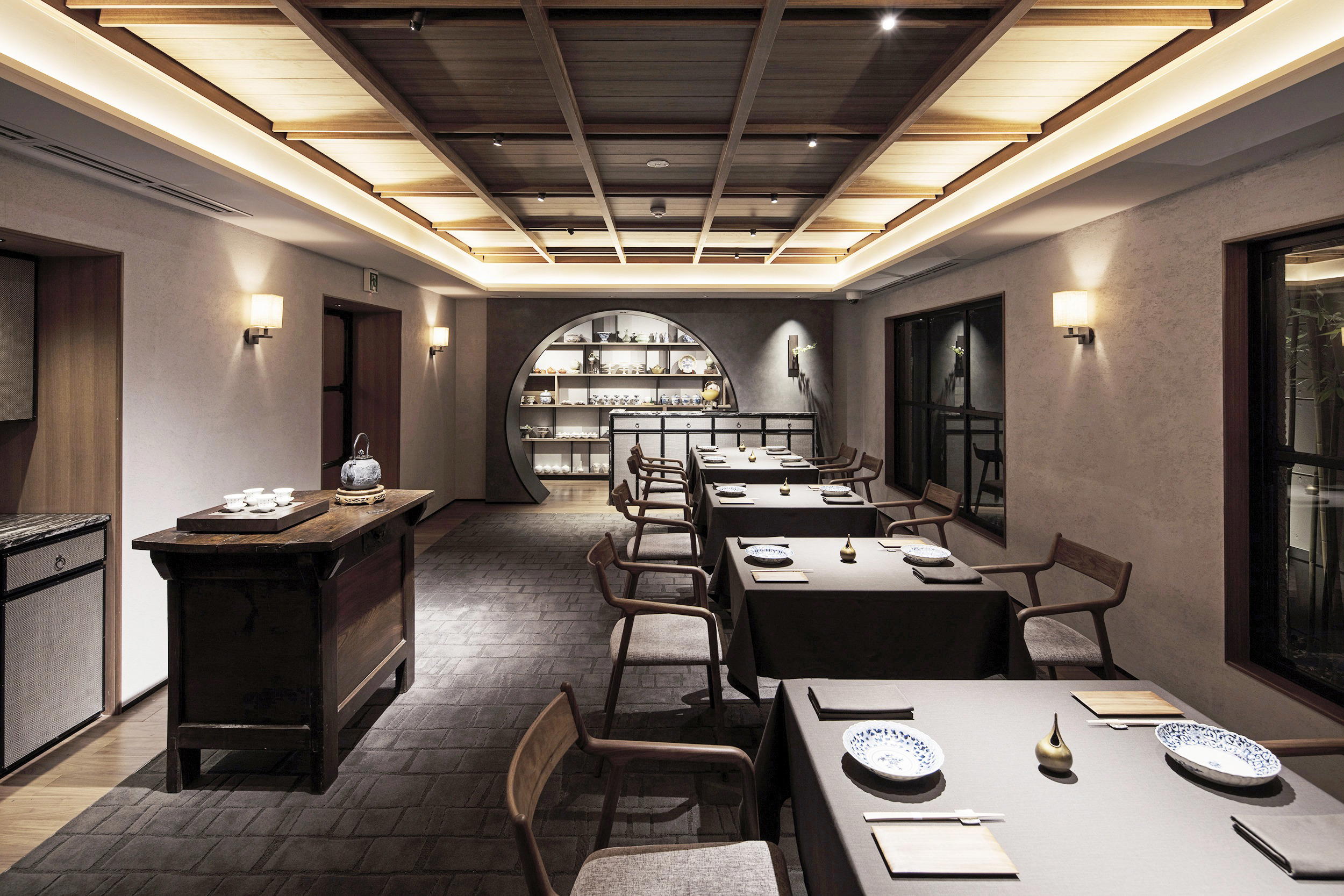
Chic and elegant basement space with white and creamy tones, hinoki wood counter for 8 guests, open kitchen, relaxed and pure atmosphere focusing on cuisine.