
Tabelog Bronze #147
Our verdict
A Tabelog Award 2026 Bronze winner in Shibuya's Nanpeidai quarter, jinen. applies French technique to seasonal Japanese ingredients across a 14-seat room that splits between an eight-seat counter and a private dining space. Dinner runs JPY 50,000–59,999; lunch offers the same kitchen at roughly half the price. Open Tuesday through Saturday, with online reservations required.

Pearl is the En Primeur Club membership app, where members save venues, book tables and use the concierge.
French Cuisine, Japanese Seasons: The Framework That Defines This Corner of Shibuya
The Franco-Japanese format has become one of the more contested spaces in Tokyo dining. At its most superficial, it means French technique applied to domestic produce as a kind of seasonal garnish. At its most considered, it means a complete re-examination of what French structure can hold when the ingredient logic comes from a different culinary tradition entirely, one governed by the four seasons, by terroir expressed through fish markets and mountain forage rather than Breton coasts or Provençal hillsides. jinen. which opened in September 2021 in the Nanpeidai quarter of Shibuya, sits in the latter camp. Its Tabelog score of 4.02 and Tabelog Award 2026 Bronze recognition, alongside selection for the Tabelog French TOKYO "Tabelog 100" in 2025, place it inside a competitive tier of French restaurants where the cooking is evaluated on its own terms, not as a curiosity.
The approach is framed explicitly around seasonal Japanese ingredients and the aesthetic of the four seasons, which in Japan is not a marketing phrase but a culinary philosophy with deep roots. The tradition of shun, eating ingredients at their precise seasonal peak, runs through every major Japanese cuisine form, from kaiseki at places like RyuGin to the sushi counter at Harutaka. What distinguishes the Franco-Japanese format is the decision to route that philosophy through French technique: classical saucing, European plating logic, courses structured around the French progression. The question the kitchen has to answer, every service, is whether the French container enhances the Japanese ingredient or diminishes it.
The Room: Counter, Private Space, and the Nanpeidai Quiet
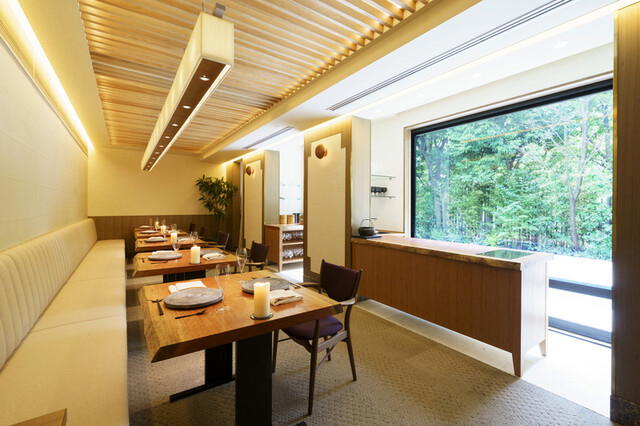
Dining room holds 14 seats: eight at a counter, and the remainder in a private room. The counter format matters here as it does at every serious Japanese restaurant operating in this register, it creates proximity to the kitchen that a dining-room table does not, and it enforces a shared tempo across all guests. The location data tags the space as having a night view and a quality of being a hideout, which tracks with Nanpeidai's character. The neighbourhood sits above Shibuya proper, quieter and more residential than the station district below it. The address at 6-7 Nanpeidaicho places it roughly ten minutes on foot from Shibuya Station across multiple lines, and approximately the same distance from Shinsen Station on the Keio Inokashira Line. Coin parking is available nearby; the restaurant has no on-site parking.
Non-smoking room and the availability of private dining for full-party buyout make the space functional for business dinners or celebration meals where discretion matters. These are not unusual features at this price point in Tokyo, but they are worth noting because the room configuration, small total capacity, counter-focused, means private use occupies a significant share of the available seating. Booking when private use is in effect may limit counter availability.
Sits in Tokyo French Dining
Dinner pricing of JPY 50,000–59,999 per person places jinen. in the upper tier of Tokyo French dining, though not at the ceiling. L'Effervescence and Sézanne, both Michelin three-star holders, operate at comparable or higher price points. Crony, with two Michelin stars and an innovative French positioning, occupies a similar bracket. What jinen. Review-based pricing data shows an average dinner spend of JPY 40,000–49,999 in practice, which suggests that the menu leading is not always reached. This is a useful calibration for first-time visitors deciding between lunch and dinner.
Price variation built into the reservation notes, that pricing depends on seasonal ingredients available at the time, reflects the honest reality of cooking to shun. Ingredient costs shift with season, and a kitchen that refuses to compromise on sourcing absorbs those shifts into its pricing rather than its menus. That transparency is increasingly standard at this tier in Tokyo, but it is worth understanding before arrival.
The Franco-Japanese Format in Broader Context
Tokyo's French restaurant ecosystem is more crowded and more technically accomplished than almost any city outside Paris. This is partly a historical consequence of the deep exchange between French and Japanese professional kitchens since the 1960s, and partly a function of the city's general culinary density. The Franco-Japanese format that jinen. occupies has evolved considerably from its earlier forms, which often read as French cooking with Japanese ingredients as accent notes. The more recent iteration, particularly at smaller, chef-driven counters, treats the Japanese ingredient as structurally primary, the seasons determine the menu, and the French technique serves the ingredient rather than the reverse.
This positions Tokyo's leading Franco-Japanese counters in an interesting relationship with both their French-cuisine peers and their Japanese-cuisine peers. They are neither purely French nor kaiseki, and the most serious among them have developed a distinct culinary grammar. Internationally, the closest analogues might be restaurants like Le Bernardin in New York, where a single ingredient category (seafood) becomes the organising principle for French technique, or Atomix, where Korean culinary logic sits beneath a European fine-dining format. Across Japan, similar questions are being worked through at restaurants including HAJIME in Osaka and akordu in Nara, each arriving at different answers about how much French structure the local ingredient tradition should carry.
Booking, Hours, and Planning Notes
jinen. operates Tuesday through Thursday from 17:00, with Friday and Saturday adding a lunch service from 12:00. The kitchen is closed Sundays, Mondays, and public holidays. That five-day schedule with a single daily service on three of those days limits total cover count substantially, which puts pressure on reservation availability. Online reservations are available through Tabelog.
The reservation notes flag two specific conditions worth reading before booking: guests with extensive allergies or strong aversions to certain ingredients may not be accommodated, given the fixed-course format tied to seasonal availability; and late arrivals or early departures may result in courses being skipped rather than served out of sequence. Both are standard operating procedures at counter restaurants where a shared-pace format is structural rather than incidental.
A service charge applies. Payment by major credit cards is accepted (Visa, Mastercard, JCB, Amex, Diners Club); electronic money and QR code payments are not. Reservations: Online via Tabelog, in advance. Budget: Dinner JPY 50,000–59,999 (avg. JPY 40,000–49,999 per reviews); Lunch JPY 20,000–29,999. Hours: Tue–Thu from 17:00; Fri–Sat from 12:00 and 17:00; closed Sun, Mon, public holidays. Address: 6-7 Nanpeidaicho, Shibuya, Tokyo 150-0036, approximately 10 minutes on foot from Shibuya Station.
Explore Further
For more dining in Tokyo at this tier, our full Tokyo restaurants guide covers the city's French, sushi, and kaiseki counters in detail. If you are building a broader itinerary, see our Tokyo hotels guide, Tokyo bars guide, Tokyo wineries guide, and Tokyo experiences guide. For creative French-influenced cooking elsewhere in Japan, Gion Sasaki in Kyoto, Goh in Fukuoka, 1000 in Yokohama, and 6 in Okinawa each represent distinct regional takes on the question of what French cuisine becomes when the ingredient logic is Japanese.
Frequently asked questions
What should I order at jinen.?
jinen. operates a fixed-course format, so the menu is not a la carte. The courses are built around whatever seasonal Japanese ingredients the kitchen is working with at the time of your visit, and the Tabelog reservation notes confirm that pricing itself shifts with ingredient availability. The clearest directive is to book the dinner service for the fullest expression of the cooking, the JPY 50,000–59,999 course represents the kitchen's primary statement, while the Friday and Saturday lunch at JPY 20,000–29,999 offers access to the same culinary logic at a lower commitment. The restaurant holds a Tabelog score of 4.02 and earned Bronze at the Tabelog Awards 2026, placing it among the recognised French counters in Tokyo for seasonal Japanese ingredient work. Allergy or ingredient restrictions should be communicated at the time of reservation, as the fixed-course structure leaves limited room for substitution.
Quick Comparison
Comparable venues nearby, for context on price, style, and recognition.
| Venue | Cuisine | Price | Awards | Notes |
|---|---|---|---|---|
| jinen.This venue (the venue you are viewing) | Modern French with Seasonal Japanese Ingredients | $200–300 | Tabelog Bronze #147 | Not listed |
| Peter | Modern French Grill with Japanese Influences | $150–200 | Star Wine List | Chiyoda |
| クーカーニョ | French Provençal Fine Dining | $100–150 | Not listed | Shibuya |
| ギンザ カンセイ | French Fine Dining | $150–200 | Not listed | Chūō |
| Four Seasons Hotel Tokyo at Otemachi | Contemporary French with Japanese Terroir | $200–300 | Not listed | Chiyoda |
| トワヴィサージュ | Modern French with Seasonal Japanese Ingredients | $200–300 | 1 Michelin Star | Chūō |
Recognition history
Dated appearances from independent guides and award organizations, with the underlying list record or original source where available.
Tabelog Bronze #147
Tabelog
Full recognition history (2 entries)
Tabelog 100 #51 · No. 51
Tabelog · Tabelog 100 - French - TOKYO - 2025
Continue exploring
More in Tokyo
Restaurants in Tokyo
All restaurants in Tokyo →


Bars in Tokyo
All bars in Tokyo →





Details
- Elegant
- Sophisticated
- Intimate
- Modern
- Cozy
- Date Night
- Special Occasion
- Open Kitchen
- Extensive Wine List
- Garden
- Tasting Menu
- Wine
High-quality space filled with the warmth of wood, open design with garden view, soothing and elegant atmosphere.