Our verdict
Hyōto Shijō Karasuma occupies the ground floor of the Meirinビル in Nakagyō Ward, positioning it at one of Kyoto's most transit-accessible intersections where the Shijō commercial corridor meets the north-south spine of Karasuma.

Pearl is the En Primeur Club membership app — saves, bookings, and concierge access live there. Same editors, same standards.
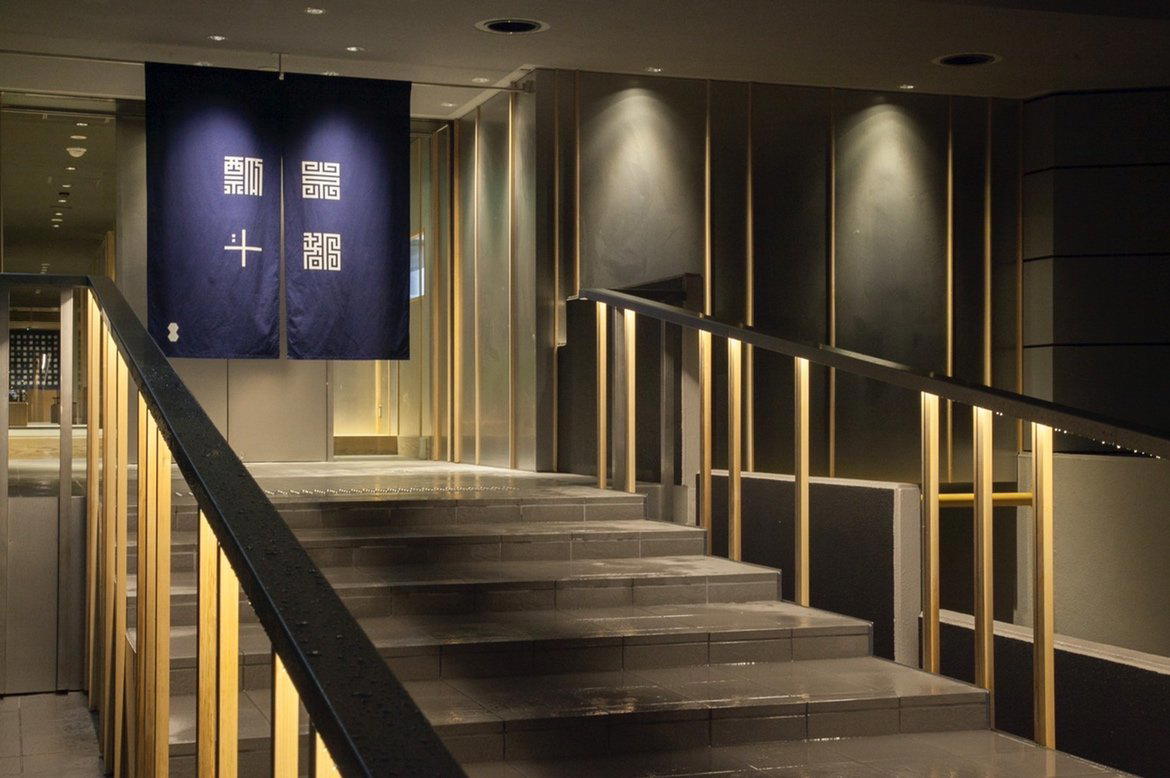
Where the City Grid Becomes the Room
Kyoto's central dining scene has a geography problem that most visitors misread. The temples and ryokan draw attention east toward Higashiyama and north toward Kinkaku-ji, but the intersection of Shijō-dōri and Karasuma-dōri has quietly accumulated a different kind of gravity: a mid-city density of offices, covered shopping arcades, and commuter transit that produces a dining culture more interested in precision and repeatability than in tourist ceremony. Hyōto Shijō Karasuma sits at that intersection, in the ground floor of the Meirinビル on Yamabushiyamachō, and its address is itself an editorial statement about which Kyoto it belongs to.
Ground-floor tenancies in mid-century commercial buildings along this corridor tend to do one of two things: lean into the transient foot traffic with fast formats, or resist it by creating contained, deliberate environments that force a shift in register the moment you step inside. The distinction matters because it determines what kind of experience the building's envelope can sustain. In Nakagyō Ward, where the street-level noise of Shijō competes with the quieter residential lanes running north, venues that opt for the latter approach are making a claim about attention span and the value of stillness in a city that increasingly has neither.
The Architecture of Arrival in Nakagyō Ward
Karasuma's commercial spine is lined with buildings that range from Meiji-era machiya conversions to postwar concrete blocks, and the Meirinビル sits in that postwar cohort: functional, recessive, not designed to announce itself from the street. For a dining venue, that kind of building sets a particular challenge. The approach lacks the stone-path drama of a kaiseki house in Gion or the courtyard reveal of a converted townhouse. What it offers instead is neutrality, a canvas that places the burden of atmosphere entirely on the interior.
This is a format pattern that has become increasingly common in Kyoto's central wards as real-estate costs have pushed newer operations toward commercial buildings rather than heritage structures. Venues like kiln and Kiharu operate within this same logic: the container is unremarkable by Kyoto's historic standards, but the interior articulation does the work that the façade cannot. The question for any such venue is whether the design vocabulary inside justifies the decision to locate in a building that offers the visitor no atmospheric runway before they reach the door.
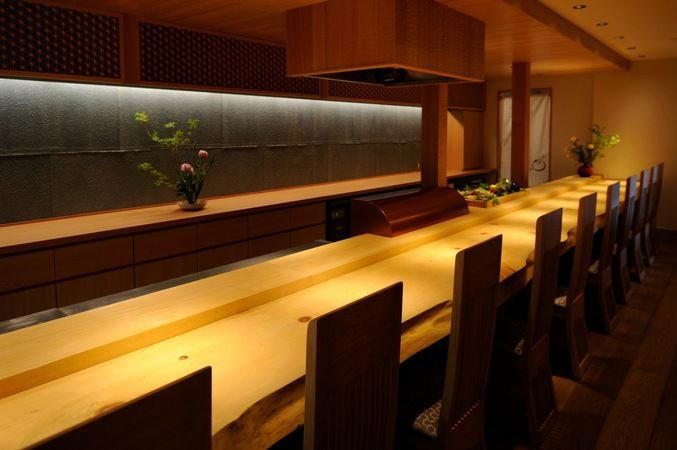
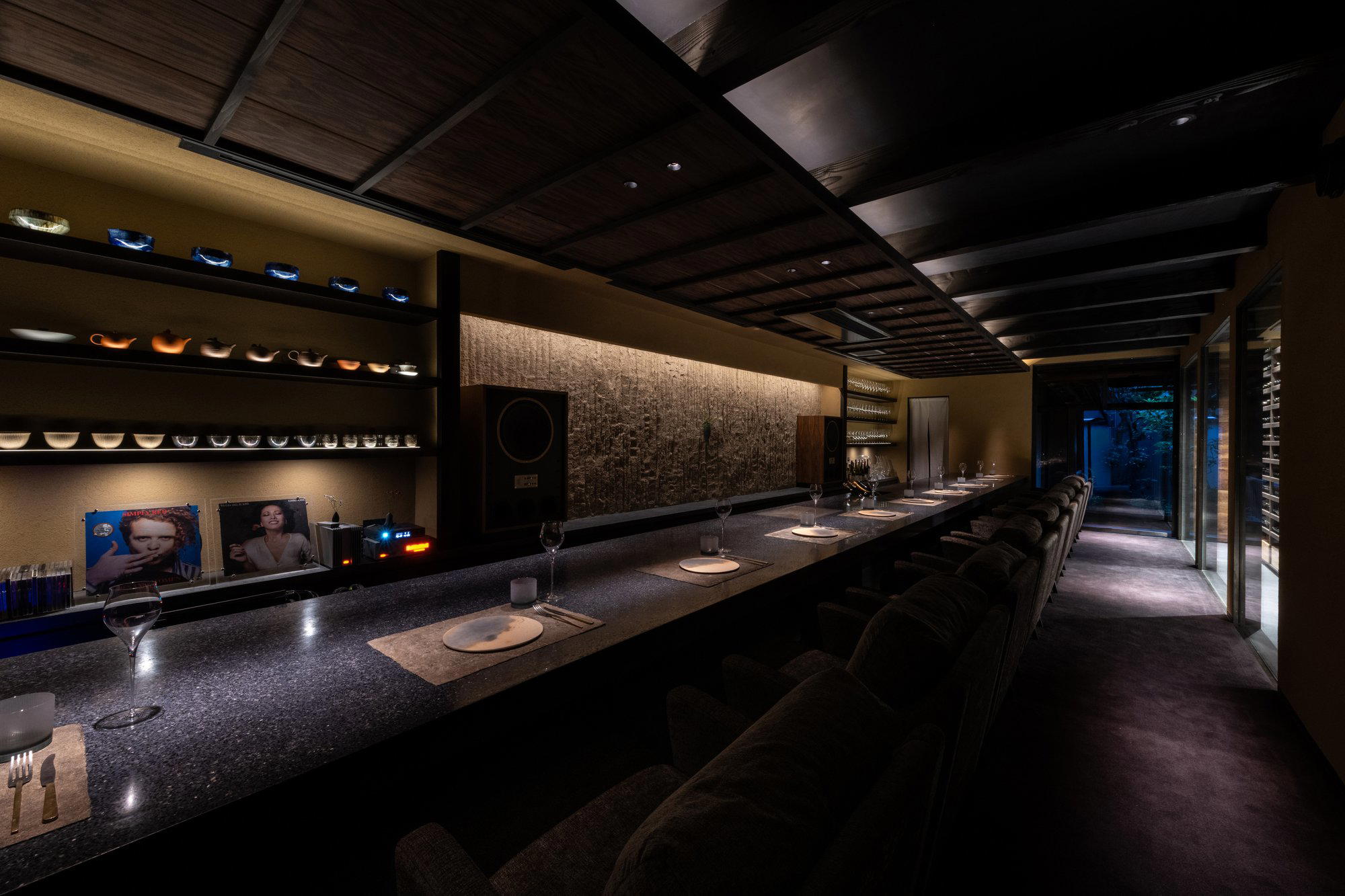
In Kyoto's mid-city dining tier, seating arrangements tend to signal the dining tempo more reliably than any written description. Counter formats imply a single-focus, chef-directed pace. Table service in a commercial-building ground floor tends toward a more flexible rhythm, accommodating lunch-hour practicality and evening lingering within the same physical space.
The Shijō-Karasuma Dining Tier and Its Competitive Set
Positioning a venue at this intersection places it in direct conversation with a specific tier of Kyoto dining: not the destination-pilgrimage category of Gion Sasaki, and not the neighbourhood-local category of the backstreets north of Imadegawa, but the mid-city professional tier that serves Kyoto residents and informed visitors who want quality without ceremony tax. That tier has expanded significantly over the past decade as Kyoto's office population has grown and as visitors have become more fluent in reading the city beyond its postcard inventory.
For comparison, venues operating in analogous mid-city commercial positions in other Japanese cities, including Harutaka in Tokyo and HAJIME in Osaka, have used the commercial-building format to strip away heritage signaling and let food and service carry the full weight of the experience. The constraint becomes the discipline. Whether Hyōto Shijō Karasuma operates under the same logic is a question the limited data leaves open, but the address places it squarely in the category where that question is worth asking.
Further afield, the same tension between container and content plays out at venues like akordu in Nara and Goh in Fukuoka, both of which have built reputations that significantly exceed what their physical environments suggest from the outside. The Kansai region has developed a particular fluency in this format: understated arrival, concentrated interior, the meal as the architecture.
Planning a Visit: What the Address Tells You
The practical logic of this location is direct. Shijō station on the Kyoto Municipal Subway's Karasuma Line is within walking distance, as is Karasuma station on the Hankyu Kyoto Line, making this one of the more transit-accessible dining addresses in the city. For visitors staying in Gion or along the Kamo River, the approach is a ten-to-fifteen-minute walk through the covered arcade of Shijō-dōri, a route that passes through some of Kyoto's densest retail and food provisioning streets before depositing you at the Yamabushiyamachō address.
Visitors planning a meal here should verify current operating details directly. For a broader map of Kyoto's dining options at various price points and formats, the EP Club Kyoto Shi restaurants guide provides comparative context across the city's key corridors and neighbourhoods. Comparable Kyoto addresses worth considering in parallel include Kiharu Brasserie and Junsei, both of which operate in the accessible mid-city tier with confirmed formats and booking options. The Kanga-an Temple dining experience offers a contrasting register entirely, for those seeking the ceremonial end of the Kyoto spectrum.
Outside Kyoto, the same editorial intelligence that applies to this address applies to venues like Abon in Ashiya, affetto akita in Akita, Aji Arai in Oita, Ajidocoro in Yubari District, and Akakichi in Imabari: mid-city or regional addresses where the building says little and the room does everything. Internationally, the same dynamic appears at Le Bernardin in New York City and Lazy Bear in San Francisco, where commercial or industrial containers have been made to carry significant culinary weight.
Frequently asked questions
Does Hyōto Shijō Karasuma work for a family meal?
The Nakagyō Ward address puts the venue inside Kyoto's commercial core, which tends to suit adult-focused dining rather than family groups with young children. That said, the Shijō-Karasuma intersection is well-served by subway and bus, making logistics simple.
How would you describe the vibe at Hyōto Shijō Karasuma?
The ground-floor position inside the Meirinビル on Yamabushiyamacho places the venue in a building stock that runs from Meiji-era machiya conversions to postwar commercial blocks — a working Kyoto streetscape rather than a curated heritage setting. Expect the energy of the city's central business district rather than the quieter register of Higashiyama's dining rooms. The Shijō-Karasuma node draws a mix of office workers, local regulars, and transit-oriented visitors.
Is Hyōto Shijō Karasuma easy to reach by public transport from central Kyoto?
The address on Yamabushiyamacho in Nakagyō Ward sits within the transit nexus formed by Shijō Station on the Kyoto Municipal Subway's Karasuma Line and the adjacent Hankyu Kyoto Line stop — two of the city's highest-frequency rail corridors. For visitors staying in central Kyoto, this location is reachable without a taxi. The Meirinビル's ground-floor position makes the venue straightforward to identify on arrival.
What's the must-try dish at Hyōto Shijō Karasuma?
The venue's own channels or a direct inquiry will give the most accurate picture of what the kitchen is focused on at a given time.
Where do I go for Hyōto Shijō Karasuma?
Hyōto Shijō Karasuma is located at Japan, 〒604-8156 Kyoto, Nakagyo Ward, Yamabushiyamacho, 550-1 明倫ビル 1F, Kyoto Shi.
Should I book Hyōto Shijō Karasuma in advance?
The Shijō-Karasuma intersection is one of Kyoto's busiest transit hubs, and restaurants at this address draw a consistent local crowd alongside visitors moving between the Karasuma Line and Hankyu Kyoto Line. Walk-in availability will likely depend on the time of day and season.
What's Hyōto Shijō Karasuma best at?
Based on its position at the Shijō-Karasuma crossing in Nakagyō Ward, the venue sits in a dining tier that serves the working city rather than the destination-pilgrimage circuit. That positioning typically means accessibility, practical pricing, and a clientele that returns regularly rather than once.
Just the Basics
| Venue | Cuisine | Price |
|---|---|---|
| Hyōto Shijō KarasumaThis venue — the venue you are viewing | Kyoto Dashi Shabu-Shabu Kaiseki | $100–150 |
| Junsei | Kyoto Kaiseki Yudofu | $50–100 |
| Kiharu | Modern Western Brasserie with Kyoto Influences | $20–30 |
| Kiharu Brasserie | Western Brasserie with Kyoto Influences | $20–30 |
| kiln | Italian | Not listed |
| Kyoto Handicraft Center | Seasonal Japanese Kaiseki | Not listed |
Continue exploring
More in Kyoto Shi
Restaurants in Kyoto Shi
All restaurants in Kyoto Shi →

Bars in Kyoto Shi
All bars in Kyoto Shi →
Hotels in Kyoto Shi
All hotels in Kyoto Shi →
Wineries in Kyoto Shi
Browse all →
Hyōto Shijō Karasuma
The wine
- Wine program
- Curated wine list
- Sake program
Details
- Elegant
- Cozy
- Sophisticated
- Modern
- Date Night
- Special Occasion
- Group Dining
- Private Dining
- Sake Program
- Set Menu
- Sake
- Vegetarian Friendly
- Gluten Free Options
- Allergy Accommodating
Current opening hours
- Monday
- 11:30 AM–2 PM, 5:30–11 PM
- Tuesday
- 11:30 AM–2 PM, 5:30–11 PM
- Wednesday
- 11:30 AM–2 PM, 5:30–11 PM
- Thursday
- 11:30 AM–2 PM, 5:30–11 PM
- Friday
- 11:30 AM–2 PM, 5:30–11 PM
- Saturday
- 11:30 AM–3 PM, 5:30–11 PM
- Sunday
- 11:30 AM–3 PM, 5:30–11 PM
Hours can change for holidays and private events. Last verified .
Comfortable and chic Japanese-style interior with clean, tidy ambiance evoking sandalwood aroma, warm attentive service, and intimate dining spaces.