Kiharu Brasserie occupies a Nakagyo Ward address that places it squarely within Kyoto's dense mid-city dining corridor, where French-inflected brasserie formats have found a durable foothold alongside the city's kaiseki tradition. The name shares lineage with the broader Kiharu family of restaurants in the city, suggesting a house approach to hospitality rooted in Kyoto's exacting service culture. Reservation lead times and format details reward advance research.
Pearl is the En Primeur Club membership app — saves, bookings, and concierge access live there. Same editors, same standards.
- Address
- 71-1 Daikokucho, Nakagyo Ward, Kyoto, 604-8031, Japan
- Phone
- +81 75 231 8832
- Directions
- Get directions
 Saves & bookings on Pearl
Where Brasserie Culture Meets Kyoto's Pace
Nakagyo Ward, the administrative and commercial spine of central Kyoto, has long functioned as the city's connective tissue between the tourist-dense corridors of Gion to the east and the transit hub of Kyoto Station to the south. The streets around Daikokucho, where Kiharu Brasserie holds its address at 71-1, carry the particular character of urban Kyoto at its most practical: covered arcades, narrow machiya shopfronts, and a dining scene that ranges from long-standing kaiseki houses to the kind of European-format restaurants that have steadily accumulated in the city since the 1990s. Kiharu Brasserie is a restaurant in Kyoto's Nakagyo Ward, serving Western brasserie cooking with Kyoto influences. It is in this second category that the brasserie format has found an interesting home, not as an import awkwardly grafted onto Japanese hospitality, but as a vehicle shaped by local expectations around pacing, service precision, and seasonal awareness.
The brasserie as a format occupies a particular position in the hierarchy of European-style dining in Japan. It sits below the formality of a full gastronomique restaurant but above the casualness of a bistro, and in Kyoto that middle register aligns more comfortably with the city's dining culture than it might in Tokyo. Kyoto diners tend to expect a meal to have structure, a sense of ceremony in the progression of courses, and attentive but unobtrusive service. A brasserie format, when executed with those expectations in mind, produces something distinct from its Parisian counterpart: more deliberate in pacing, more attuned to seasonal produce, and less reliant on the convivial noise that defines the French original.
The Kiharu Name and What It Signals
In Kyoto's dining scene, the Kiharu name appears across more than one address. Kiharu operates as a distinct entity from Kiharu Brasserie, and the relationship between the two speaks to a pattern common in Kyoto's established restaurant families: a flagship kaiseki or Japanese format house and a more accessible, European-influenced sibling designed to serve a different occasion and a broader audience. This structure is not distinctive to this corner of the city. Across Kyoto, houses that built their reputations on traditional Japanese cuisine have opened adjacent concepts that allow the kitchen's seasonal discipline and sourcing relationships to express themselves through different formats. The brasserie label, in this context, is less a statement of French identity and more a signal of format: multi-course, seated, structured, and priced and paced for an evening rather than a quick lunch.
Restaurants like HAJIME in Osaka demonstrate what a singular, uncompromised vision looks like at the high end of European-Japanese fusion. The restaurant, by positioning itself in a brasserie register rather than at that ceiling, makes a different kind of argument: that the discipline of good sourcing and attentive service can be delivered without the full ceremony and price point of a tasting-menu destination.
The Ritual of the Brasserie Meal in Kyoto
The dining ritual at a Kyoto brasserie differs from its European model in ways that matter for how a visitor should approach the meal. In France, the brasserie is partly defined by its flexibility: you can arrive at the counter for a single dish, linger over a carafe, or leave quickly. In Kyoto, the expectation runs differently. Restaurants in this register tend to assume a complete meal, and the pacing reflects that assumption. Courses arrive at intervals that feel considered rather than rushed, and the transition between them is handled with the kind of quiet attentiveness that defines Kyoto hospitality across formats.
This pacing ritual is not incidental. It reflects the city's broader view that a meal is an occasion with a shape, not a transaction. Visitors accustomed to more informal European brasserie dining should expect a more structured experience, with the kitchen setting the tempo rather than the guest. That shift can feel unfamiliar, but it is precisely what makes the Kyoto brasserie format worth experiencing on its own terms rather than measuring against a Parisian or Tokyo equivalent.
The restaurant sits in neither of those categories but draws from the same city-wide culture of hospitality that makes Kyoto's restaurants, across formats, feel more deliberate than those in most other Japanese cities.
Nakagyo Ward as a Dining Neighbourhood
Daikokucho and the surrounding blocks of Nakagyo Ward function as a working neighbourhood in ways that Gion and Higashiyama do not. There are fewer tourists at street level, the architecture mixes eras without the preserved-district self-consciousness of the eastern precincts, and the restaurant density is high without being performative. This is where Kyoto residents eat, which makes it a more reliable indicator of what the city's dining culture actually values than the more photographed corridors to the east.
The Kanga-an Temple dining experience, for those interested in how Kyoto frames meals within architectural and cultural context, represents a completely different register of the city's hospitality range.
akordu in Nara shows how European technique gets applied in a historically dense Japanese city with its own set of culinary constraints and opportunities. Further afield, Goh in Fukuoka and addresses like Harutaka in Tokyo illustrate how Japan's upper-tier restaurant culture continues to develop in formats and at price points well above the brasserie register. International comparison points such as Le Bernardin in New York City and Lazy Bear in San Francisco demonstrate how different cities frame the structured tasting meal, for readers who want to calibrate the restaurant's format within a global context.
Planning Your Visit
This makes the location practical for visitors staying in central Kyoto without requiring a taxi or bus.
Cuisine and Credentials
Comparable venues nearby, for context on price, style, and recognition.
| Venue | Cuisine | Price | Notes |
|---|---|---|---|
| Kiharu BrasserieThis venue — the venue you are viewing | Western Brasserie with Kyoto Influences | $$$ | Not listed |
| Kanga-an Temple | Vegan Shojin Ryori Fucha Cuisine | $$$ | Kita-ku |
| Kiharu | Modern Western Brasserie with Kyoto Influences | $$ | Nakagyo-ku |
| Monk | Modern Japanese Wood-Fired Pizza Omakase | $$$$ | Sakyo Ward |
| kiln | French-Inspired Charcoal Grill & Coffee Bistro | $$ | Shimogyo Ward |
| Kyoto Modern Terrace | Modern Japanese-Western Fusion | $$$ | Okazaki |
Continue exploring
More in Kyoto Shi
Restaurants in Kyoto Shi
Browse all →
Bars in Kyoto Shi
Browse all →
Hotels in Kyoto Shi
Browse all →
Wineries in Kyoto Shi
Browse all →
At a Glance
- Modern
- Cozy
- Elegant
- Family
- Casual Hangout
- Hotel Restaurant
- Craft Cocktails
- Local Sourcing
Current opening hours
- Monday
- Closed
- Tuesday
- Closed
- Wednesday
- Closed
- Thursday
- Closed
- Friday
- Closed
- Saturday
- 7–10 AM, 11:30 AM–3 PM
- Sunday
- 7–10 AM, 11:30 AM–3 PM
Hours can change for holidays and private events. Last verified .
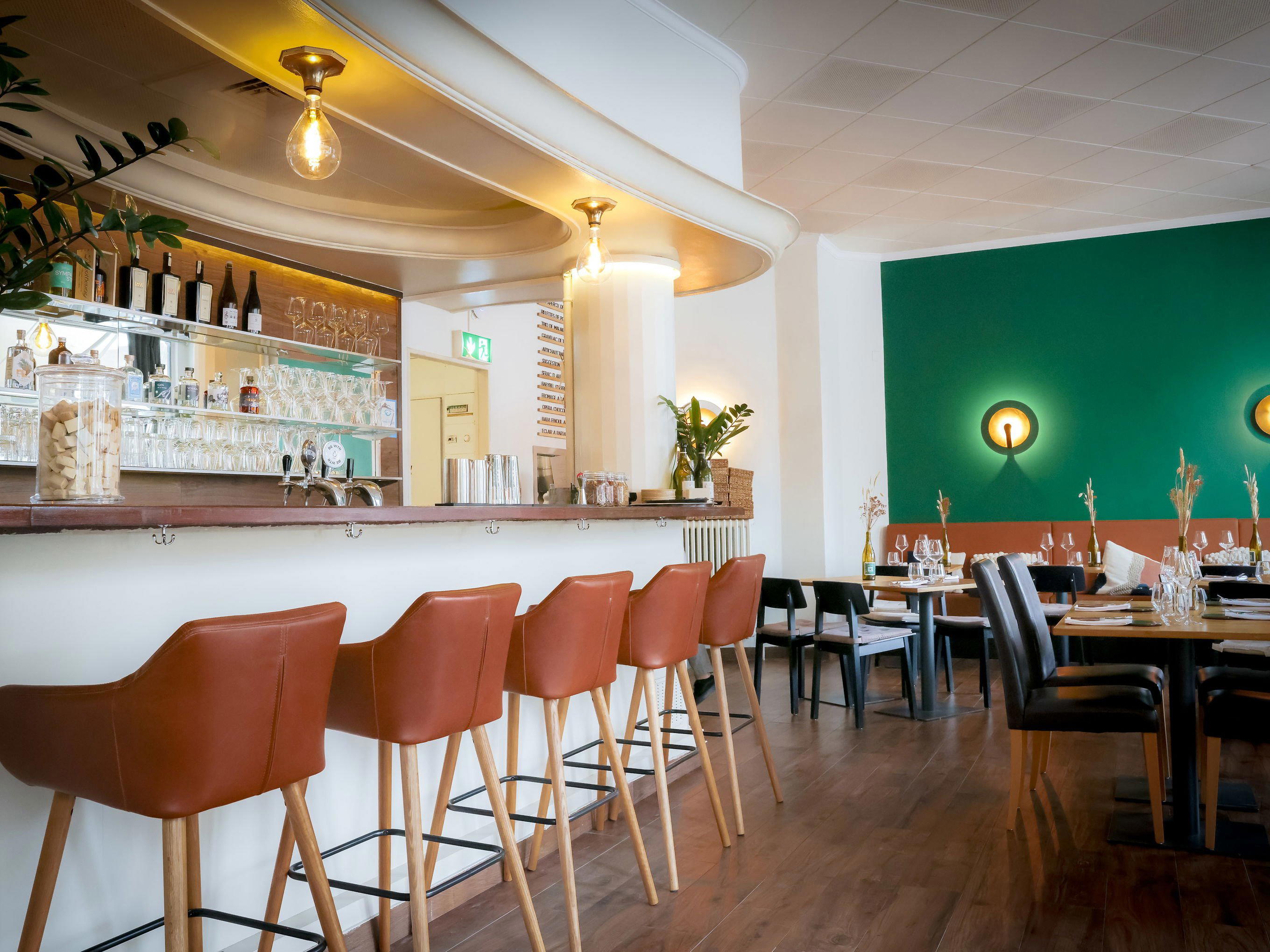
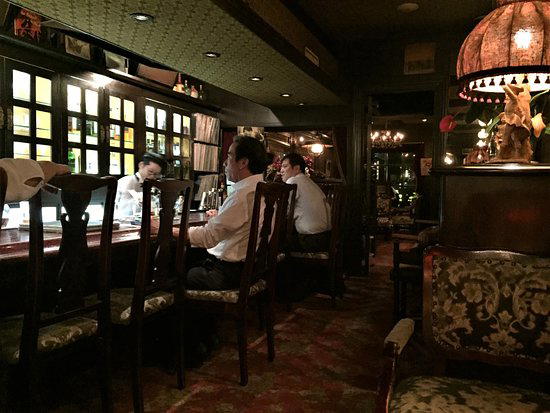
Spacious and cozy dining area with modern yet retrospective arts, cool and funky decor aligned with minimalist hotel design, and a relaxing atmosphere.