
Honke Funahashiya sits in Kyoto’s old confectionery register: wagashi, senbei, arare and bean sweets treated less as dessert than as edible craft. Its 2023 Tabelog 100 selection for Japanese traditional sweets and sweets cafes in WEST places it among the region’s serious addresses, with a casual spend that keeps the experience closer to shopping ritual than formal dining.
Pearl is the En Primeur Club membership app — saves, bookings, and concierge access live there. Same editors, same standards.
- Address
- 京都府京都市中京区三条大橋西詰112
- Phone
- +81752212673
- Website
- funahashiya.com
 Saves & bookings on Pearl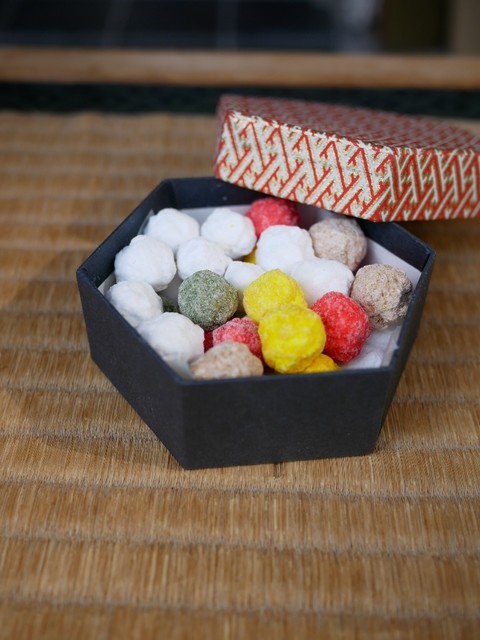
Approaching the Sanjo Ohashi side of Kyoto, the city changes scale. The river crossing pulls traffic, walkers and old shopping habits into the same frame, and confectionery shops here have never needed the theatre of a dining room to make their case. Jars, packets, seasonal gifting boxes and small purchases do the work. Honke Funahashiya belongs to that Kyoto category where selection matters as much as service: wagashi and rice crackers are bought with the eye of someone choosing tea accompaniments, train snacks, house gifts or something to carry back to a hotel room after dinner.
That distinction matters in a city where sweets can be mistaken by visitors for a light add-on to kaiseki culture. Kyoto’s confectionery tradition has its own hierarchy, tied to tea, temple visits, annual observances and the etiquette of giving. The serious shops are not chasing restaurant pacing. They are built around curation, shelf life, texture, packaging and the quiet grammar of what suits green tea, what travels, and what feels appropriate for a host. For travellers mapping Kyoto through meals alone, this is the missing register between restaurant reservation and souvenir counter.
Kyoto wagashi, senbei and the discipline of the small purchase
Honke Funahashiya is categorized around Japanese traditional sweets and senbei, a pairing that says a great deal about Kyoto’s everyday confectionery culture. Wagashi often carries the ceremonial imagination of the city, while senbei and arare sit closer to household rhythm: crisp, portable, giftable, and easy to fold into a day of walking. The named products associated with the shop include Meibutsu Goshikimame, a colorful bean snack, and Fuku Daruma, a biscuit-like sweet. Those names are useful not because they turn the shop into a tasting-menu destination, but because they show how Kyoto’s sweet shops trade in recognizable objects rather than chef-driven improvisation.
Within Kyoto’s broader dining field, this is a different price and time commitment from formal rooms such as Oryori Menami, Kyoto Neze, Morita Ya Kiya machi ten or MUNI ALAIN DUCASSE. It sits closer in function to a specialist stop: short, focused, and easy to pair with a day that might otherwise include obanzai, sukiyaki, French fine dining or a cocktail bar later in the evening. For a fuller city map, Our full Kyoto restaurants guide gives the sit-down context, while Our full Kyoto hotels guide, Our full Kyoto bars guide, Our full Kyoto wineries guide and Our full Kyoto experiences guide help place it inside a wider itinerary.
The curation is the point, not a dessert course
The assigned lens for this page is the wine list, and in a confectionery shop the parallel is clear: range, restraint and pairing logic matter more than spectacle. A strong cellar is not judged only by rare bottles; it is judged by whether the selection has purpose. Kyoto sweet shops work in the same register. Bean snacks, rice crackers and tea-facing sweets form a compact pantry of textures and uses, from personal eating to formal gifting. The interest is in how categories are edited, not in how loudly any single item announces itself.
Tabelog selected Honke Funahashiya for its 2023 Japanese traditional sweets and Japanese sweets cafe WEST 100 list, and the listing carries a 3.61 score. In Japan’s food culture, that kind of recognition is especially useful for small-format venues because the usual luxury markers are absent. There is no long tasting menu to decode, no wine pairing to price against peers, no chef biography functioning as a headline. The trust signal comes from category specificity: this is a sweets and senbei address recognized within a regional field of comparable specialists.
Kyoto has many ways to compress food culture into a quick stop. Aburi Mochi Honke Nemoto Kazariya frames another old Kyoto sweet tradition around grilled mochi, while casual city eating can move through 551蓬莱, 3TOKU6MI Shijo karasuma ten, [ki:] and Abbesses. The useful comparison is not cuisine to cuisine, but format to format: which stops reward a short visit, which require a planned meal, and which give a traveller something culturally legible to carry away.
Where it fits in a Kyoto day
The Sanjo area is one of Kyoto’s practical crossroads, and that location suits a confectionery specialist. A sweets stop here does not need to anchor the day. It works between museum time, riverside walking, shopping streets and dinner elsewhere, especially for travellers who understand that Kyoto’s food culture is not confined to seated courses. The smarter approach is to treat it as part of the city’s edible infrastructure: tea sweets, crackers, bean confections and gifts belong to the same ecosystem as restaurants and bars, just with a different rhythm.
For readers building a Japan route beyond Kyoto, the same logic applies nationally: small-format food addresses often reveal more about daily appetite than another formal meal. Compare the function of a Kyoto confectionery stop with.cafe in Osaka,.know in Kumamoto, [Curry Senmon Ten] Maruyama Kyoju. in Sapporo,. 鮪と炭火焼き うお炭 秋葉原店 in Tokyo, (Shoku) Vietnam in Kawasaki or -Grilled beef Sukiyaki- KAMAKURA TANUKIAN 鎌倉 たぬき庵 in Kamakura. Outside Japan, the carry-and-share format has its own analogues at Jōdo Saké Bar in Los Angeles and Onigiri Time in Pasadena, where narrow focus, not breadth, defines the appeal.
The editorial case for Honke Funahashiya is therefore measured rather than grand. It is for travellers who want Kyoto’s confectionery culture in a form that is specific, portable and grounded in a recognized regional sweets category. In a city crowded with reservation anxiety, this kind of stop restores proportion: not every serious food experience requires a long sitting, and not every meaningful purchase needs to behave like a restaurant meal.
Cuisine and Credentials
Comparable venues to anchor price and recognition.
| Venue | Cuisine | Price | Awards | Notes |
|---|---|---|---|---|
| Honke FunahashiyaThis venue — the venue you are viewing | Japanese traditional sweets | $ | , | |
| Kyogashi Tsukasa Shojuken | Japanese Traditional Sweets | $ | , | Higashiyama |
| Menya Yuko | Japanese Ramen | $ | , | Nakagyō |
| 熙怡 | Kyoto Saba Sushi | $ | , | Shimogyō |
| Yamamoto Menzou | Traditional Kyoto udon noodle shop | $ | , | Sakyō |
| Demachi Futaba | Traditional Kyoto wagashi & mochi shop | $ | , | Kamigyō |
Continue exploring
More in Kyoto
Restaurants in Kyoto
Browse all →
Bars in Kyoto
Browse all →
Hotels in Kyoto
Browse all →
Wineries in Kyoto
Browse all →
At a Glance
- Classic
- Cozy
- Hidden Gem
- Iconic
- Casual Hangout
- Solo
- Family
- Historic Building
- Standalone
- Street Scene
Old-fashioned and nostalgic, with a calm, timeworn atmosphere that feels reminiscent of older Kyoto, especially in the evening.