Our verdict
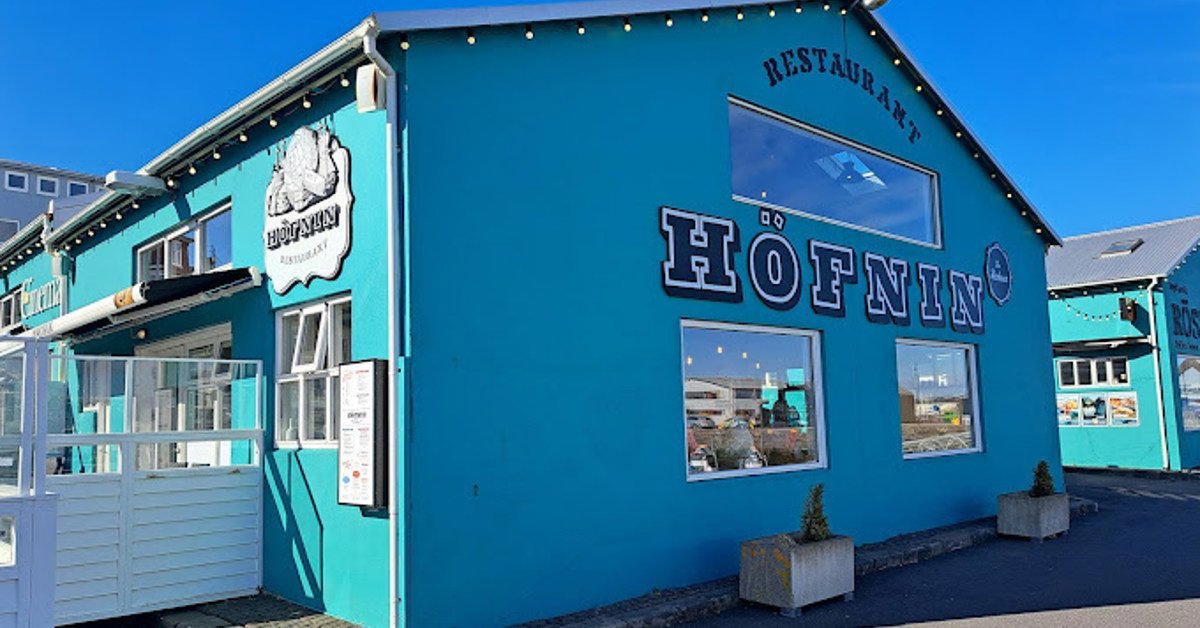
Höfnin sits on Geirsgata 7 at Reykjavik's old harbour, where the gap between fishing pier and dining room narrows to a few metres. The restaurant draws on Iceland's coastal larder in a setting shaped by the working waterfront rather than the city's increasingly polished centre. It occupies a distinct position among Reykjavik's harbour-facing options, where the menu's relationship to the sea is geographic as much as culinary.

Pearl is the En Primeur Club membership app — saves, bookings, and concierge access live there. Same editors, same standards.
- Address
- Geirsgata 7, 101 Reykjavík, Iceland
- Phone
- +354 511 2300
- Hours
- Mon–Wed 11:30 AM–2 PM, 5:30–9 PMThu–Sat 11:30 AM–2 PM, 5:30–10 PMSun 11:30 AM–2 PM, 5:30–9 PM
- Website
- hofnin.is
- Directions
- Get directions
- Booking
- Book on the venue's website
The Harbour Table: How Reykjavik's Waterfront Shapes What You Eat
Geirsgata is not a decorative waterfront. The street running along Reykjavik's old harbour has functioned as a working edge of the city for most of its modern history, and the buildings that line it carry that weight. Höfnin sits at number 7, close enough to the pier that the distance between the catch leaving the boat and arriving on a plate is not a metaphor. In a city where the conversation about Icelandic food has increasingly moved toward the tasting-menu format — represented at the formal end by venues like DILL in Reykjavík and Moss in Grindavík — the harbour-facing brasserie occupies a different register: more direct, less ceremony, and oriented around the kind of eating that the location makes self-evident.
What the Menu Architecture Reveals
The structure of a restaurant's menu is rarely neutral. It reflects decisions about what the kitchen believes it can execute with consistency, what it thinks its guests want to order, and what the supply chain makes reliable. At Höfnin, the positioning along the harbour shapes those decisions in ways that would be harder to sustain a kilometre inland. Reykjavik's dining scene has split over the past decade into roughly three tiers: the omakase-adjacent tasting formats at the high end, the casual international and café formats that serve the city's growing tourism volume, and a middle band of brasserie and bistro-style operations that rely on Iceland's seafood and lamb supply without demanding a pre-fixed commitment from the diner.
Höfnin occupies that middle band, and it does so in a location that functions as a physical argument for its menu's logic. The harbour-adjacent placement in a city of this size means provenance is not a selling point requiring elaboration, it is structural. This is a pattern visible in comparable small-capital coastal cities across northern Europe, where proximity to source has historically produced a genre of restaurant that prices itself above the tourist trap but below the destination-dining tier. The point of comparison is less Le Bernardin in New York City and more the serious regional fish house that a well-travelled local would direct a trusted visitor toward.
For a broader orientation to where Höfnin fits within Reykjavik's full dining range, the full Reykjavik restaurants guide maps the city's options from casual to formal.
The Harbour District as Context
The old harbour area has changed considerably as Reykjavik's tourism infrastructure has expanded. The stretch from the Harpa concert hall westward along Geirsgata has absorbed a mix of maritime museums, whale-watching operators, and restaurants that vary sharply in ambition. Within that range, the address at number 7 sits closer to the working end of the street than the cultural-district end. That positioning matters when reading the room: the clientele tends to be mixed between visitors who have done enough research to move away from Laugavegur and locals who treat this part of the waterfront as an extension of the city's everyday geography.
Other parts of Iceland's dining network have found different solutions to the provenance question. Friðheimar in Reykholt builds its entire proposition around geothermal greenhouse tomatoes; Fjöruborðið in Stokkseyri has made langoustine the organisational principle of its menu for decades. Höfnin's equivalent logic is the harbour itself, which functions as both larder and setting. Reykjavik's other notable harbour-adjacent options, including the Chef's Table at Moss Restaurant in Iceland, have tended toward the higher-formality end; Höfnin operates without that level of ceremony.
Where Höfnin Sits Among Its Reykjavik Peers
Within the city, the comparison set is specific. Bon Restaurant and Brút both operate in Reykjavik's mid-to-upper casual register. Bergsson Mathús anchors the daytime café end of the market. Amma Don represents the city's growing appetite for international formats. And then there is the baseline democratic institution that any honest account of Reykjavik eating must acknowledge: Bæjarins Beztu Pylsur, which has operated long enough to function as a cultural reference point rather than a restaurant in the conventional sense.
Its address on Geirsgata places it physically apart from the Laugavegur-centred cluster where most of Reykjavik's mid-range dining is concentrated. That separation creates a slightly different experience of arrival, one where the harbour rather than the shopping street sets the tone. For visitors arriving by taxi from central Reykjavik, the distance is short. For the planning exercise, the separation is useful: the old harbour area rewards a longer commitment than a single meal, with the Harpa concert hall and the maritime museum providing reasons to spend an afternoon in the district before or after eating.
Beyond Reykjavik, Iceland's regional dining options include Strikið in Akureyri in the north, Nesjavallavirkjun in Selfoss to the south, and the internationally mixed offer at Malai-Thai in Keflavik near the airport. The contrast with those options underscores what the Reykjavik harbour setting makes possible that the rest of Iceland's restaurant geography cannot replicate at the same scale.
Planning a Visit
Geirsgata 7 is walkable from the centre of Reykjavik, roughly ten to fifteen minutes from Laugavegur on foot depending on starting point. The harbour area tends to be busiest during the summer high season when whale-watching and puffin tour operations bring significant foot traffic to the street; visiting outside those peak hours, or in the shoulder seasons of May or September, shifts the experience toward something quieter. Iceland's dining costs sit above most European averages across all categories, so the relevant comparison for value is the Reykjavik market rather than a broader international baseline. Specific current pricing, hours, and booking requirements are best confirmed directly with the venue, as these details change with season and demand. For visitors building a broader Reykjavik eating itinerary, Von Mathús-Bar in Hafnarfjörður is close enough to include as a secondary stop without significant additional travel.
Frequently asked questions
What's Höfnin Restaurant's location?
Höfnin Restaurant is located at Geirsgata 7, 101 Reykjavík, Iceland, Reykjavik.
Where is Höfnin Restaurant located relative to central Reykjavik, and is it walkable?
Höfnin sits at Geirsgata 7 in the 101 Reykjavík postcode, along the old harbour waterfront. The address is walkable from Laugavegur, the city's main commercial street, in roughly ten to fifteen minutes on foot depending on your starting point. The Harpa concert hall is the nearest major landmark along the same stretch of Geirsgata, making it a practical stop before or after an event there.
What's the must-try dish at Höfnin Restaurant?
The harbour district has supplied Reykjavik's kitchens for generations, and restaurants in this stretch tend to build their reputation on whatever the boats bring in. Ask staff what's running fresh that day rather than committing to a single dish in advance.
How far ahead should I plan for Höfnin Restaurant?
During peak summer months — when Reykjavik sees its highest visitor volumes — harbour-adjacent restaurants fill quickly, so planning at least a few days ahead is sensible. check the venue's official channels to confirm current availability.
What makes Höfnin Restaurant worth seeking out?
Höfnin occupies Geirsgata 7, which puts it on the active working edge of Reykjavik's old harbour rather than a pedestrianised restaurant row. That address matters: the harbour district has shifted considerably as Reykjavik's tourism infrastructure expanded, and restaurants here operate within a specific maritime context that shapes both sourcing and atmosphere. Within Reykjavik's mid-to-upper casual tier, the harbour location gives Höfnin a practical point of difference from inland competitors like Bon Restaurant or Bergsson Mathús.
Is Höfnin Restaurant good for vegetarians?
Confirmed menu data for Höfnin is not available, so a definitive assessment of vegetarian options cannot be made. Reykjavik's dining scene has expanded its plant-forward offerings considerably in recent years, but harbour-focused restaurants in this district tend to orient their kitchens around fish and seafood.
Is Höfnin Restaurant worth it?
Höfnin's address on Geirsgata 7 places it inside one of Reykjavik's most contextually interesting dining corridors — a working harbour that predates the city's tourism boom by decades. Whether the kitchen matches that setting is best judged by current reviews from guests who have visited recently.
| Venue | Cuisine | Price | Awards |
|---|---|---|---|
| Höfnin RestaurantThis venue — the venue you are viewing | Classic Icelandic Seafood | Not listed | Not listed |
| Bon Restaurant | French Wine Bar | Not listed | Star Wine List |
| Eiriksson Brasserie | European Brasserie with Italian Emphasis | $50–100 | Star Wine List |
| Hjá Jóni | Contemporary Icelandic with International Influences | $50–100 | Star Wine List |
| Kröst | Modern Icelandic Grill & Wine Bar | $20–30 | Star Wine List |