
Eimverk Distillery in Garðabær, Iceland crafts distinctly Icelandic spirits using 100% local barley and geothermal-driven distillation. Signature expressions include Flóki single malt, the peat-alternative Smoked Reserve, pot-distilled Vor gin and the classic Brennivín Víti. The distillery’s signature technique, smoking barley with sheep dung, imparts earthy, savory smoke layered with sweet bread and citrus oil. Double pot distillation followed by maturation in new American oak delivers a spirit that sits between Bourbon warmth and northern restraint. Visitors encounter tactile aromas of warm grain, coastal minerality and bracing spice; the production’s sustainability credentials, local provenance and experimental releases make Eimverk a must-visit for serious spirits collectors and luxury travelers seeking a story-driven tasting experience.
Pearl is the En Primeur Club membership app — saves, bookings, and concierge access live there. Same editors, same standards.
- Address
- Back of the lot, Lyngás 13, 210 Garðabær
- Phone
- +354 416 3000
- Website
- flokiwhisky.is
 Saves & bookings on Pearl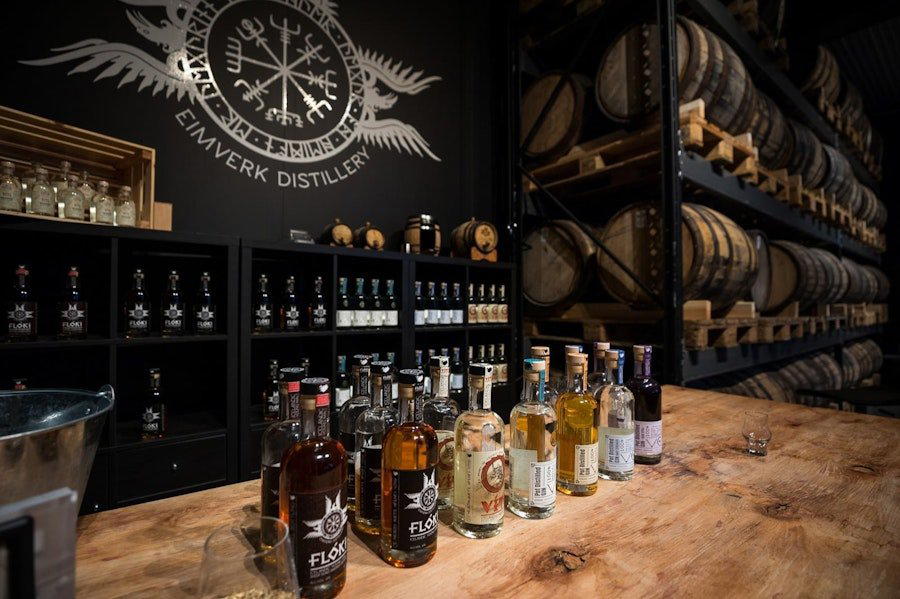
Where Iceland's Climate Does the Work
The address alone tells you something: back of the lot, Lyngás 13, in the suburban municipality of Garðabær, just south of Reykjavík. There is no grand entrance, no tasting room designed to impress on first approach. What you find instead is a working distillery operating in a country where the idea of local spirits production was, until recently, barely a conversation. That industrial setting turns out to be the point. Eimverk is less a destination designed for guests than a production facility that has earned its audience through the quality of what it makes, and that distinction matters when you are trying to understand Iceland's emerging position in the world of craft spirits.
The Environmental Argument
Iceland's terroir case for distilling is, in several ways, more compelling than its wine case. The island sits at the intersection of the Gulf Stream and Arctic air masses, with water drawn from some of the purest glacial sources in the northern hemisphere. Barley grown in Icelandic conditions contends with extreme light variation, the same long summer days that drive vine growers in other northern-latitude regions to experiment are here pressing cereal crops through unusually rapid growth cycles. The result is a raw material shaped by conditions that no other grain-producing country can fully replicate. For distilleries with the discipline to work with local grain rather than import commodity malt, this environmental specificity becomes a genuine expression argument, the spirits equivalent of what terroir advocates make for grapes in regions like Alsace, where producers such as Albert Boxler in Niedermorschwihr argue that place expresses itself through the grape as clearly as technique does through the winemaker.
Eimverk's position within that argument is anchored by consistent recognition. The distillery holds a Pearl 2 Star Prestige rating for 2025, placing it within a tier of producers where the product is measured against international peers rather than local novelty. That credential shifts the conversation from curiosity to comparative quality.
A Production Model Built for Provenance
Craft distilleries in northern Europe occupy a different position from their counterparts in established Scotch or Irish whiskey regions. There is no centuries-old infrastructure to inherit, no received wisdom about which local varieties to use or how long to age in which cask type. That absence of inherited convention is both a liability and an opening. Producers in newly emerged distilling regions, from Amrut in Bengaluru, which built India's single malt category largely from scratch, to smaller northern European operations, have had to construct their production identities from first principles, which tends to produce either undifferentiated commodity output or genuinely distinctive work. Eimverk sits closer to the latter, with provenance as the organising principle rather than style imitation.
The Garðabær location, within the greater capital region, keeps the operation close to Reykjavík's growing visitor economy without positioning it as a tourist attraction in the conventional sense. Visitors who make the trip do so with some intention: this is not a distillery you stumble into.
Iceland in the Broader Premium Spirits Conversation
Premium spirits from non-traditional regions have spent the past decade forcing a reassessment of what provenance means in the category. Scotland and Ireland defined the early grammar of aged whiskey, and their institutional credibility still anchors the upper end of the market. But collectors and serious drinkers have progressively extended the map. Japan established that non-Scottish production could reach parity on quality terms. India followed. The Nordic countries are now presenting their own case, built on clean water, cold-climate maturation conditions, and raw materials shaped by latitude.
Within that regional argument, Iceland occupies a specific niche: a country small enough that any serious local production is immediately consequential, with environmental conditions distinct enough that provenance claims are difficult to dismiss. The comparison to wine regions in this respect is instructive. When Adelsheim Vineyard in Newberg helped establish Oregon's Willamette Valley as a serious Pinot Noir address in the 1970s, it was making an argument that place could produce something that California's warmer valleys could not replicate. Eimverk is, in a different category and at a different scale, making a version of the same argument about Iceland.
The 2025 Pearl 2 Star Prestige recognition gives that argument institutional backing. In the ratings framework, two-star prestige placement signals sustained quality at a level that competes across international comparable venues, not merely within a local or novelty category. That distinction is worth holding onto when assessing what this distillery represents for Iceland's broader premium production story.
Garðabær as Context
Garðabær is one of the municipalities in the greater Reykjavík capital region, functionally integrated with the city but carrying its own suburban character. It is not a dining or drinking destination in the way that central Reykjavík's 101 district has become, and Eimverk does not position itself as part of a hospitality cluster. The address at the back of a commercial lot on Lyngás reinforces the production-first identity. For visitors building a broader Garðabær or Reykjavík itinerary, the distillery works as a purposeful stop rather than a neighbourhood anchor.
How Eimverk Relates to the Global Craft Tier
Placing Eimverk in a global craft context requires honesty about scale and reach. This is not a large operation with international distribution comparable to an established Scottish house or a Napa producer like Alpha Omega in Rutherford. The comparison set for Eimverk is other craft producers at the prestige end of their respective regional categories: operations where limited output and strong provenance credentials define the offering rather than volume or brand recognition. Within that peer group, which internationally includes producers across Scotland such as Aberlour, Rhône-trained independents, and craft operations in emerging markets, a Pearl 2 Star Prestige rating is a meaningful signal that the production quality holds up to external scrutiny.
For the collector or serious spirits drinker, the question with any small-production distillery is whether the terroir and production story translates into what is actually in the bottle. Eimverk's recognition in 2025 suggests the answer is yes, at a level that justifies treatment as a prestige-tier producer rather than a regional curiosity. What the distillery does with Icelandic barley, glacial water, and northern-latitude maturation conditions is, on the evidence of its ratings, something more than the sum of its geographic novelty.
For broader context on prestige craft production across very different terroirs and climates, the contrast with Southern Hemisphere and warm-climate producers is instructive: All Saints Estate in Rutherglen, Angove Family Winemakers in Renmark, and Adelaida Vineyards in Paso Robles each demonstrate how extreme climate conditions at the opposite end of the temperature scale shape production character in ways that temperate-region producers cannot reproduce. Eimverk is the cold-latitude corollary to that argument.
Planning a Visit
Eimverk Distillery is located at Lyngás 13, 210 Garðabær, Iceland, accessed via the rear of the commercial complex. Given the production-focused operation, visit logistics including hours, tour formats, and tasting availability should be confirmed directly with the distillery before travel. The location within the Reykjavík capital region means it is reachable from central Reykjavík without extended travel, making it a practical addition to a capital-area itinerary for anyone with a specific interest in Icelandic spirits production.



At a Glance
- Industrial
- Intimate
- Modern
- Group Outing
- Wine Education
- Barrel Room
- Organic
Intimate and personal atmosphere in a small family-run facility with engaging guided tastings and informative tours.